
An omnichannel AI Face Scanner gives beauty brands and retailers a consistent personalization layer across e-commerce, mobile experiences and physical retail. The customer journey does not need to look identical in every channel. A website can focus on immediate product discovery, a mobile experience on convenient repeat access, and a store on self-service or advisor-assisted consultation.
The omnichannel value comes from keeping the underlying beauty-analysis and product-discovery logic coherent while adapting the experience to each touchpoint.
Key Takeaways
- Omnichannel beauty connects personalization across digital and physical touchpoints instead of treating each channel as an isolated experience.
- The same core Face Scanner concept can support web, mobile and in-store journeys without requiring identical interfaces.
- Shared beauty terminology, product data and personalization principles help create a more coherent customer experience.
- Channel-specific UX still matters: e-commerce, mobile and physical retail serve different customer contexts.
- Cross-channel continuity does not automatically require accounts, saved scans or shared identity.
- Skinive currently provides a ready-to-use Web Widget, Web SDK and API; native iOS and Android SDKs are planned.
- Skinive provides analytics for scans, users, product clicks and sales conversions; additional channel and cross-channel measurement depends on the business’s own systems.
- A staged rollout is usually easier to evaluate than launching every channel simultaneously.
What Is Omnichannel Beauty?
Omnichannel beauty is an approach to customer experience in which digital and physical beauty touchpoints are designed to work as parts of a coherent journey.
A beauty business may already operate:
- An e-commerce website
- A mobile experience
- Physical stores
- Beauty counters
- Customer accounts or other digital touchpoints
Simply having several channels is multichannel.
Omnichannel begins when those channels use coordinated customer-experience principles rather than functioning as unrelated environments.
For AI-powered beauty personalization, this can mean using the same underlying Face Scanner concept wherever customers need help discovering relevant skincare products.
Multichannel vs. Omnichannel Beauty
The difference is primarily about coordination.
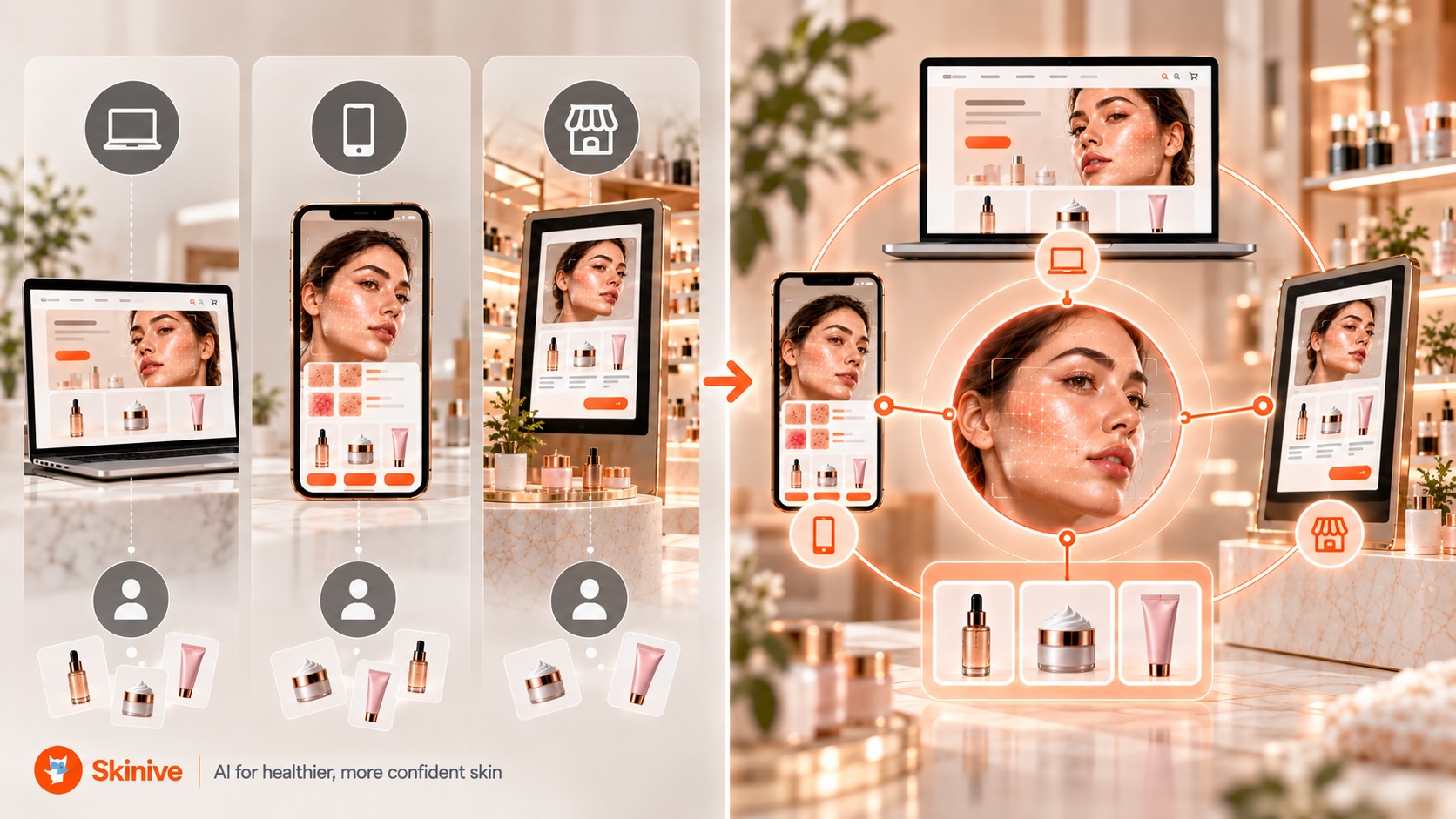
| Multichannel Beauty | Omnichannel Beauty | |
|---|---|---|
| Channels | Several channels exist | Channels are designed as parts of a coherent journey |
| Face Scanner | Separate feature in individual channels | Reusable personalization concept |
| Beauty insights | May be presented differently | Core terminology can remain consistent |
| Product information | May be managed independently | Can be coordinated across touchpoints |
| UX | Designed separately | Channel-specific but based on shared principles |
| Customer journey | Often restarts | Can continue where the implementation supports it |
| Measurement | Mostly channel-specific | Channel measurement plus cross-channel analysis where reliable |
Omnichannel therefore does not mean forcing every touchpoint into the same interface.
It means deciding what should be shared and what should be adapted.
Why Does Omnichannel Matter in Beauty?
Beauty discovery rarely happens in only one context.
A customer might research skincare online, encounter personalized recommendations, compare products later on another device and eventually visit a physical store.
Another customer may begin with an in-store consultation and later continue shopping online.
The business challenge is that each transition can reset the experience.
Product terminology changes. Recommendations may be disconnected. The customer may need to navigate the assortment again from the beginning.
An omnichannel personalization strategy attempts to reduce that fragmentation.
A Face Scanner can provide a recognizable starting point:
Facial Beauty Analysis → Understandable Cosmetic Insights → Relevant Product Discovery
The surrounding interface and next action can then change according to the channel.
One Face Scanner, Three Different Customer Contexts
The same personalization concept can serve different purposes across the three main beauty channels.
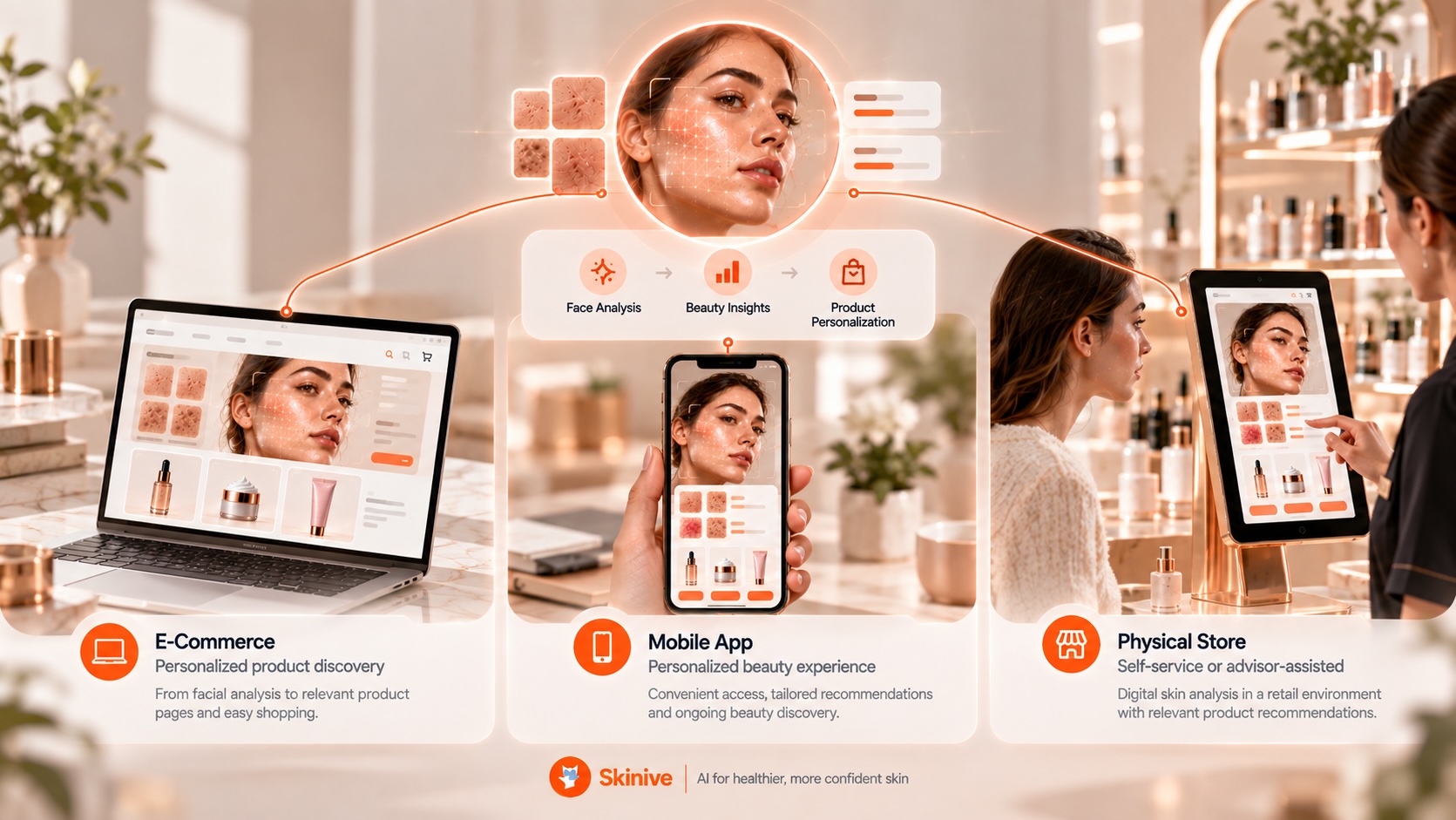
| Channel | Primary Role | Typical Next Step |
|---|---|---|
| E-commerce | Narrow online product discovery | Explore relevant product pages |
| Mobile experience | Provide convenient personalized beauty interaction | Continue product or beauty discovery |
| Physical retail | Support self-service or advisor-assisted consultation | Explore relevant products in store |
The important distinction is between the shared personalization layer and the channel experience built around it.
E-Commerce: Move from Analysis Toward Products
On an e-commerce website, customers are already inside a commerce environment.
The Face Scanner therefore works best when the distance between analysis and relevant products remains short.
Skinive provides a ready-to-use Web Widget for faster website deployment, while the Web SDK and API support more customized implementations.
The detailed e-commerce implementation is covered separately in AI Face Scanner for E-Commerce: How to Personalize Skincare Shopping.
For an omnichannel strategy, the important point is simpler:
web should use the shared personalization logic in a way that supports online product discovery.
Mobile: Adapt the Experience to a Mobile Context
Mobile beauty experiences create a different interaction environment.
The Face Scanner can be incorporated into a broader mobile journey using Skinive’s available integration approaches. Web SDK and API are currently available, while native iOS and Android SDKs are planned.
The mobile interface does not need to reproduce the e-commerce website.
Instead, businesses can design the surrounding experience around the role mobile plays in their customer journey.
The detailed integration and mobile use cases are covered in AI Face Scanner for Beauty & Skincare Apps: Integration and Use Cases.
In-Store: Combine Digital Personalization with the Retail Environment
Physical retail introduces something digital channels cannot reproduce directly: the store itself.
Customers can see products physically and may also interact with beauty advisors.
A Face Scanner can support web-based or integrated in-store experiences on suitable devices, depending on the retailer’s technical setup.
The experience may be:
- Self-service
- Advisor-assisted
- A hybrid of both
Skinive should not be assumed to provide dedicated kiosk hardware, real-time inventory information, shelf-location functionality or a retailer’s POS system. Those elements depend on the retailer’s own implementation and integrations.
The dedicated in-store model is covered in AI Face Scanner for In-Store Beauty Retail: Personalized Beauty Consultations at the Point of Sale.
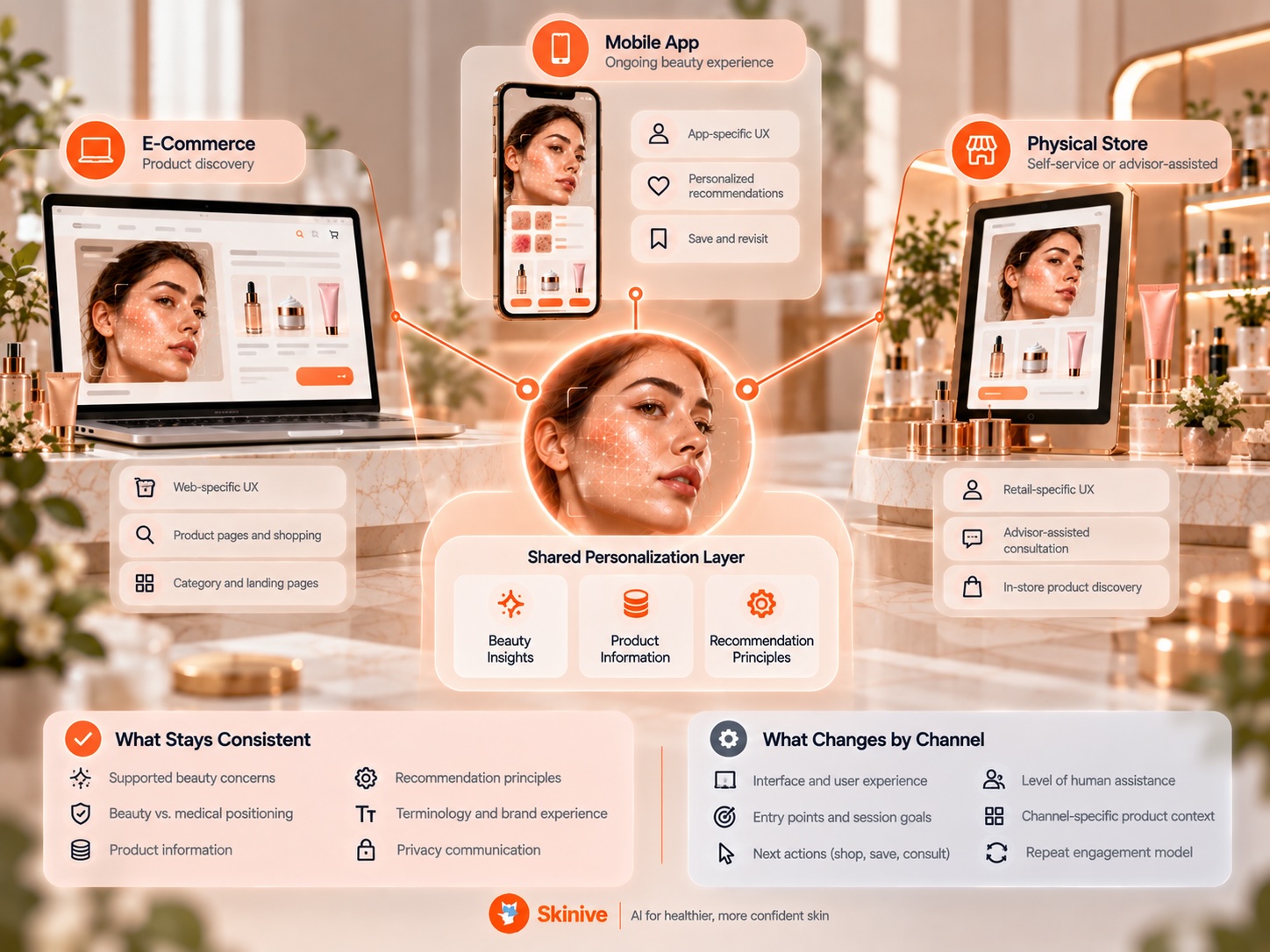
What Should Stay Consistent Across Web, Mobile and Store?
This is one of the most important omnichannel design decisions.
Consistency should focus on the parts of the experience that define the personalization logic.
Supported Beauty Concerns
The underlying cosmetic concepts should remain understandable across touchpoints.
Customers should not encounter conflicting descriptions of the same supported visible characteristics simply because they changed channels.
Beauty Positioning
Skinive Face Scanner is designed for beauty, cosmetics and personalized skincare.
That boundary should remain consistent across every channel rather than allowing one implementation to drift toward medical diagnosis or treatment claims.
Product Information
Personalization should be based on current product information appropriate to the experience.
Recommendation Principles
The business should define coherent rules for how beauty insights relate to product discovery.
The exact products displayed may vary according to assortment or implementation, but the underlying logic should remain understandable.
Terminology and Brand Experience
Customers should recognize the same personalization concept even when the interface changes.
Consistency does not require identical screens.
It requires a recognizable experience.
What Should Change by Channel?
A common omnichannel mistake is trying to make every interface identical.
Different channels create different constraints and customer expectations.
| Experience Element | E-Commerce | Mobile | Physical Retail |
|---|---|---|---|
| Entry | Website CTA or embedded experience | Mobile journey | In-store digital touchpoint |
| Primary context | Online shopping | Mobile interaction | Physical product discovery |
| Next action | Open relevant products | Continue digital discovery | Explore products in store |
| Human assistance | Usually limited | Usually limited | Can be important |
| Interface | Web commerce UX | Mobile-oriented UX | Retail-oriented UX |
The Face Scanner can remain recognizable while the surrounding experience changes.
That is a stronger omnichannel model than copying the same interface into every environment.
The Shared Personalization Layer
A useful way to think about omnichannel Face Scanner architecture is as two levels.
The first is the shared layer:
Face Analysis → Supported Beauty Insights → Product Personalization Logic
The second is the channel layer:
Web | Mobile | Physical Store
Each channel receives the same basic personalization concept but determines how the customer enters, interacts and continues.
This distinction prevents omnichannel strategy from becoming a collection of duplicated interfaces.
The Role of Product Data Across Channels
Product data is another potential source of inconsistency.
Skinive Face Scanner can work with a beauty brand or retailer’s own skincare catalog. Product information can be supplied through CSV or XML.
The minimum product information includes:
- Product name
- Product description
- Ingredients
- Price
- Product-page URL
Catalog synchronization is unlimited.
For an omnichannel business, Skinive’s product catalog is only one part of the broader commerce architecture. Market-specific assortment, physical-store availability, localization, pricing and other operational information may depend on the retailer’s own systems.
The detailed recommendation architecture is covered in AI Product Recommendation Engine for Beauty and Skincare Brands.
From Face Analysis to Channel-Specific Product Discovery
The shared journey can remain simple:
Face Images → Visible Cosmetic Insights → Relevant Product Discovery
What happens next depends on where the customer is.
On the Website
The natural destination may be a relevant product page or online product-discovery journey.
In a Mobile Experience
The next step may remain within the mobile beauty experience or connect to the business’s commerce environment.
In a Physical Store
The next step may be product exploration with or without assistance from a beauty advisor.
This is the core omnichannel principle:
keep the personalization logic coherent while adapting the action to the channel.
Does Omnichannel Require Customers to Continue Between Channels?
No.
This distinction is important.
An omnichannel Face Scanner strategy can create value even when customers do not carry a saved analysis from one environment into another.
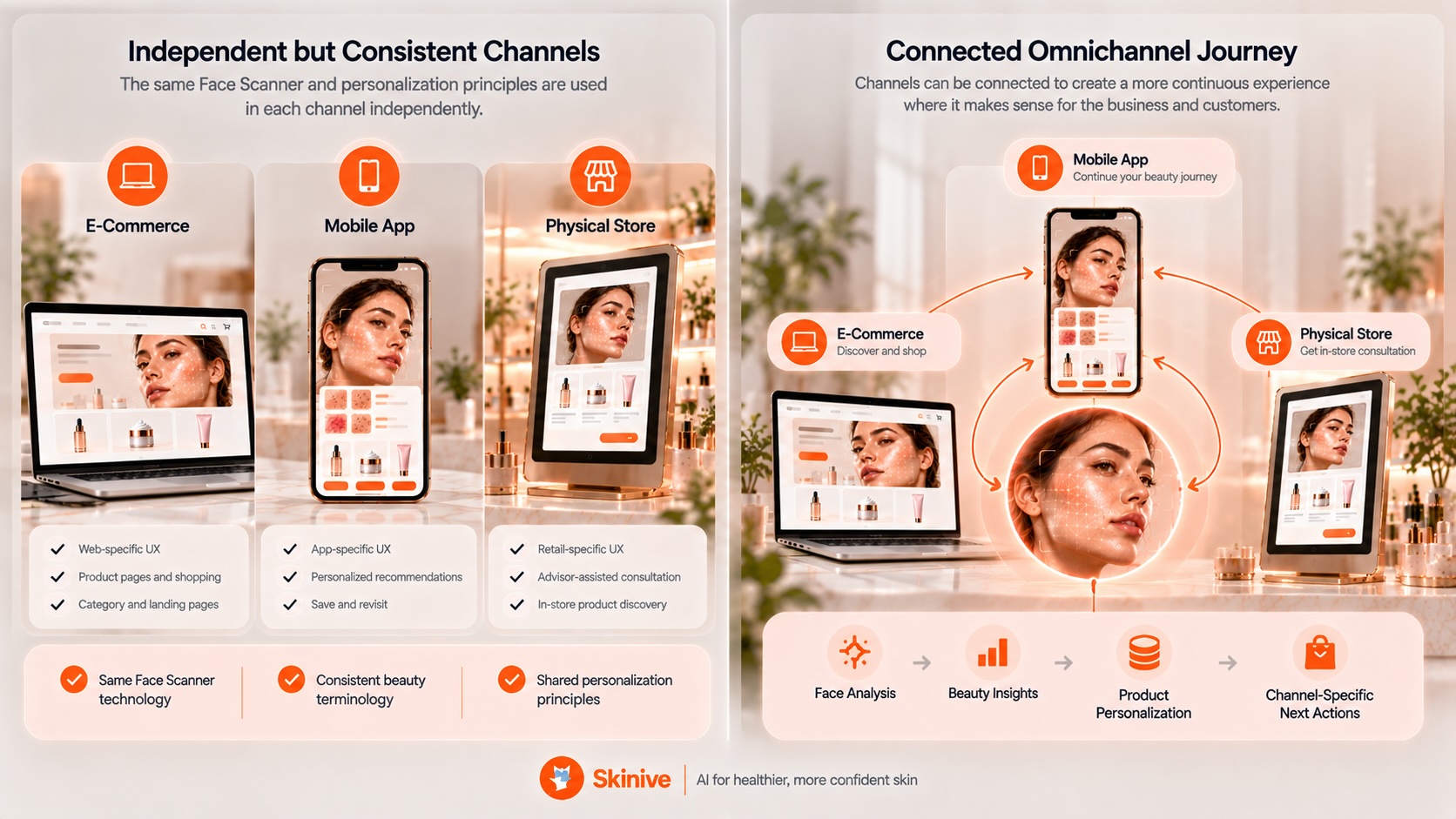
For example, a retailer can use the same:
- Face Scanner technology
- Supported beauty terminology
- Product information
- Recommendation principles
- Brand presentation
across web and physical retail without linking customer identity between those environments.
This creates consistency without requiring persistent cross-channel data.
When Does Cross-Channel Continuity Add Value?
A more connected implementation may be useful when the customer genuinely benefits from continuing a journey elsewhere.
For example, a business may want customers to move from an in-store experience toward its online commerce environment.
But continuity should begin with a customer need, not with the assumption that every interaction must be stored or linked.
Before designing cross-channel persistence, businesses should define:
- What information needs to continue
- Why the customer benefits
- Which systems would support that continuation
- Whether customer identity is actually required
- What consent and privacy requirements apply
- How long relevant data needs to be retained
Skinive Face Scanner should not be described as automatically providing cross-channel identity, account synchronization or persistent Face Scanner history unless those capabilities are part of the specific implementation.
Four Omnichannel Journey Models
There is no single correct omnichannel Face Scanner journey.
Website to Physical Store
A customer begins with personalized beauty discovery online and later encounters the same Face Scanner concept in a physical retail environment.
The experiences can remain recognizable without requiring the original scan to follow the customer.
Store to Digital Commerce
A physical consultation can be followed by digital product discovery where the retailer’s implementation provides an appropriate path.
The important element is continuity in the beauty and product experience.
Mobile to E-Commerce
A mobile Face Scanner experience can connect customers with the retailer’s commerce environment for further product discovery.
Independent but Consistent Channels
Web, mobile and store can operate independently while sharing the same Face Scanner concept, terminology and personalization principles.
This is often the simplest form of omnichannel implementation and does not require cross-channel identity linking.
Shared Technology Does Not Mean Shared UX
Using one underlying personalization technology can reduce inconsistency, but it does not remove the need for channel-specific product design.
A web shopper may need a direct route toward products.
A mobile user may need a compact interaction designed for a smaller screen.
A physical-store customer may need clear guidance that fits naturally into a consultation or self-service environment.
The question should therefore not be:
How do we reproduce the same Face Scanner everywhere?
A better question is:
Which parts should remain consistent, and which parts should adapt to the channel?
How Can Omnichannel Face Scanning Support Beauty Advisors?
Physical retail adds human context to the shared personalization layer.
AI can provide supported visible beauty insights, while an advisor can contribute information that cannot be determined from facial images alone.
Depending on the retailer’s workflow, an advisor may:
- Help explain the Face Scanner experience
- Support image capture
- Discuss beauty-focused results
- Ask about customer preferences
- Help narrow relevant product options
- Continue the conversation around the retailer’s physical assortment
The Face Scanner therefore does not need to compete with the beauty advisor.
It can become one structured input within the consultation.
How Should an Omnichannel Face Scanner Be Measured?
Omnichannel measurement should begin by separating two questions:
How is the Face Scanner performing within each channel?
and
Are customers meaningfully continuing between channels?
These are not the same measurement problem.
Skinive provides dashboard analytics for:
- Scans
- Users
- Product clicks
- Sales conversions
Additional metrics depend on the business’s own web, app, commerce, retail, CRM, loyalty or POS analytics.
| Measurement Layer | Example Questions |
|---|---|
| Face Scanner | How much usage does the Face Scanner receive? |
| E-commerce | What happens after customers interact with personalized products? |
| Mobile | How do customers engage with the surrounding mobile experience? |
| Physical retail | How is the Face Scanner incorporated into the store journey? |
| Cross-channel | Do customers continue into another touchpoint where this can be reliably measured? |
Cross-channel attribution should only be claimed when the underlying data actually supports it.
Cross-Channel Measurement Without False Attribution
Omnichannel reporting can easily create misleading conclusions.
A customer may use one channel and purchase in another without the business being able to establish a reliable connection between those events.
For this reason, businesses should distinguish:
Observed continuation — a journey that can be reliably linked.
from
Assumed continuation — two events that may belong to the same broader customer journey but cannot be confidently connected.
This matters especially when evaluating commercial performance.
An omnichannel strategy can still be useful even when every transition cannot be attributed to an individual customer.
Privacy and Data Minimization Across Channels
Connecting several touchpoints can increase implementation complexity around customer data.
Businesses should review the requirements relevant to their specific deployment, including consent, data processing, storage, retention, security and applicable privacy obligations.
The most useful design principle is data minimization.
Do not create cross-channel persistence simply because it is technically possible.
Determine what information is actually required to provide the intended customer experience.
An independent but consistent channel model may sometimes provide most of the customer-experience benefit with less identity and data complexity.
How Skinive Supports Omnichannel Beauty
Skinive provides several components that can support Face Scanner deployment across beauty touchpoints.
| Capability | Skinive Face Scanner |
|---|---|
| Face capture | Front, left and right facial images |
| Beauty analysis | Multiple supported visible cosmetic concerns |
| Product catalog | CSV or XML |
| Minimum product data | Name, description, ingredients, price, product-page URL |
| Catalog synchronization | Unlimited |
| Web Widget | Available; launch can take around five minutes |
| Web SDK | Available |
| API | Available |
| Native iOS SDK | Planned |
| Native Android SDK | Planned |
| Analytics | Scans, users, product clicks, sales conversions |
The exact surrounding architecture depends on the business and channel.
A Practical Omnichannel Rollout Strategy
An omnichannel strategy does not require launching every channel simultaneously.
A staged approach can make the implementation easier to understand and evaluate.
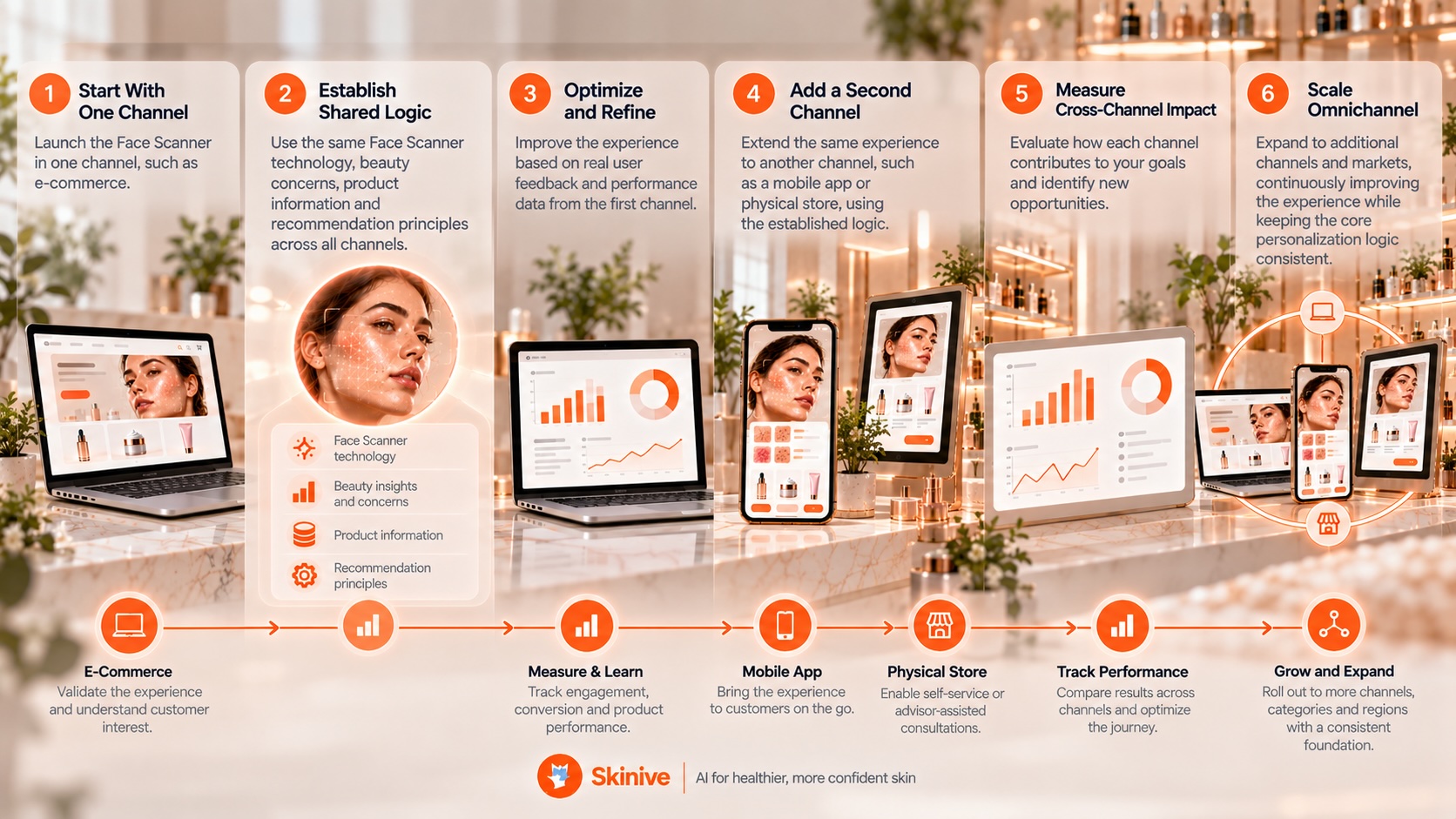
Start With One Customer Problem
Choose a specific need rather than beginning with a technology rollout.
For example, the first use case might be helping online shoppers navigate a large skincare assortment.
Establish the Shared Personalization Logic
Define the supported beauty language, product information and recommendation principles that should remain recognizable elsewhere.
Optimize the First Channel
Understand how customers enter, complete and continue from the Face Scanner experience.
Identify What Is Actually Reusable
Separate the underlying personalization layer from interface elements that belong only to the first channel.
Add a Second Channel
Adapt the shared concept to a mobile or physical-retail context.
Do not simply copy the original interface.
Decide Whether Continuity Requires Identity
Determine whether customers genuinely need saved or linked information between channels.
If not, keep the architecture simpler.
Measure Channels Independently First
Understand each environment before attempting broad cross-channel conclusions.
Measure Continuation Where Reliable
Add cross-channel measurement only when the underlying implementation supports trustworthy attribution.
Scale From Evidence
Expand to additional markets, stores or customer journeys after the operating model is understood.
Common Omnichannel Mistakes
Making Every Channel Identical
Consistency is not the same as duplication.
Rebuilding Personalization Logic Separately
Independent terminology and recommendation principles can create contradictory customer experiences.
Assuming Omnichannel Requires Customer Tracking
A coherent experience can exist without persistent identity across every touchpoint.
Treating Product Data as Universally Identical
Market, channel and store context may require information managed by systems outside Skinive.
Launching Everywhere at Once
A simultaneous rollout makes it harder to understand which parts of the experience work.
Assuming Cross-Channel Attribution
Only claim continuation or conversion when the data can reliably establish it.
Turning Beauty Personalization Into Medical Assessment
Skinive Face Scanner should remain positioned for beauty, cosmetics and personalized skincare rather than disease diagnosis or medical treatment.
Related Resources
- AI Face Scanner for E-Commerce: How to Personalize Skincare Shopping
- AI Face Scanner for Beauty & Skincare Apps: Integration and Use Cases
- AI Face Scanner for In-Store Beauty Retail: Personalized Beauty Consultations at the Point of Sale
- AI Face Analysis: How It Works for Beauty & Skincare
- AI Skincare Recommendations: From Face Analysis to Relevant Products
- Personalized Skincare with AI: How Beauty Brands Can Move Beyond Generic Routines
- AI Product Recommendation Engine for Beauty and Skincare Brands
- How AI Face Scanners Can Increase Conversion in Beauty E-Commerce
- Virtual Beauty Consultation: How AI Is Changing the Beauty Advisor Experience
- AI Face Scanner vs. Skin Quiz: Which Creates Better Skincare Personalization?
- What Can an AI Face Scanner Detect? Wrinkles, Pores, Blackheads, Dark Spots and More
- How to Integrate an AI Face Scanner Into a Website in Minutes
- How to Connect a Cosmetics Product Catalog to AI Skincare Recommendations
- The Business Case for AI Beauty Technology: Conversion, Engagement and Customer Retention
Bring One Personalization Layer Across Your Beauty Channels
Use AI-powered facial beauty analysis and your own skincare assortment to create a coherent personalization concept across the channels that matter to your customers.