
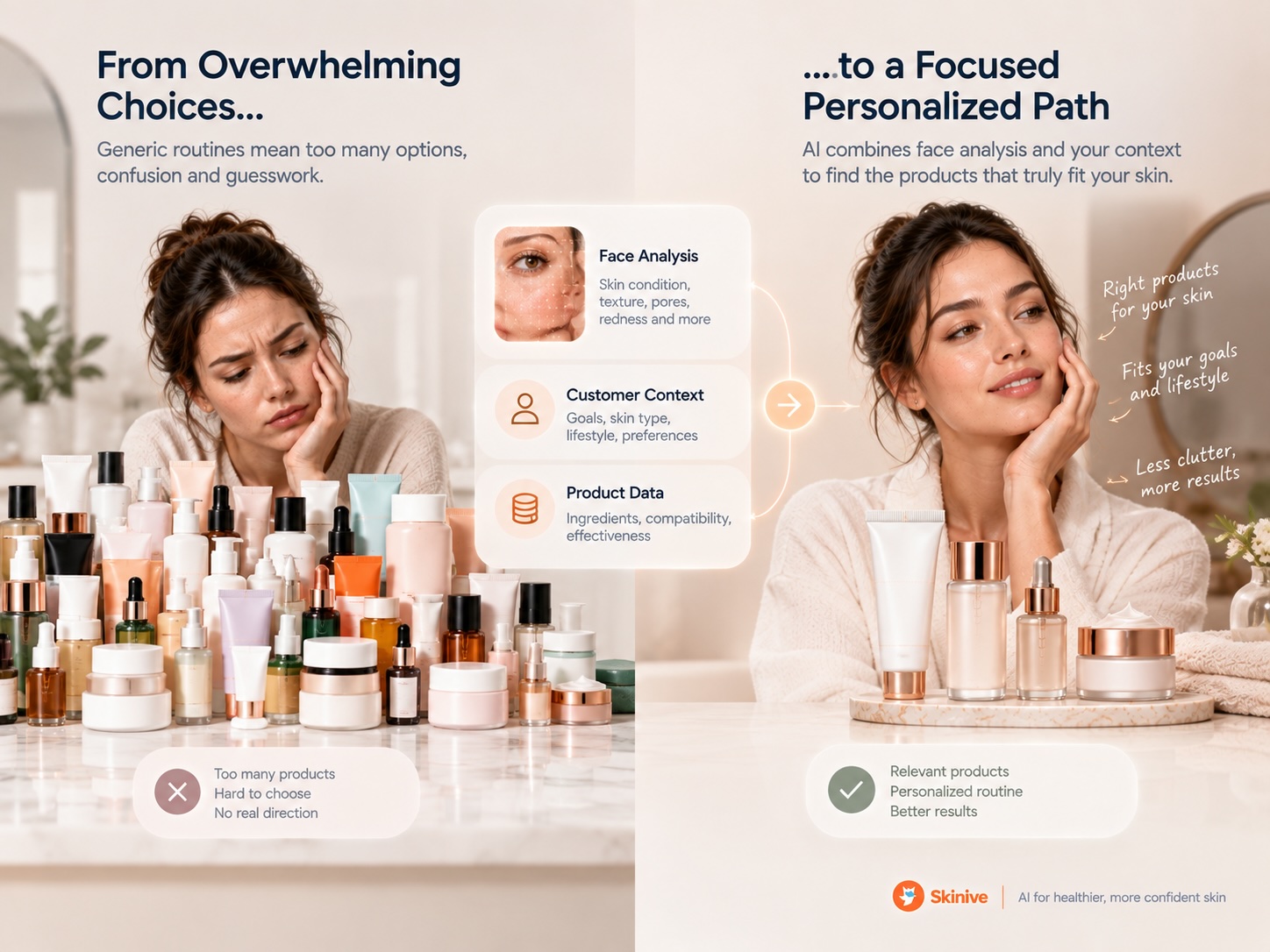
Personalized skincare with AI uses customer-specific signals to make beauty product discovery more relevant than a generic, one-size-fits-all routine. AI face analysis can contribute information about supported visible cosmetic concerns, while customer preferences and product data add context that an image alone cannot provide. For beauty brands and retailers, the strongest model is not “AI chooses a routine from a selfie,” but a layered personalization experience built from the right combination of signals.
Key Takeaways
- AI personalization can help beauty businesses move beyond showing the same skincare journey to every customer.
- Face analysis contributes visual information about supported cosmetic concerns, while customer-provided context contributes preferences, goals and routine information.
- No single personalization signal provides a complete understanding of the customer.
- Product data connects customer insights with products the beauty business can actually offer.
- Personalized output does not always need to be a complete routine; it can be a relevant category, product, shortlist or other focused next step.
- Skinive Face Scanner can provide the visual-analysis layer and connect supported concerns with a beauty business’s own product assortment.
- The effectiveness of personalization should be evaluated through the wider customer journey, not scan volume alone.
What Is Personalized Skincare with AI?
Personalized skincare with AI is a beauty approach that uses artificial intelligence together with customer-specific information to adapt product discovery and other parts of the skincare experience.
Instead of presenting every customer with the same categories, routine or bestseller list, personalization uses relevant signals to determine what information or products should be prioritized.
Those signals can come from different sources.
AI face analysis can contribute information about supported visible cosmetic characteristics. Customer questions can provide preferences and goals. Browsing or purchase behavior can provide commercial context. Product data describes what the beauty business can actually offer.
AI personalization is therefore broader than face scanning alone.
Face analysis can be an important starting point, but the personalization experience is created by how different customer and product signals are used together.
Why Do Generic Skincare Journeys Fall Short?
Generic skincare journeys are designed around broad groups rather than individual customer context.
A customer may enter a website and see categories such as cleansing, hydration, appearance-focused skincare, brightening or blemish-focused care. Those categories are useful for navigation, but the customer still needs to decide which direction is relevant.
The challenge increases as the assortment grows.
Two customers browsing the same category may have different visible concerns, product preferences, budgets, routines and shopping goals.
A generic experience treats much of that context as unknown.
Personalization attempts to reduce this ambiguity by using available customer signals to determine what should be shown or prioritized next.
Generic vs. AI-Personalized Skincare
The difference is not simply whether AI appears somewhere in the journey. The more important difference is whether the experience responds to individual customer information.
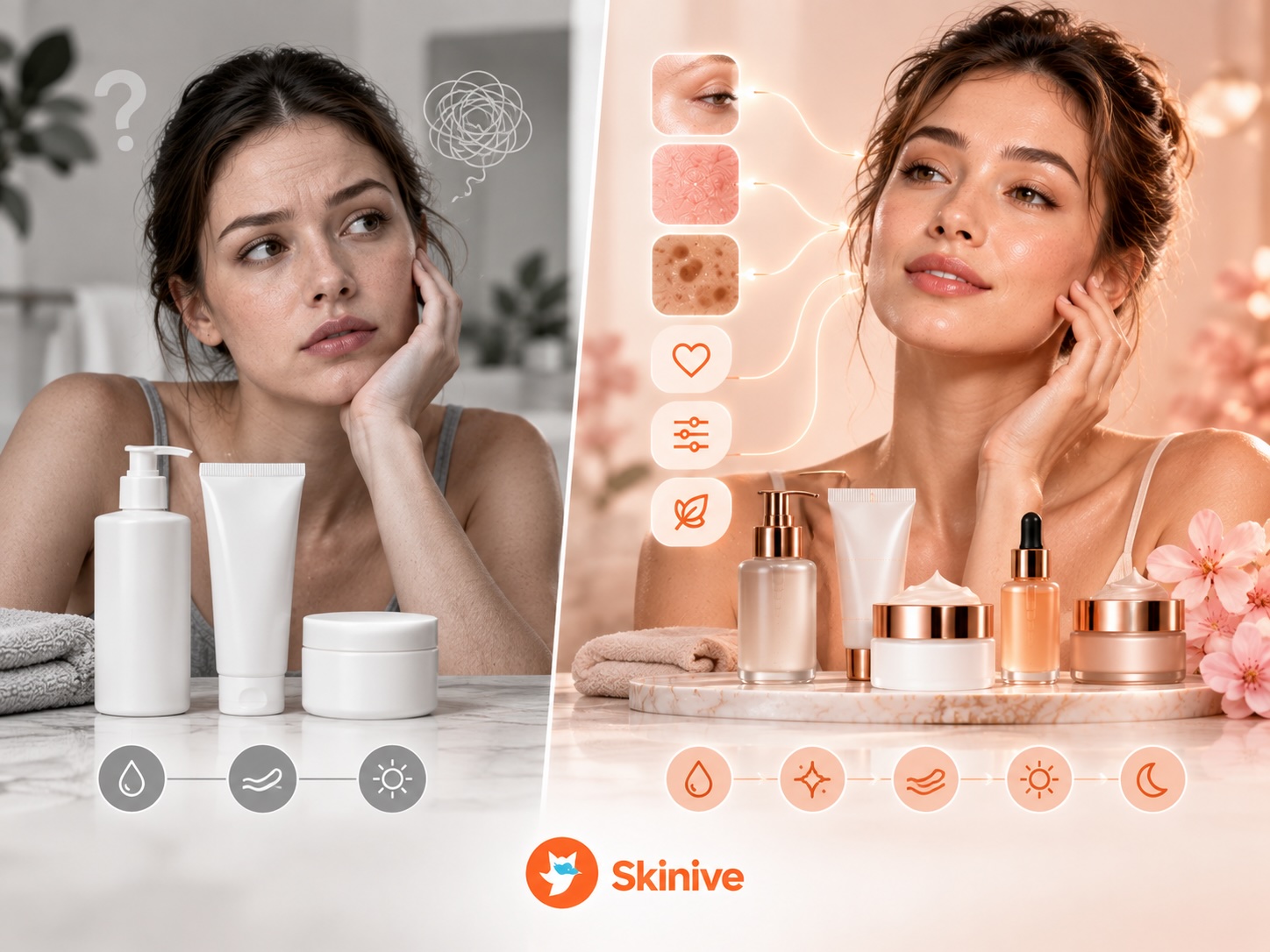
| Generic Skincare Journey | AI-Personalized Skincare Journey | |
|---|---|---|
| Starting point | Broad category or predefined routine | Individual customer signals |
| Visible cosmetic concerns | Usually identified by the customer | Face analysis can contribute visual information |
| Preferences | Often unknown | Can be collected separately |
| Product discovery | Broad catalog, categories or bestsellers | Relevant products can be prioritized |
| Routine structure | Usually predefined | Can adapt to available context |
| Customer journey | Mostly the same for many users | Can respond to customer inputs |
| Measurement | General category and product behavior | Personalized journey plus downstream behavior |
Personalization does not mean every customer must receive a completely unique experience.
Even reducing a catalog from hundreds of possibilities to a smaller, more relevant path can make product discovery more personalized.
What Data Can Power AI Skincare Personalization?
No single input can reliably answer every question about a skincare customer.
Different signals contribute different types of information.
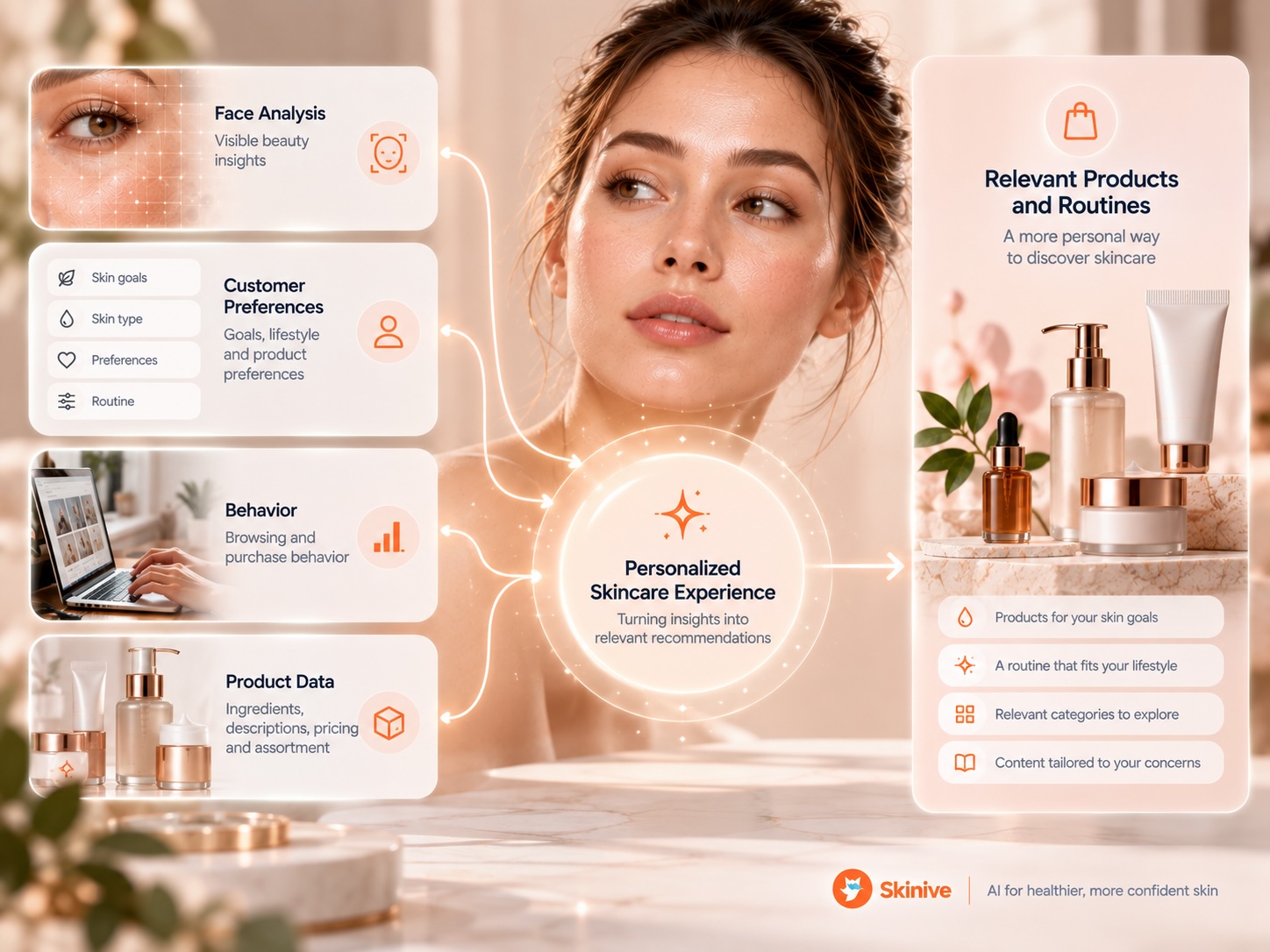
| Personalization Signal | What It Can Contribute | What It Does Not Provide Alone |
|---|---|---|
| AI face analysis | Supported visible cosmetic characteristics | Preferences, budget or other non-visible context |
| Customer questions | Goals, preferences and self-reported context | Independent visual input |
| Customer profile | Information provided or available within the customer experience | Current visible facial characteristics |
| Browsing behavior | Product and category interest | Why the customer has that interest |
| Purchase history | Previous purchasing behavior | Whether previous products remain relevant |
| Product catalog | Product descriptions, ingredients, prices and assortment | Which product is relevant without customer signals |
| Beauty advisor input | Human conversation and product context | Automated personalization at scale |
The appropriate combination depends on the customer journey.
A beauty brand may need only face analysis plus a few preference questions. A retailer with a large assortment may use additional signals available within its own customer experience.
The objective is not to collect as much information as possible.
It is to use the smallest useful combination of signals that makes the next decision more relevant.
How Does AI Face Analysis Fit Into Personalized Skincare?
AI face analysis gives personalization a visual input.
Instead of relying entirely on customers to identify visible concerns themselves, computer vision can evaluate the cosmetic characteristics the Face Scanner is designed to support.
Skinive Face Scanner supports visible concerns including fine lines and wrinkles, pores, blackheads, whiteheads, acne-related imperfections, dark spots, pigmentation, redness and uneven-looking texture.
These insights can then become one input within a wider personalization journey.
For example:
Face Analysis → Visible Beauty Insights → Customer Context → Relevant Product Discovery
Face analysis answers part of the personalization question: what supported cosmetic characteristics are visible?
It does not independently answer questions such as what the customer wants to spend, which product format they prefer, how complex they want their routine to be, or what they already use.
For a deeper explanation of the visual-analysis stage, see AI Face Analysis: How It Works for Beauty & Skincare.
How Does AI-Personalized Skincare Work?
A useful personalization journey can progressively add information instead of forcing the customer through a long assessment before showing any value.
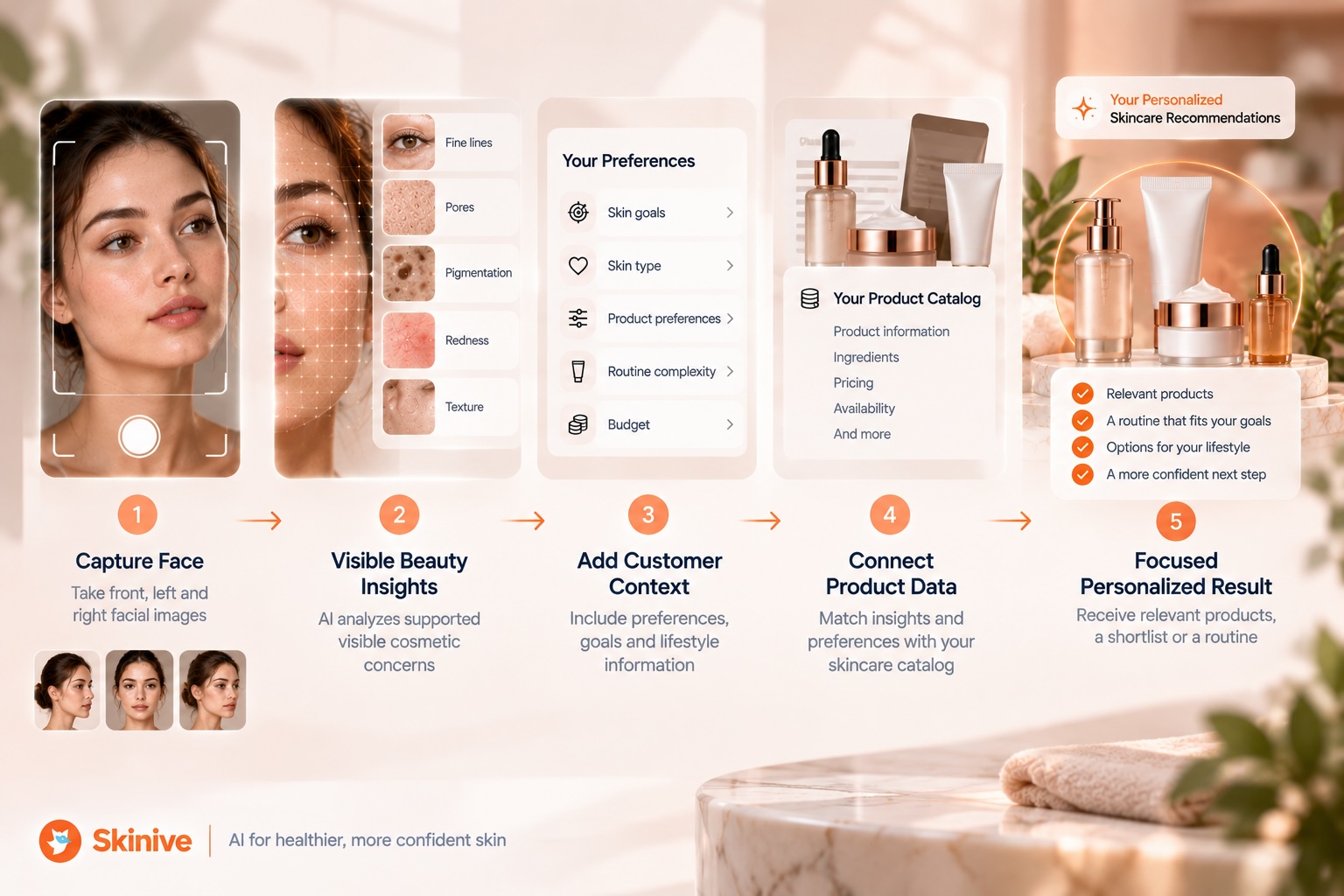
Start With a Clear Customer Goal
The experience should explain what personalization will help the customer accomplish.
That might be narrowing a large skincare assortment, discovering relevant products or creating a more focused skincare journey.
Capture Facial Images
With Skinive Face Scanner, the customer captures front, left and right facial images.
These provide the visual input for supported cosmetic analysis.
Analyze Supported Visible Concerns
The Face Scanner converts the images into beauty-focused insights about the cosmetic characteristics it supports.
Add Customer Context Where It Matters
The business can then collect information that cannot be determined from facial images.
Rather than asking every possible question, the experience can focus on information that materially affects the next step.
Connect the Signals With Product Data
Customer signals become commercially useful when they can be connected with products from the beauty business’s assortment.
Present a Focused Personalized Result
The output might be:
- A relevant product
- A focused shortlist
- A product category
- A skincare routine
- Another appropriate product-discovery path
The format should reflect the information available rather than automatically generating the same type of routine for every customer.
Measure What Customers Do Next
The business can then evaluate whether customers engage with the personalized result and continue toward useful product interactions.
From Face Analysis to a Personalized Skincare Routine
A face scan can contribute useful visual information, but a personalized routine requires more context than an image alone can provide.
Consider two customers whose analysis highlights the same visible cosmetic concern.
One may want a minimal routine with only a few products. Another may prefer a more extensive skincare sequence. One may already have products they intend to keep using, while another may be exploring an entirely new routine.
The visual concern is similar.
The appropriate customer experience may not be.
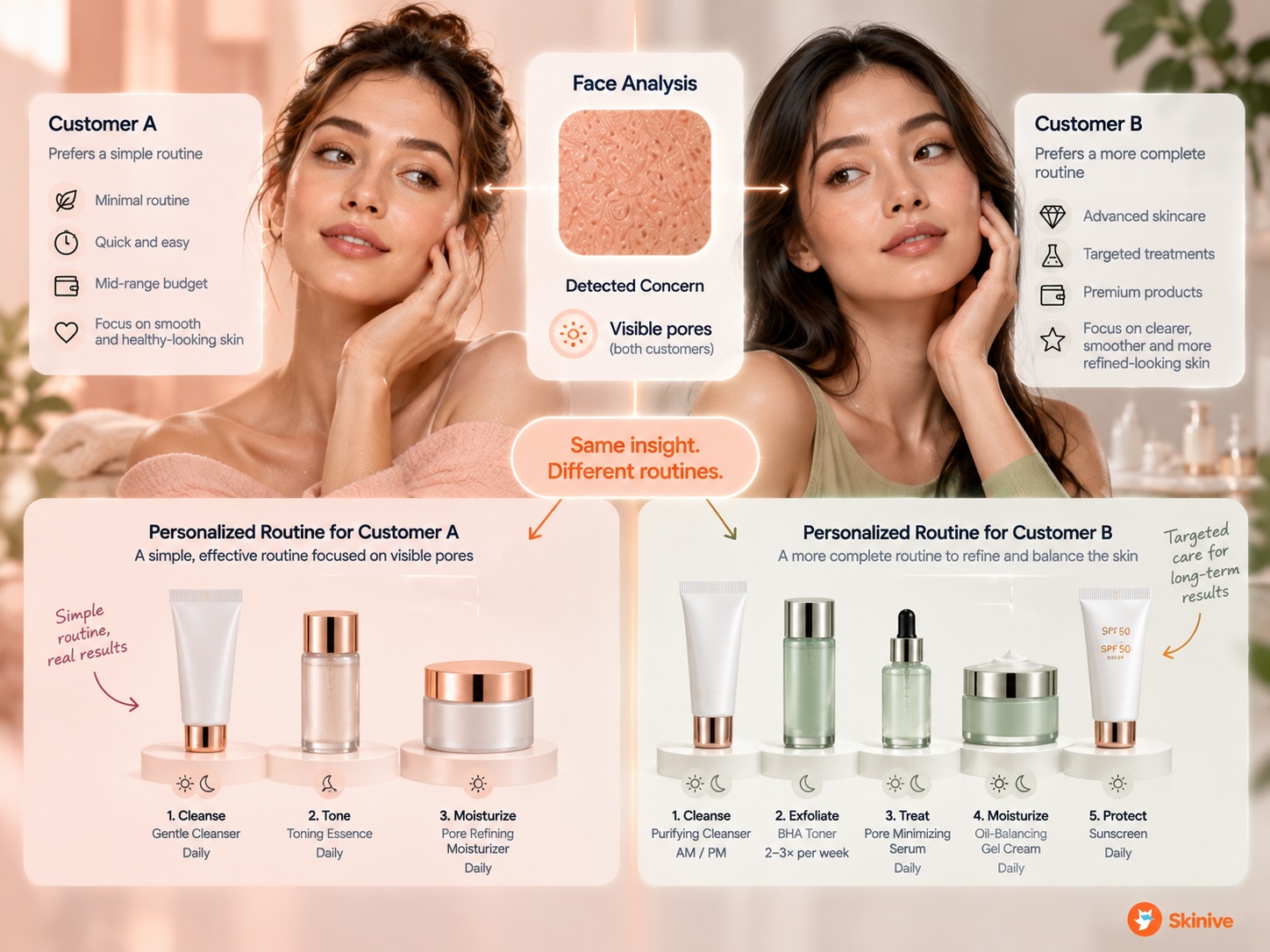
This is why personalized skincare works best as a layered model:
Visible Beauty Insights + Customer Context + Product Data → Personalized Skincare Experience
Face analysis contributes what can be evaluated visually.
Customer context contributes what the person wants.
Product data defines what the business can offer.
The personalization layer determines how those inputs should shape the next step.
What Parts of the Skincare Journey Can Be Personalized?
Personalization does not have to mean generating a completely different routine for every customer.
A beauty business can personalize whichever part of the journey provides the most value.
| Element | How It Can Be Personalized | Example |
|---|---|---|
| Product shortlist | Prioritize products relevant to available customer signals | Show a smaller set of relevant products |
| Product category | Narrow discovery toward a relevant area of the catalog | Guide the customer toward tone-focused product discovery |
| Routine | Organize several relevant products into steps | Present a simple skincare sequence |
| Beauty content | Prioritize information related to visible concerns | Explain pores or uneven-looking texture |
| Product discovery | Change which products are surfaced first | Prioritize relevant items instead of generic bestsellers |
| Advisor-assisted experience | Give staff a structured starting point | Combine visual insights with customer conversation |
The right level of personalization depends on the business model and customer intent.
Sometimes the most useful personalized outcome is not a complete routine. It may simply be a much better starting point.
How Does Product Data Fit Into Personalized Skincare?
Customer personalization and product information are two different sides of the same experience.
Customer signals help establish what may be relevant.
Product data establishes what the business can actually offer.
Skinive Face Scanner can work with a beauty brand or retailer’s existing skincare catalog. Product information can be supplied through CSV or XML and synchronized as the assortment changes.
The relevant product information includes:
- Product name
- Product description
- Ingredients
- Price
- Product-page URL
Rather than reproducing the complete recommendation and catalog workflow here, see AI Skincare Recommendations: From Face Analysis to Relevant Products for a detailed explanation of how facial insights can connect with a beauty assortment.
For e-commerce-specific implementation, see AI Face Scanner for E-Commerce: How to Personalize Skincare Shopping.
Face Analysis and Customer Questions Are Complementary
A photograph and a customer question provide different information.
Face analysis contributes visual input.
Questions can capture information that is not visible.
A useful personalization journey might therefore begin with the Face Scanner and then ask only a few questions that meaningfully change the recommendation.
For example, the experience may need additional context about:
- Customer goals
- Preferred product formats
- Desired routine complexity
- Budget
- Existing skincare routine
This approach avoids expecting the camera to infer information it cannot see while also avoiding an unnecessarily long questionnaire.
The dedicated AI Face Scanner vs. Skincare Quiz resource explores this comparison in detail.
Personalized Skincare Across Different Beauty Touchpoints
Personalization can appear in different customer environments without requiring exactly the same interface everywhere.
An e-commerce shopper may use it to narrow product discovery.
A beauty-app user may interact with personalization inside a mobile customer journey.
In physical retail, the same visual-personalization concept can support self-service or advisor-assisted product discovery.
The underlying principle remains:
use relevant customer signals to make the next beauty decision more useful.
A broader cross-channel strategy will be covered in the dedicated Omnichannel Beauty resource.
How Can Beauty Brands Avoid Over-Personalization?
More personalization is not automatically better personalization.
An experience can become less useful if customers must provide excessive information before receiving value.
Several principles help keep personalization focused.
Collect Information for a Reason
Every additional question or customer input should improve a meaningful next step.
Keep Capture and Questions Concise
Customers should not feel that they need to complete a lengthy assessment simply to explore skincare products.
Prioritize Results
Showing every possible insight can make the experience harder to understand.
Keep Product Discovery Focused
Personalization should reduce choice overload rather than recreate a large category page.
Explain Relevance
Customers should understand why a product or piece of content is being prioritized.
Keep the Experience Optional
Personalized discovery can complement normal browsing rather than replacing it.
Maintain Clear Beauty Boundaries
Cosmetic personalization should remain clearly separate from medical assessment or diagnosis.
The goal is not maximum data collection.
The goal is a more relevant customer decision with as little unnecessary friction as possible.
What Makes AI Personalization Valuable for Beauty Brands?
The strategic value of AI personalization is not the presence of AI itself.
It is the ability to organize beauty discovery around more relevant customer signals.
A well-designed personalization experience can potentially help a business:
- Make a large skincare assortment easier to navigate
- Give customers a more relevant starting point
- Connect visible cosmetic insights with product discovery
- Create a more interactive beauty experience
- Support different customer journeys using the same personalization concept
These are potential benefits rather than guaranteed commercial outcomes.
Actual performance depends on factors such as customer adoption, implementation quality, assortment, merchandising, traffic, pricing and the wider shopping experience.
Businesses should therefore evaluate personalization through their own customer data rather than relying on generic performance claims.
How Should AI Skincare Personalization Be Measured?
Personalization should be evaluated as a journey rather than as a single interaction.
Skinive provides dashboard analytics for:
- Scans
- Users
- Product clicks
- Sales conversions
Businesses can combine these metrics with their own analytics to evaluate other parts of the personalization journey, such as:
- Entry into the personalized experience
- Completion of relevant customer steps
- Recommendation interaction
- Product-page visits
- Add-to-cart behavior
- Repeat engagement
- Other channel-specific customer actions
Metrics outside Skinive’s dashboard depend on the business’s own website, app, commerce, CRM or retail analytics.
The central measurement question is whether personalization helps customers move toward more relevant product discovery and useful downstream actions.
Common Mistakes in AI Skincare Personalization
Treating AI as the Strategy
Adding an AI feature does not automatically create a useful personalized customer journey.
Assuming a Face Image Reveals Everything
Visual analysis cannot reliably determine preferences, budget, routine complexity or many other contextual factors.
Showing Generic Products After a Personalized Experience
If customer-specific signals were collected, the next step should meaningfully reflect them.
Collecting Too Much Information
Additional customer data is only useful when it improves the experience.
Overloading Customers With Results
More scores or insights do not necessarily create more value.
Using Poor Product Data
Personalization depends on the quality of the information available about the assortment.
Making Unsupported Commercial Claims
Conversion or revenue impact should be measured within the business’s own implementation.
Blurring Beauty and Medical Use
Skinive Face Scanner is intended for beauty and cosmetics experiences rather than medical diagnosis.
Privacy, Transparency, and Customer Trust
Personalized beauty experiences can involve facial images and other customer information.
Customers should understand what information is being requested, why it contributes to the experience, and where they can review relevant privacy information.
Businesses should review the privacy, consent, data-processing, storage, security and other compliance requirements relevant to their particular implementation.
Trust also depends on appropriate claims.
Skinive Face Scanner should be presented as a beauty and cosmetics personalization product, not as a medical diagnostic service.
Clear purpose and clear boundaries make personalization easier for customers to understand.
How Skinive Supports Personalized Skincare
Skinive Face Scanner can provide the visual-analysis and product-discovery components of a personalized beauty experience.
| Capability | Skinive Face Scanner |
|---|---|
| Facial capture | Front, left and right facial images |
| Beauty analysis | Multiple supported visible cosmetic characteristics |
| Product catalog | CSV or XML |
| Catalog synchronization | Unlimited |
| Ready-to-use integration | Web Widget |
| Custom web integration | Web SDK |
| Custom workflows | API |
| Native iOS and Android SDKs | Planned |
| Dashboard analytics | Scans, users, product clicks, sales conversions |
The Web Widget can support rapid deployment, while the Web SDK and API provide options for businesses that need a more customized customer journey.
A Practical Framework for Moving Beyond Generic Skincare
Beauty brands do not need to build the most complex personalization system immediately.
A focused implementation can begin with one customer problem.
Choose a High-Intent Journey
Start where customers genuinely need help choosing between products.
Add Visual Personalization
Use face analysis to provide information about supported visible cosmetic concerns.
Connect the Product Assortment
Make sure the personalized experience can work with relevant products from the business’s catalog.
Add Only Useful Customer Context
Ask questions only when the answers materially improve the next step.
Present a Focused Result
Use a relevant product, shortlist, category or routine rather than overwhelming the customer.
Measure the Customer Journey
Evaluate whether users continue from personalization into meaningful product interactions.
Expand When the Model Is Useful
Once a focused journey works well for the business, the same personalization principles can be considered for other customer touchpoints.
The objective is straightforward:
replace unnecessary guesswork with a more relevant path from customer signals to beauty product discovery.
Related Resources
- AI Face Scanner for E-Commerce: Personalized Skincare
- AI Face Scanner for Beauty & Skincare Apps: Integration and Use Cases
- AI Face Scanner for In-Store Beauty Retail: Personalized Beauty Consultations at the Point of Sale
- AI Face Analysis: How It Works for Beauty & Skincare
- AI Skincare Recommendations: From Face Analysis to Relevant Products
- AI Product Recommendation Engine for Beauty and Skincare Brands
- How AI Face Scanners Can Increase Conversion in Beauty E-Commerce
- Omnichannel Beauty: One AI Face Scanner Across Web, App and In-Store
- Virtual Beauty Consultation: How AI Is Changing the Beauty Advisor Experience
- AI Face Scanner vs. Skin Quiz: Which Creates Better Skincare Personalization?
- What Can an AI Face Scanner Detect? Wrinkles, Pores, Blackheads, Dark Spots and More
- How to Integrate an AI Face Scanner Into a Website in Minutes
- How to Connect a Cosmetics Product Catalog to AI Skincare Recommendations
- The Business Case for AI Beauty Technology: Conversion, Engagement and Customer Retention
Build a More Personalized Skincare Journey
Move beyond generic skincare discovery by combining supported facial beauty insights with customer context and products from your own assortment.