
AI skincare recommendations connect supported visible facial beauty concerns with relevant products from a beauty brand or retailer’s own assortment. Instead of leaving customers to navigate a large skincare catalog without guidance, AI face analysis can provide a personalized starting point for product discovery. The real value is not the scan itself—it is the journey from visible cosmetic insights to products that are relevant to the individual customer.
Key Takeaways
- AI skincare recommendations can use face-analysis results as one input for personalized product discovery.
- Supported visible concerns such as fine lines, pores, blackheads, pigmentation, redness, and uneven-looking texture can help organize the recommendation journey.
- Recommendations are most useful when they connect with products from the beauty business’s actual skincare assortment.
- Product information such as descriptions, ingredients, prices, and product-page URLs helps support catalog-based discovery.
- Face analysis does not reveal customer preferences, budget, routine, or other personal context, so additional inputs can complement visual analysis.
- Recommendation design matters: a focused shortlist or clearly structured routine is usually more useful than simply displaying a large number of products.
- Skinive provides analytics for scans, users, product clicks, and sales conversions, while businesses can use their own analytics for additional customer-journey metrics.
What Are AI Skincare Recommendations?
AI skincare recommendations are personalized product suggestions created using artificial intelligence and customer-specific information.
In a Face Scanner experience, one of those inputs is visual analysis of supported facial cosmetic characteristics.
The recommendation journey can connect those results with relevant products from a beauty brand or retailer’s own assortment.
For example, if a beauty analysis highlights visible pigmentation or uneven-looking texture, those concerns can become starting points for discovering products the business has associated with the relevant beauty needs.
This is different from simply displaying bestsellers or the same product collection to every customer.
The goal is to reduce the distance between two questions:
What visible beauty concerns are relevant to me?
and
Which products in this assortment should I explore?
How Do AI Skincare Recommendations Work?
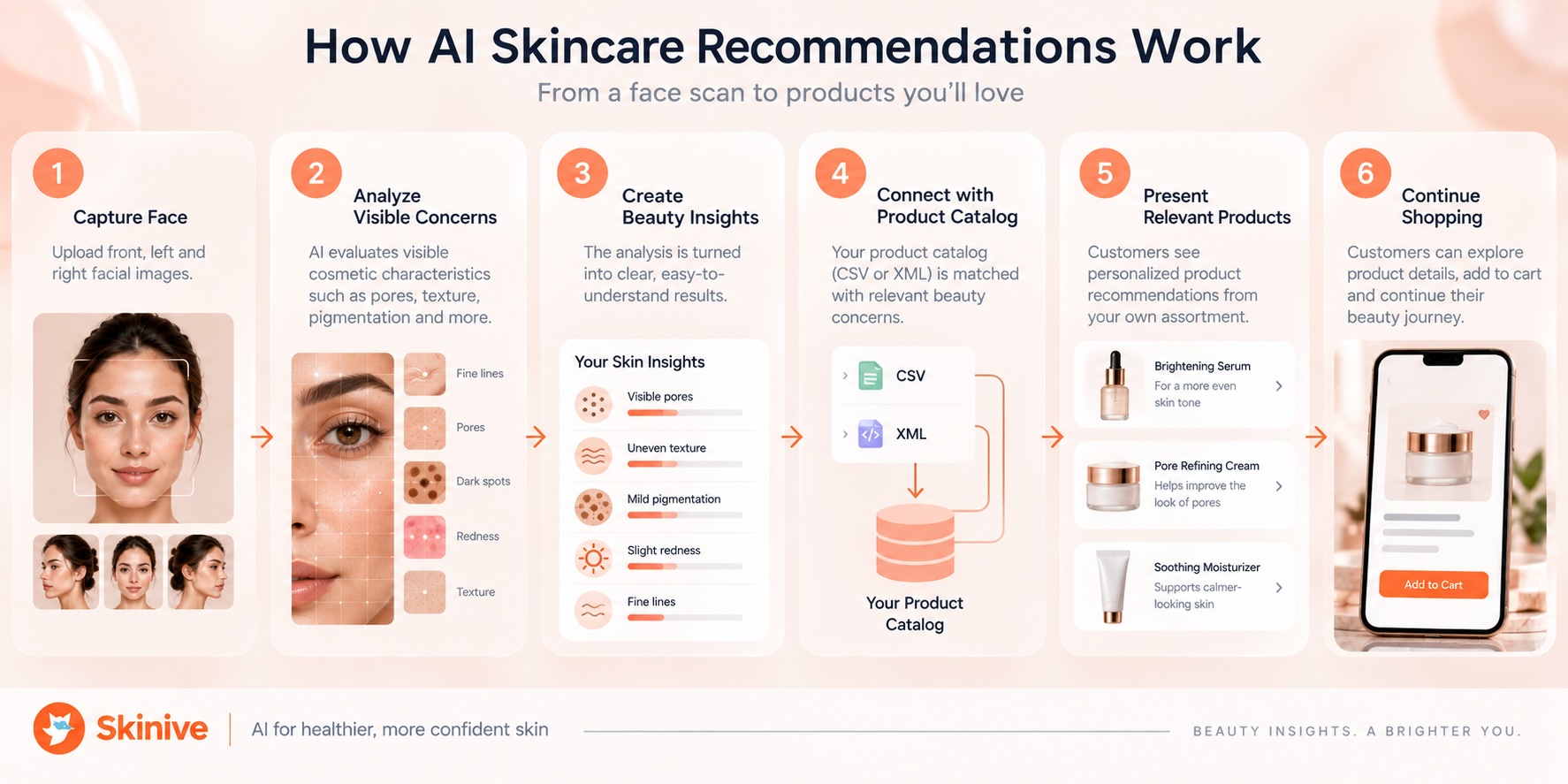
A face-analysis recommendation journey moves from visual input to product discovery through several connected stages:
Capture Face → Analyze Supported Visible Concerns → Create Beauty Insights → Connect With Product Catalog → Present Relevant Products → Continue Shopping
Capture Facial Images
The customer begins with the Face Scanner experience.
With Skinive Face Scanner, front, left, and right facial images provide the visual input for analysis.
Analyze Supported Visible Concerns
AI evaluates supported cosmetic characteristics such as:
- Fine lines and wrinkles
- Visible or enlarged pores
- Blackheads
- Whiteheads
- Acne-related imperfections and blemishes
- Dark spots
- Pigmentation
- Redness
- Uneven-looking facial texture
These are beauty-focused visual outputs rather than medical diagnoses.
For a deeper explanation of the analysis process, see AI Face Analysis: How It Works for Beauty & Skincare.
Turn Analysis Into Understandable Beauty Insights
Raw computer-vision output needs to become information customers can understand.
Instead of exposing technical model data, the experience can present supported concerns in clear beauty-focused language.
Connect Insights With the Product Assortment
The recommendation layer connects relevant beauty concerns with product information supplied by the brand or retailer.
This is the step that turns facial analysis into personalized product discovery.
Present a Focused Recommendation
The customer can then see a relevant product, shortlist, category, or routine depending on how the business has designed its recommendation journey.
Continue Toward Product Discovery
Recommendations should provide an obvious next step.
In e-commerce, that might mean opening a product page. In a beauty app, it might mean continuing a personalized product journey. In physical retail, the recommendation can support product exploration with or without a beauty advisor.
Why Can Face Analysis Make Skincare Product Discovery More Personal?
Traditional skincare discovery often begins with navigation, search, filters, product categories, or bestseller lists.
These tools remain useful, but they frequently require customers to decide for themselves which visible concerns are relevant before they can narrow the assortment.
Face analysis adds another starting point.
Instead of relying entirely on self-identification, the customer can begin with AI-supported evaluation of visible cosmetic characteristics and use those results to organize product discovery.
This does not mean facial images contain everything needed for personalization.
A camera cannot determine a customer’s budget, preferred product format, desired routine length, brand preferences, or many other personal considerations.
That is why visual analysis can work alongside customer-provided context rather than replacing it.
From Visible Beauty Concerns to Relevant Products
The core idea behind AI skincare recommendations is simple:
turn a supported visible concern into a more relevant starting point for product discovery.
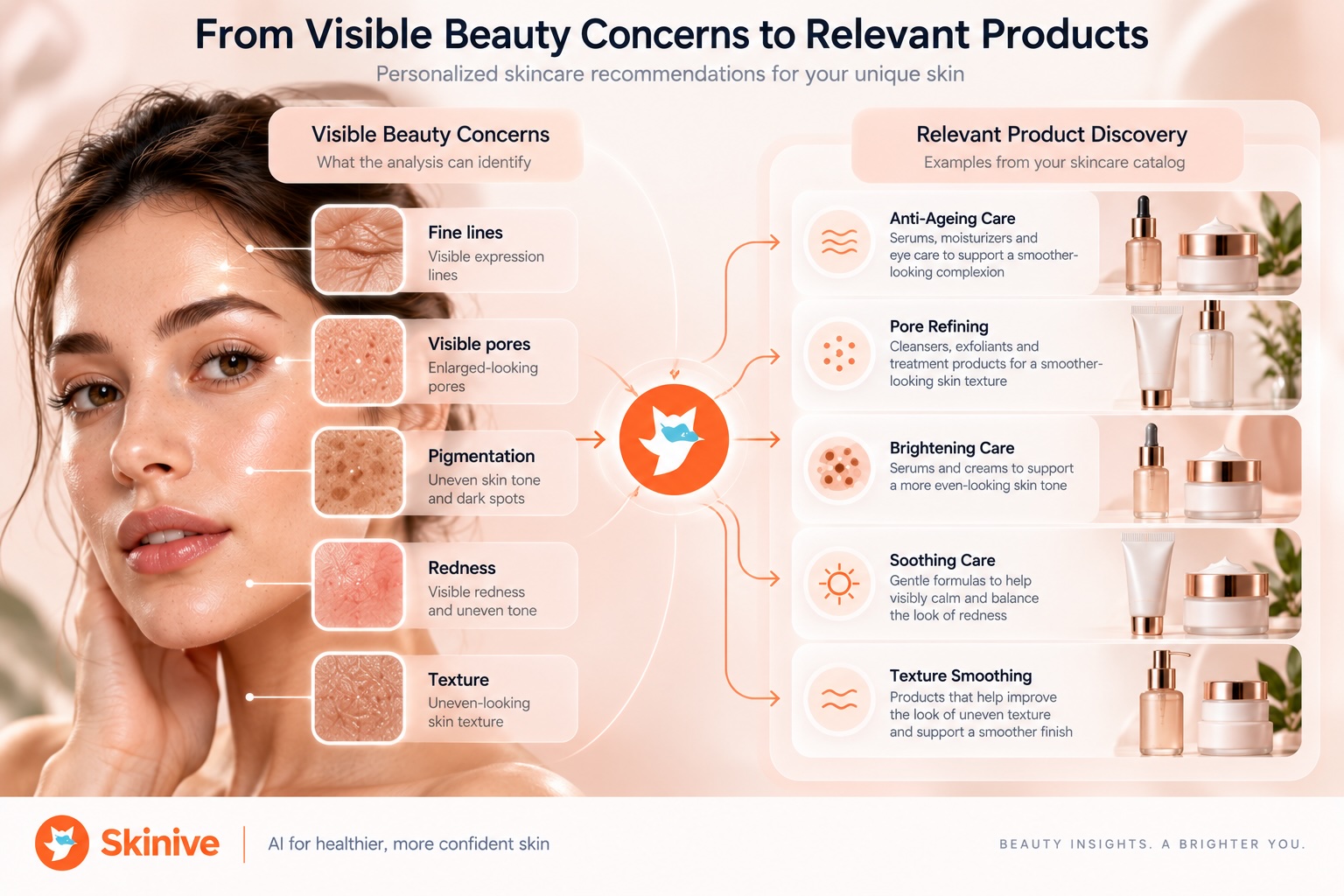
| Face-Analysis Input | Recommendation Direction | Example Product-Discovery Context |
|---|---|---|
| Fine lines and wrinkles | Products associated with appearance-focused skincare | Relevant serums, moisturizers or other catalog items |
| Visible pores | Products positioned around pore appearance and texture | Relevant cleansing or texture-focused products |
| Blackheads and whiteheads | Blemish-focused cosmetic product discovery | Relevant cleansing and targeted skincare categories |
| Dark spots and pigmentation | Tone-focused product discovery | Relevant serums, creams or other catalog products |
| Redness | Soothing and redness-focused beauty discovery | Relevant gentle skincare products |
| Uneven-looking texture | Texture-focused product discovery | Products positioned around smoother-looking skin |
This mapping should not be interpreted as medical treatment guidance.
The exact products shown depend on the business’s catalog, product information, recommendation setup, and any additional customer context used in the experience.
The objective is relevance—not prescribing a product based on an image.
Why Is the Product Catalog Important for AI Recommendations?
Face analysis can provide supported visual information about the customer.
But a beauty business also needs information about its products.
Without that second layer, an AI experience may understand a visible concern but still have no useful way to connect it with the products the customer can actually explore.
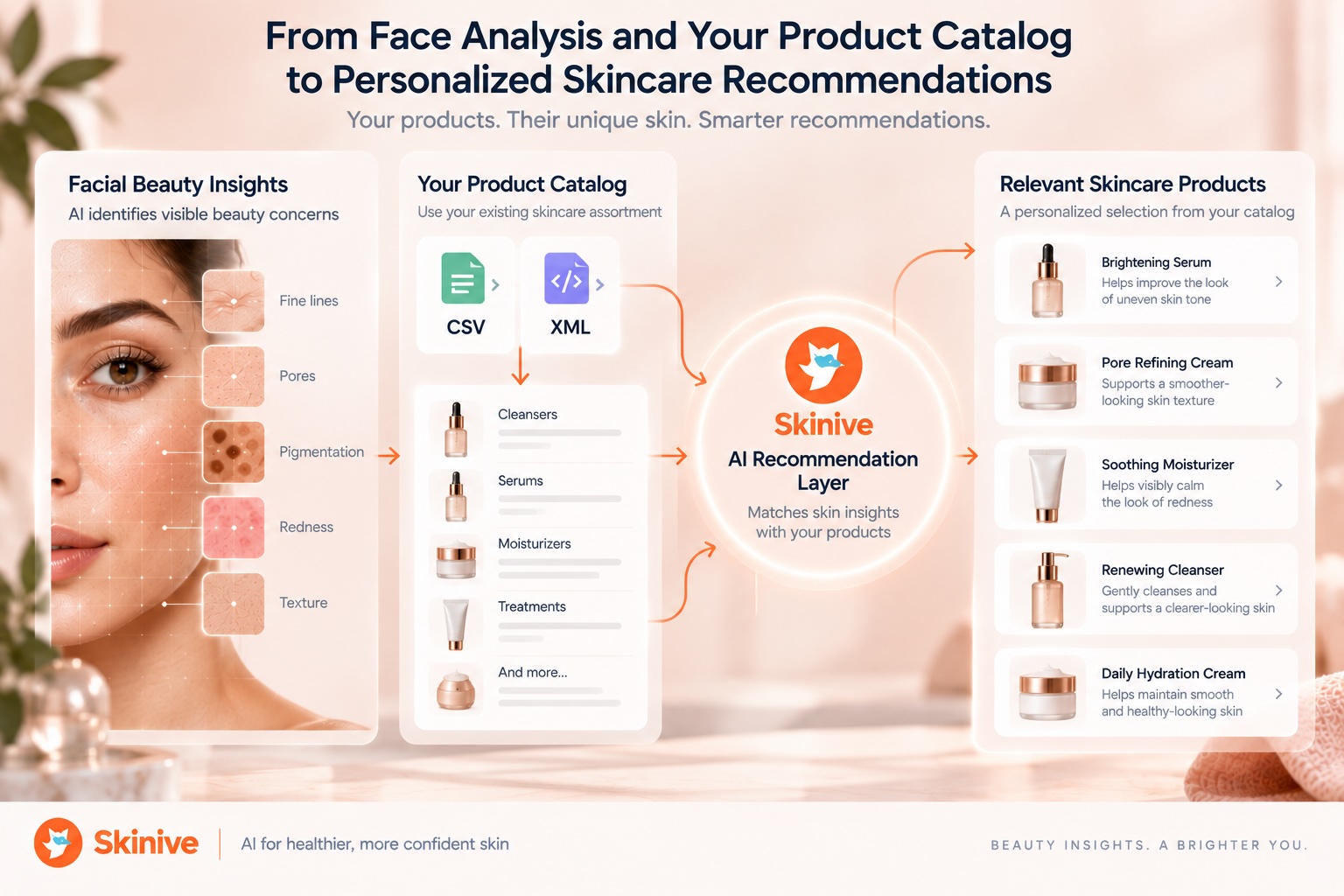
Skinive Face Scanner can work with a beauty brand or retailer’s own skincare catalog.
Product information can be supplied through CSV or XML. Relevant fields include:
- Product name
- Product description
- Ingredients
- Price
- Product-page URL
This allows the recommendation experience to work with the business’s own assortment rather than redirecting customers toward an unrelated generic catalog.
For detailed catalog setup and e-commerce implementation, see AI Face Scanner for E-Commerce: How to Personalize Skincare Shopping.
How Does Catalog Synchronization Support Recommendations?
Beauty assortments change over time.
Products may be added, removed, updated, repriced, or linked to new product pages.
Skinive supports unlimited catalog synchronization so businesses can refresh the product information used by the Face Scanner experience as their assortment changes.
Catalog capacity depends on the selected plan:
| Plan | Catalog Capacity |
|---|---|
| Starter | Up to 1,000 products |
| Growth | Up to 5,000 products |
| Enterprise | Custom requirements |
Catalog synchronization keeps the product dataset connected with the recommendation experience, but businesses remain responsible for maintaining the product information they provide.
For retailers operating across different markets, catalog structure may also need to reflect differences in assortment, pricing, language, and product destinations.
AI Face Analysis Adds a Different Signal to Product Recommendations
Beauty businesses already use several approaches to product discovery.
Face analysis does not need to replace them.
| Approach | Primary Input | Personalization Signal | Main Limitation |
|---|---|---|---|
| Bestsellers and merchandising | Store-wide priorities | Popularity or merchandising strategy | Limited individual context |
| Behavioral recommendations | Browsing or purchase activity | Observed customer behavior | Depends on available behavioral data |
| Skincare quiz | Customer answers | Self-reported preferences and concerns | Depends on what the customer reports |
| AI face analysis | Facial images | Supported visible cosmetic characteristics | Cannot determine non-visible preferences |
| Combined personalization | Multiple inputs | Visual, declared and behavioral context | Requires a more developed personalization setup |
Face analysis therefore contributes something specific: visual information.
A business can use that signal independently or combine it with other customer information when its personalization strategy requires more context.
How Can Face Analysis and Customer Preferences Work Together?
Facial images can contribute information about supported visible cosmetic characteristics, but they cannot answer every product-selection question.
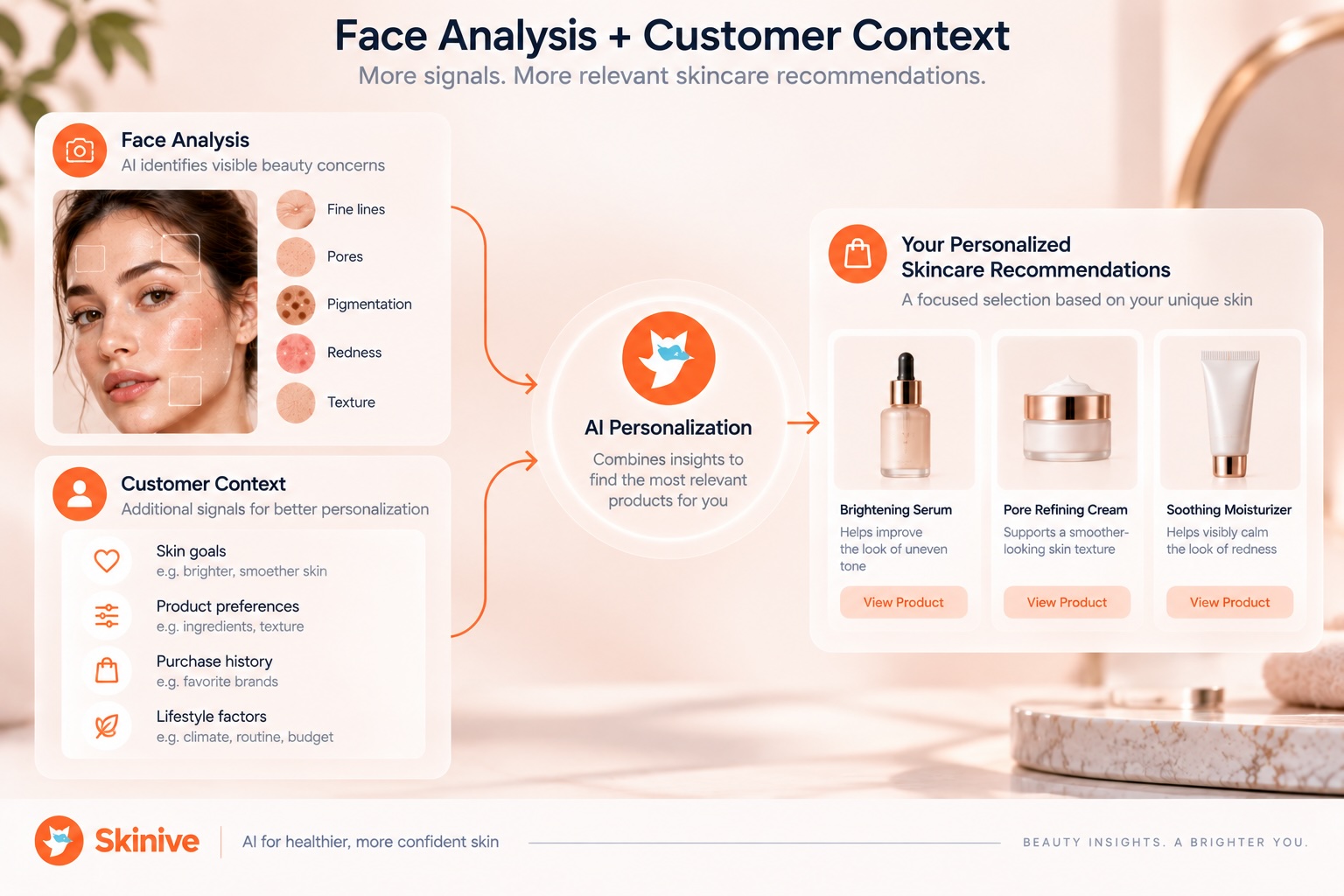
A customer may care about:
- Budget
- Preferred product format
- Routine length
- Existing routine
- Brand preferences
- Personal skincare goals
These inputs can be collected separately and used alongside visual analysis.
A practical recommendation journey might therefore use a Face Scanner first and then ask a small number of relevant questions before presenting products.
The purpose is not to create the longest possible questionnaire.
It is to add customer context where visual analysis alone cannot provide it.
For a detailed comparison of these two inputs, see AI Face Scanner vs. Skincare Quiz.
What Makes a Good AI Skincare Recommendation Experience?
Customers should be able to understand why a recommendation appears.
A strong experience connects the analysis and the product without making the user reconstruct the logic themselves.
Explain the Relevant Beauty Insight
Use clear cosmetic language to explain the supported visible concern behind the recommendation.
Make Product Relevance Understandable
Customers should see a logical connection between the beauty insight and the product being presented.
Keep the Recommendation Focused
Personalization loses value if the customer receives another long catalog page.
A smaller, relevant selection can make the next decision easier.
Use the Business’s Current Product Information
Recommendations should be based on the catalog information supplied by the beauty business.
Provide a Clear Next Action
Customers should be able to continue naturally toward product details, comparison, shopping, or an assisted consultation.
Add Customer Context When Needed
Visual analysis should not be expected to infer information that cannot be seen in an image.
Keep Beauty and Medical Claims Separate
Cosmetic recommendations should remain within beauty and skincare positioning rather than implying medical diagnosis or treatment.
Should AI Recommend One Product, a Shortlist, or a Routine?
There is no universal recommendation format.
The appropriate format depends on the customer journey, product assortment, and amount of information available.
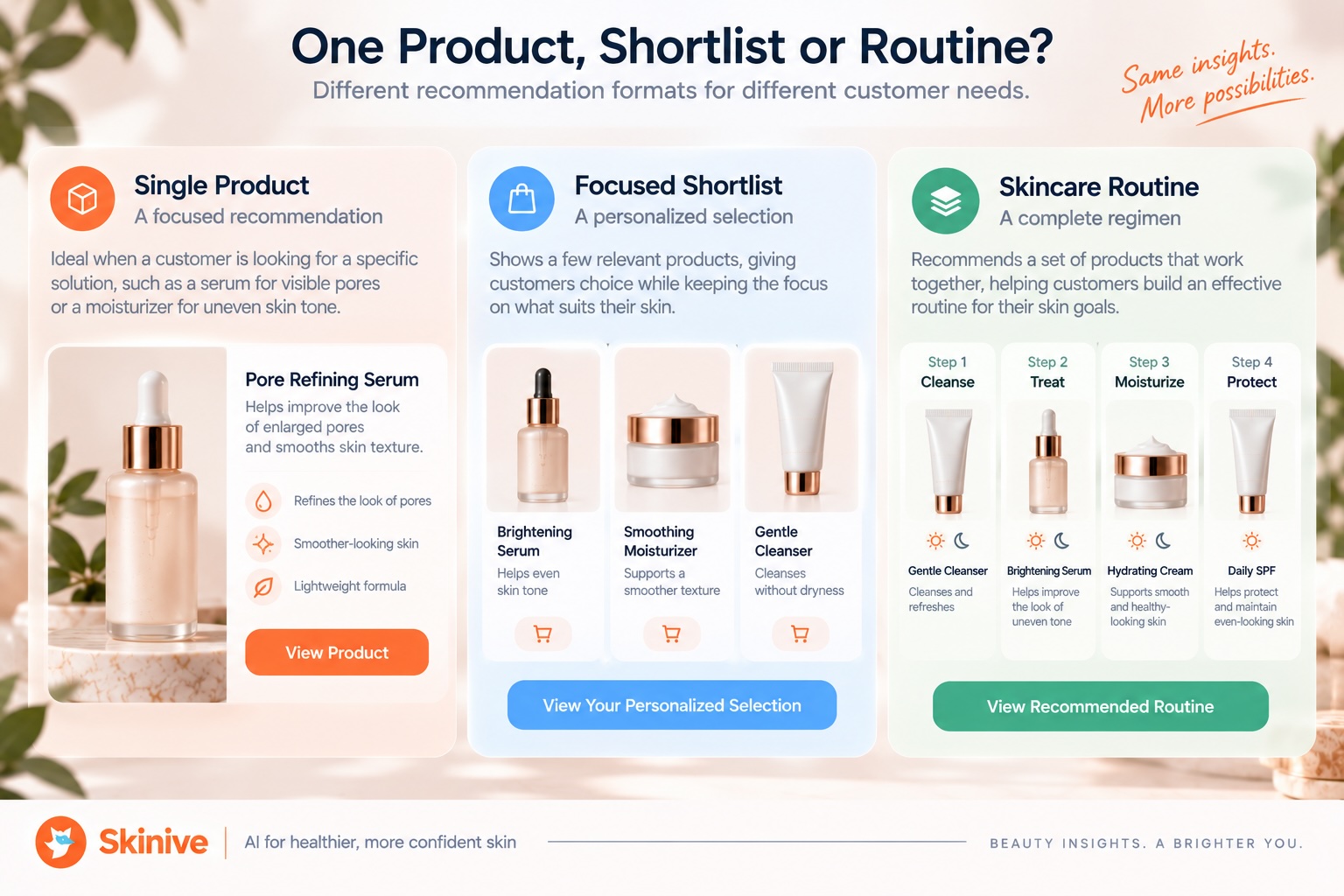
| Recommendation Format | Useful When | Customer Experience |
|---|---|---|
| Single product | The journey is highly focused | One simple next step |
| Shortlist | Several products are relevant | Compare a small number of options |
| Routine | The business uses a multi-step skincare journey | Explore products in an organized sequence |
| Category guidance | The assortment is large | Narrow discovery to a relevant category |
| Advisor-assisted selection | Used in physical retail | AI narrows discovery while staff add context |
A focused shortlist may sometimes be more useful than presenting a large number of products simply because they share a broad category.
Recommendation design should help customers make a decision rather than create another layer of choice overload.
Where Can AI Skincare Recommendations Be Used?
The same basic principle—connect relevant customer signals with relevant products—can support several beauty channels.
| Channel | Recommendation Role | Typical Next Step |
|---|---|---|
| E-commerce | Personalize online product discovery | Open relevant product pages and continue shopping |
| Beauty or skincare app | Support a personalized mobile journey | Explore relevant products or routines |
| Physical beauty retail | Support self-service or advisor-assisted discovery | Explore relevant products in store |
| Omnichannel beauty | Extend personalization across customer touchpoints | Continue through the appropriate channel |
The detailed implementation differs by channel.
This article focuses specifically on the recommendation layer between face analysis and relevant products.
How Does Skinive Face Scanner Support Product Recommendations?
Skinive Face Scanner combines facial beauty analysis with catalog-based product discovery.
| Capability | Skinive Face Scanner |
|---|---|
| Face-analysis input | Front, left and right facial images |
| Supported beauty analysis | Multiple visible cosmetic characteristics |
| Product catalog | CSV or XML |
| Product information | Name, description, ingredients, price, product-page URL |
| Catalog synchronization | Unlimited |
| Ready-to-use web option | Web Widget |
| Custom integration | Web SDK and API |
| Native mobile SDKs | iOS and Android planned |
| Dashboard analytics | Scans, users, product clicks, sales conversions |
The ready-to-use Web Widget can support rapid deployment, while the Web SDK and API provide options for more customized implementations.
The recommendation experience can therefore be connected with the beauty business’s own product assortment rather than operating as an isolated face-analysis feature.
How Should Businesses Measure Recommendation Performance?
A recommendation experience should be evaluated as part of the customer journey rather than by scan volume alone.
Skinive provides dashboard statistics for:
- Scans
- Users
- Product clicks
- Sales conversions
Beauty businesses can combine those metrics with their own analytics to evaluate additional parts of the journey, such as:
- Recommendation impressions
- Product-page visits
- Add-to-cart behavior
- Products explored after analysis
- Repeat engagement
- Channel-specific shopping behavior
The distinction matters.
Skinive provides Face Scanner and recommendation-related analytics, while additional e-commerce, app, CRM, or retail metrics depend on the business’s own systems.
The most useful question is whether recommendations help customers move from analysis toward relevant product discovery and commercial action.
Common Mistakes in AI-Powered Skincare Recommendations
Even sophisticated technology can create a weak experience if recommendation design is poor.
Showing Too Many Products
A recommendation that resembles a generic category page provides little sense of personalization.
Failing to Explain Relevance
Customers should understand why a product is being shown after the analysis.
Using Poor or Outdated Product Information
The recommendation experience depends on the quality of the catalog data supplied by the business.
Treating Face Analysis as the Only Customer Signal
Visual analysis cannot determine every preference or customer goal.
Making Medical Claims
Beauty recommendations should not imply that the Face Scanner has diagnosed a condition or that a cosmetic product constitutes medical treatment.
Measuring Only Scan Volume
A completed scan does not necessarily mean the recommendation journey was useful. Product interaction and downstream behavior provide additional context.
Privacy and Trust in Personalized Beauty Recommendations
Face-based personalization requires clear customer communication.
Users should understand why facial images are being captured, what the beauty analysis is intended to do, and how the resulting experience connects with product discovery.
Businesses should also review the privacy, data-processing, security, consent, and other compliance requirements relevant to their particular implementation.
Trust also depends on recommendation language.
A beauty recommendation should explain cosmetic relevance without implying diagnosis, treatment, or a medical conclusion.
Clear boundaries help customers understand what the Face Scanner is designed to provide.
Building a Better Journey From Face Analysis to Product Discovery
The strongest AI skincare recommendation experience makes the path from analysis to product discovery easy to understand.
For beauty brands and retailers, that requires three connected layers:
Face Analysis → Product Information → Customer-Friendly Recommendation
Face analysis contributes supported visual insights.
The product catalog provides information about the assortment.
The recommendation experience connects the two in a way that helps customers decide what to explore next.
Additional inputs—such as customer preferences, profiles, browsing behavior, purchase history, or beauty-advisor context—can enrich personalization where appropriate.
But the central principle remains simple:
use relevant customer signals to reduce guesswork in skincare product discovery.
Related Resources
- AI Face Scanner for E-Commerce: How to Personalize Skincare Shopping
- AI Face Scanner for Beauty & Skincare Apps: Integration and Use Cases
- AI Face Scanner for In-Store Beauty Retail: Personalized Beauty Consultations at the Point of Sale
- AI Face Analysis: How It Works for Beauty & Skincare
Turn Face Analysis Into Personalized Product Discovery
Connect supported visible facial beauty concerns with relevant products from your own skincare assortment.