
An AI face scanner for e-commerce analyzes a shopper’s facial images, identifies visible beauty concerns such as fine lines, pores, blackheads, dark spots, pigmentation, redness, and uneven texture, and connects these insights with relevant skincare products from an online store.
For beauty brands and cosmetics retailers, this creates a more personalized shopping experience: instead of asking customers to browse hundreds of products or guess what may suit them, AI-powered face analysis can help guide them toward products that match their individual beauty concerns.
Skinive Face Scanner can be integrated into an e-commerce website through a ready-to-use web widget, Web SDK, or API and connected directly to the retailer’s existing skincare product catalog.
Key Takeaways
- An AI face scanner can turn a selfie-based experience into personalized skincare product discovery.
- Facial analysis can identify multiple visible beauty concerns, including pores, fine lines, wrinkles, blackheads, pigmentation, dark spots, redness, and skin texture.
- Beauty retailers can connect AI analysis with their own skincare catalog rather than displaying generic product recommendations.
- Skinive Face Scanner can be added to an e-commerce website using a web widget, Web SDK, or API.
- The Skinive web widget can be launched in around five minutes without building a face scanning experience from scratch.
- Product catalogs can be uploaded via CSV or XML and synchronized with Skinive.
- Retailers can track scans, users, product clicks, and sales conversions through the Skinive dashboard.
Why Beauty E-Commerce Needs Better Product Discovery
Buying skincare online presents a particular challenge: customers are often presented with hundreds or thousands of products but have limited guidance on which products are relevant to their individual concerns.
A shopper may know that they want to improve the appearance of their skin, but choosing between different cleansers, serums, moisturizers, masks, eye products, or targeted treatments can quickly become complicated.
Traditional e-commerce navigation usually relies on categories, filters, search, and promotional collections. Beauty retailers may also use questionnaires asking customers to select their skin type and concerns.
AI face scanning introduces another approach.
Instead of relying exclusively on what the customer says about their skin, a face scanner can analyze visible facial characteristics from images and use the results to support personalized product discovery.
This creates a journey from:
Face scan → visible beauty concerns → personalized recommendations → product pages → purchase
rather than:
Homepage → categories → filters → dozens of products → customer decides alone
What Is an AI Face Scanner for E-Commerce?
An AI face scanner for e-commerce is a computer-vision technology integrated into an online beauty or cosmetics store. Customers capture facial images using a smartphone or compatible camera, and artificial intelligence evaluates visible facial characteristics.
Depending on the capabilities of the system, these may include:
- Fine lines and wrinkles
- Enlarged or visible pores
- Blackheads and whiteheads
- Acne-related imperfections and blemishes
- Dark spots and pigmentation
- Redness
- Uneven-looking texture
- Other visible cosmetic characteristics
The analysis can then be connected with the retailer’s product catalog to recommend relevant skincare products.
The purpose is not to diagnose skin diseases. In a beauty e-commerce environment, face scanning is used to improve cosmetic personalization and product discovery.
How Does an AI Face Scanner Work in an Online Store?
The customer journey can be relatively simple.
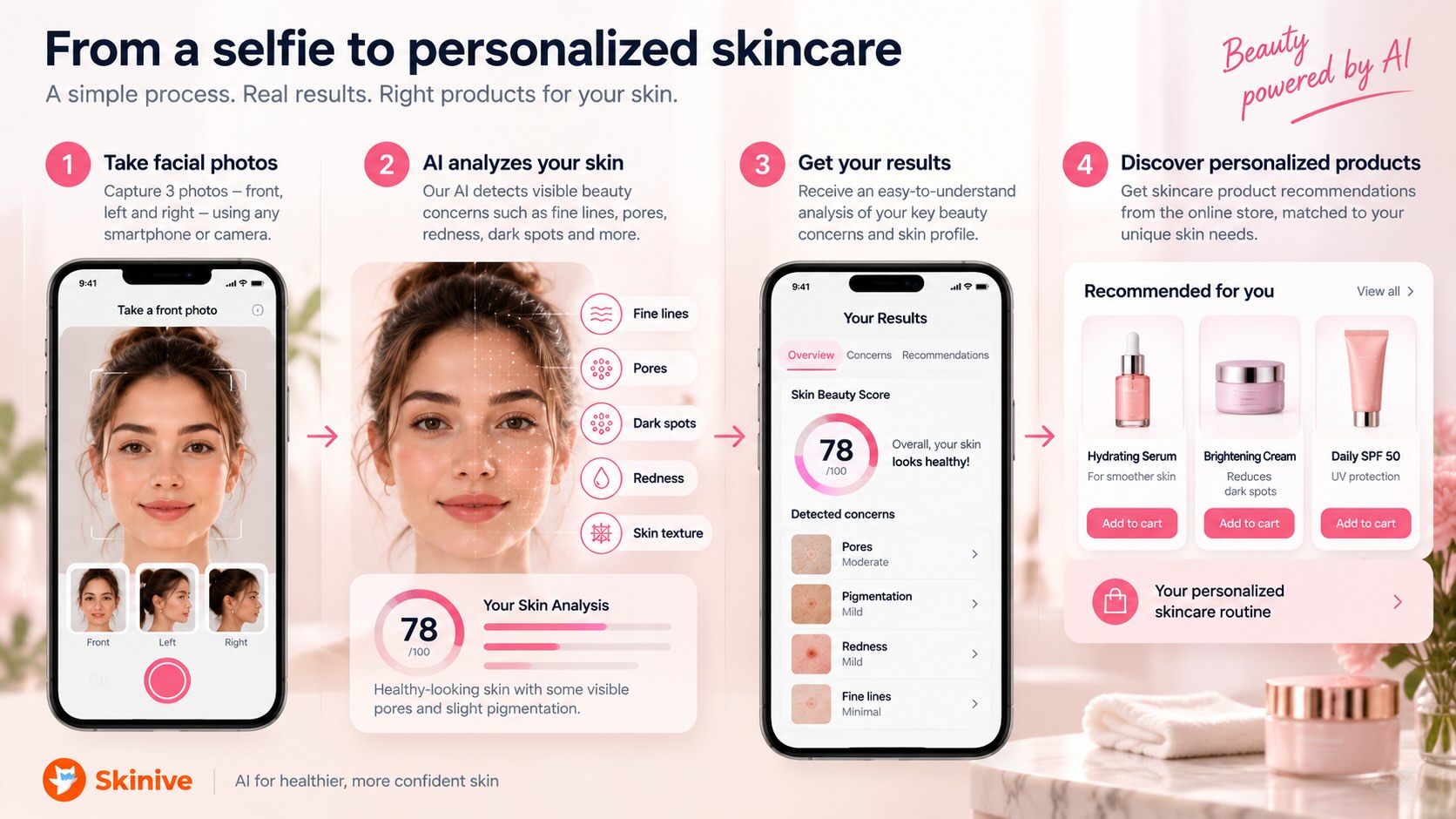
1. The customer starts a face scan
A shopper opens the Face Scanner from the retailer’s website.
With Skinive, the customer captures three facial images — front, left, and right — to provide the AI with different views of the face.
2. AI analyzes visible facial concerns
Computer-vision algorithms evaluate the images for supported cosmetic characteristics such as pores, fine lines, blackheads, pigmentation, redness, and texture.
The results are presented in an easy-to-understand format.
3. Results are connected to the retailer’s product catalog
Instead of ending with an analysis report, the Face Scanner can connect individual concerns with relevant products sold by the retailer.
For example, products in a cosmetics catalog can be associated with particular beauty concerns using their descriptions, ingredients, and other product information.
4. The customer receives personalized skincare recommendations
Relevant products can then be displayed as recommendations following the face scan.
Customers can move directly from understanding a visible concern to viewing an appropriate product page in the retailer’s online store.
5. The retailer measures customer behavior
The Skinive dashboard provides statistics on scans, users, product clicks, and sales conversions.
This allows businesses to evaluate how customers interact with the Face Scanner and how personalized product discovery contributes to the e-commerce journey.
AI Face Scanner vs. Traditional Skincare Shopping
AI face scanning does not need to replace conventional navigation, filters, search, or beauty quizzes. It can provide an additional personalized path into the same product catalog.
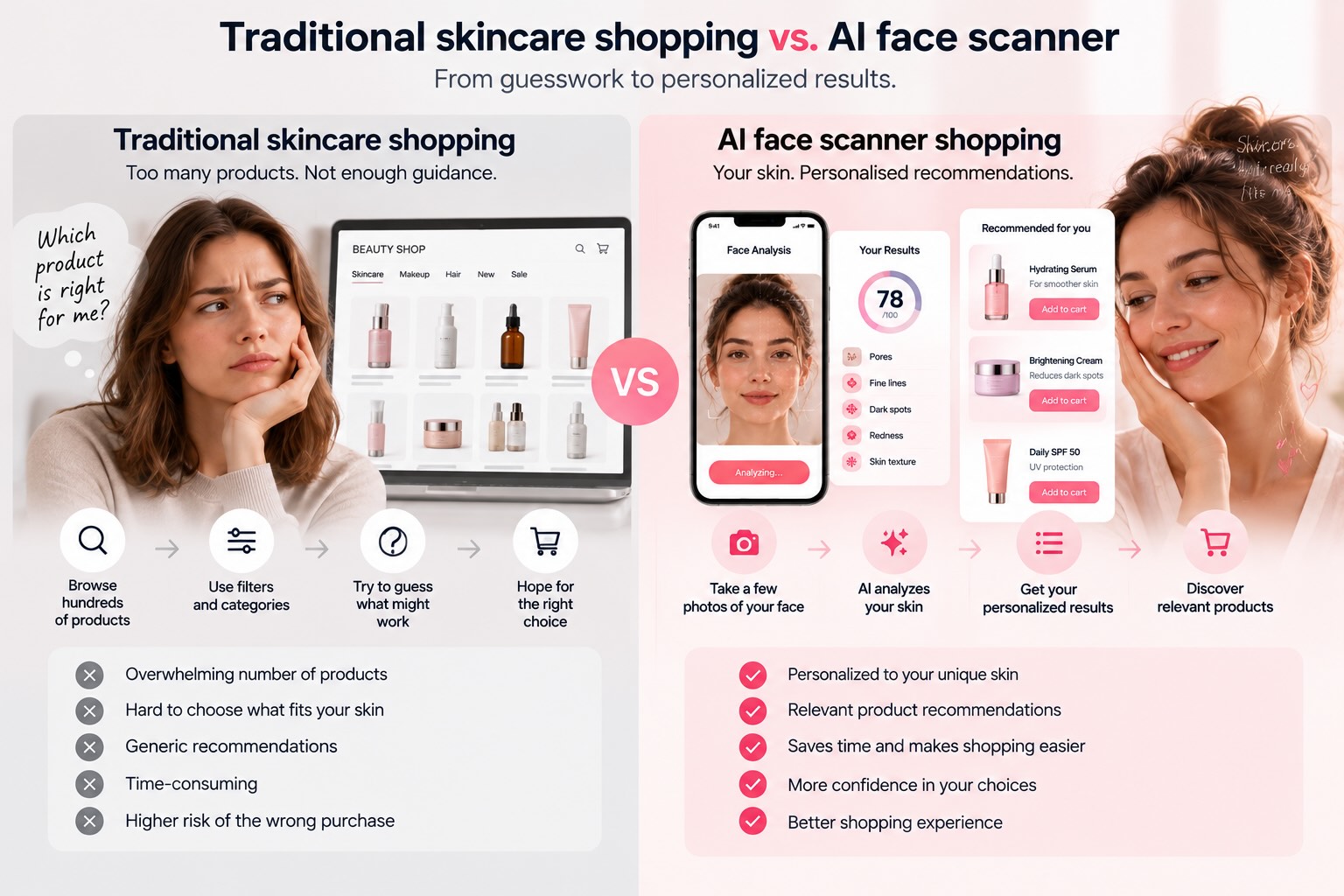
| Feature | Traditional E-Commerce | Skincare Quiz | AI Face Scanner |
|---|---|---|---|
| Customer input | Search, filters and browsing | Questionnaire | Facial images |
| Personalization | Limited | Based on customer answers | Based on AI-assisted visual analysis |
| Identifies multiple visible concerns | No | Customer selects them | Yes |
| Personalized product discovery | Limited | Yes | Yes |
| Uses retailer’s own catalog | Yes | Yes | Yes |
| Suitable for web stores | Yes | Yes | Yes |
| Visual experience | Limited | Limited | High |
| Can connect analysis directly with products | No | Yes | Yes |
The three approaches can also work together. A beauty retailer could combine AI face analysis with customer preferences, product filters, or questionnaire responses to create a richer personalization experience.
From Face Analysis to Personalized Skincare Recommendations
The commercial value of an AI face scanner does not come simply from displaying a facial score or identifying visible concerns.
The more important step is connecting the analysis with what the customer can do next.
For an e-commerce retailer, that means product discovery.
If a scan identifies visible concerns related to fine lines, pores, pigmentation, blackheads, or uneven texture, the system can use these insights to identify relevant products in the retailer’s catalog.
This allows the customer journey to continue naturally:
“What can the AI see?” → “What does this mean for my beauty routine?” → “Which products in this store are relevant to me?”
For beauty retailers with large catalogs, this can be particularly useful because customers do not need to understand every ingredient, category, or product line before beginning their search.
How Skinive Connects to Your Skincare Product Catalog
Skinive Face Scanner is designed to work with a beauty retailer’s existing product catalog.
Catalog information can be provided in CSV or XML format.
At minimum, each product should include:
- Product name
- Product description
- Ingredients
- Price
- URL of the product page in the online store
CSV catalogs can be uploaded directly through the Skinive dashboard after registration.
Skinive then synchronizes the products so that they can be used within the personalized skincare recommendation experience.
Catalog synchronization is not limited, allowing businesses to update product information as their assortment changes.
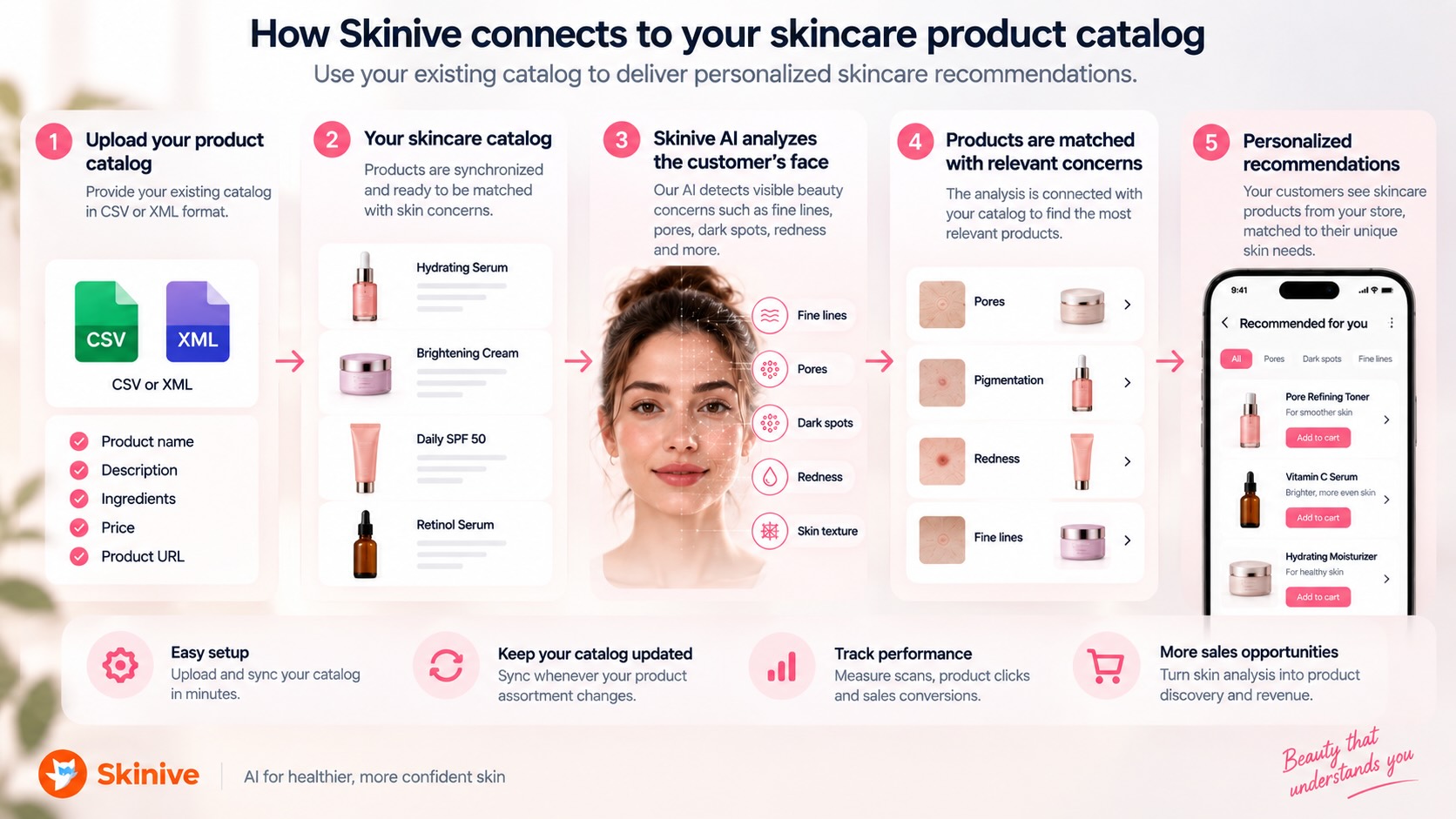
The number of supported products depends on the selected plan. The Starter plan supports up to 1,000 products, while the Growth plan supports up to 5,000 products. Larger catalogs can be discussed under an Enterprise plan.
How to Add an AI Face Scanner to an E-Commerce Website
Adding face scanning technology does not necessarily require building a computer-vision system or a new front end from scratch.
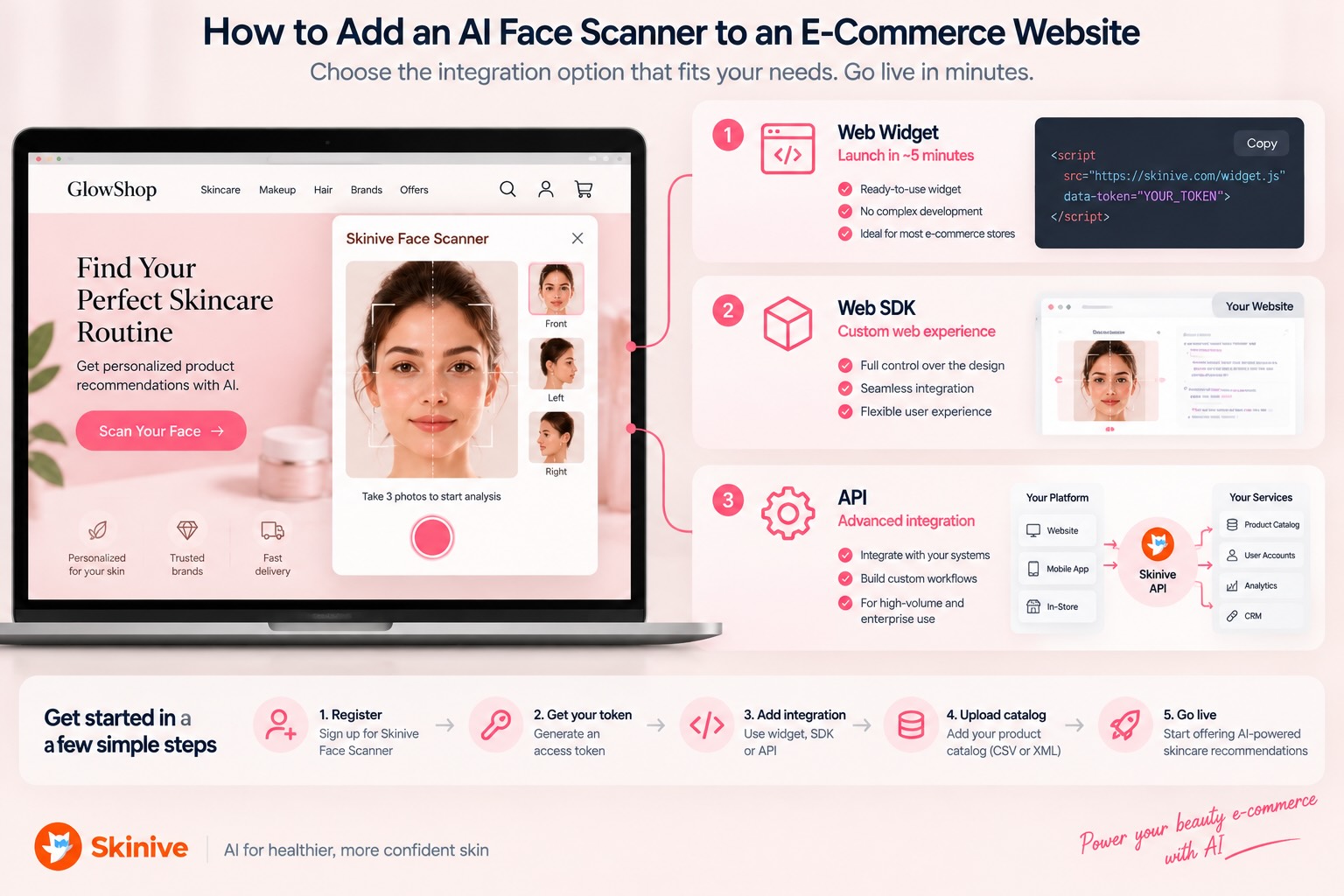
Skinive offers three main web integration approaches.
| Integration | Best suited for | Implementation |
|---|---|---|
| Web Widget | Fast deployment and standard e-commerce use | Add ready-to-use widget code |
| Web SDK | More customized web experiences | Integrate Face Scanner into the website interface |
| API | Custom workflows and deeper integrations | Connect Skinive capabilities with your own systems |
Fastest option: the web widget
For businesses looking for the fastest implementation, the Skinive Face Scanner web widget can be launched in around five minutes.
The basic process is:
- Register for Skinive Face Scanner.
- Start the free trial.
- Generate an access token.
- Copy the Face Scanner widget code.
- Add the code to your website.
- Upload or synchronize your product catalog.
- Start offering AI-powered face analysis to customers.
This makes it possible to test the experience without developing a complete face analysis interface internally.
Where Should a Face Scanner Appear in an Online Beauty Store?
There is no single location that works for every retailer.
Depending on the customer journey, an AI Face Scanner can be introduced at several points across an e-commerce website.
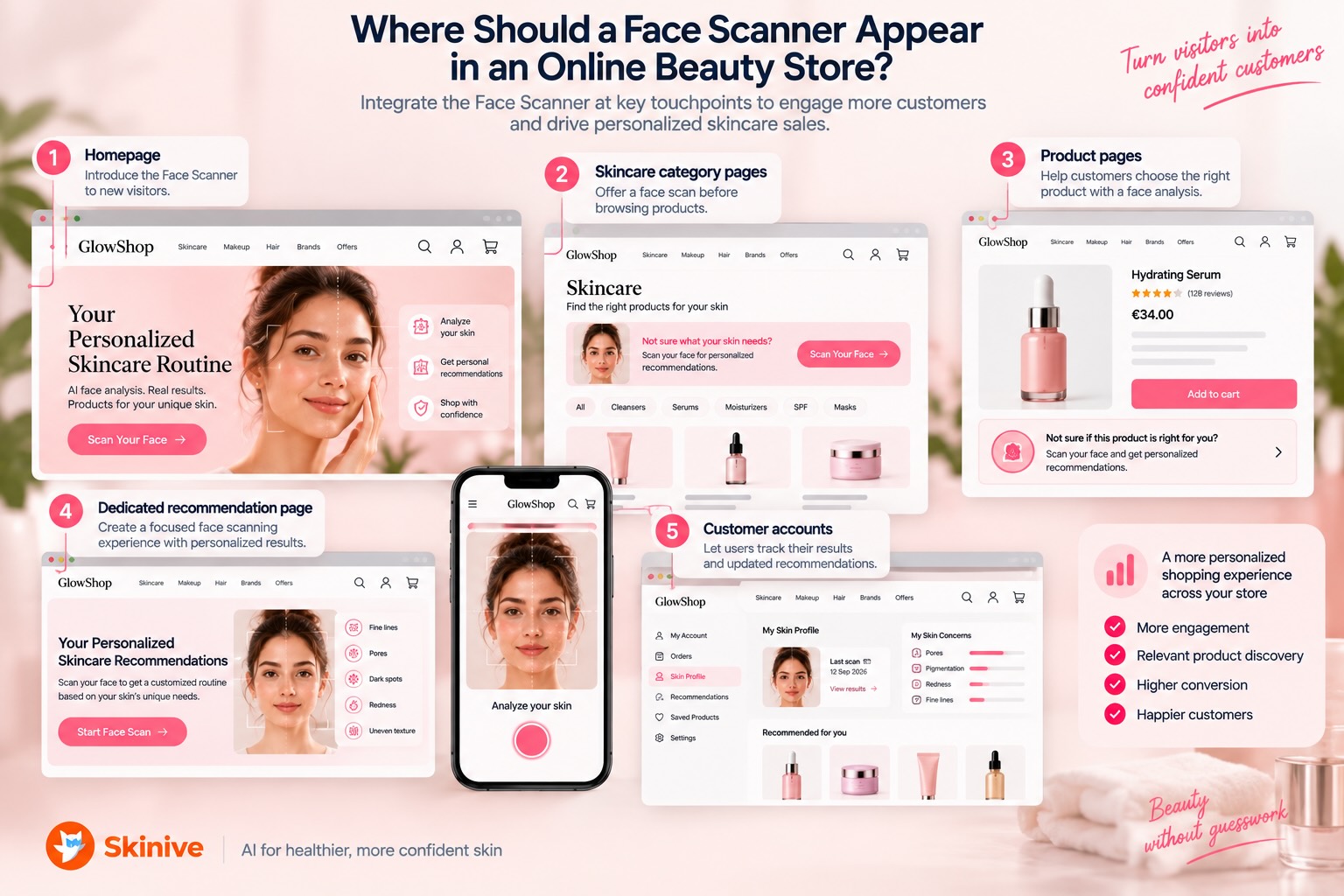
Homepage
A prominent “Scan Your Face” or “Find Your Skincare” entry point can introduce new visitors to personalized product discovery.
Skincare category pages
Customers browsing skincare can be offered a face scan before navigating hundreds of products.
Product recommendation pages
Face scanning can serve as the first step in a dedicated personalized skincare journey.
Product pages
Retailers can invite customers who are uncertain about a product to complete a face analysis and explore recommendations.
Customer accounts
Scan results and recommendations can potentially become part of a broader personalized beauty experience for returning customers, depending on the retailer’s implementation.
The right placement should ultimately be tested against customer engagement, product clicks, and conversion behavior.
What Are the Benefits for Beauty Brands and Retailers?
AI face scanning can address several challenges in online beauty retail.
More personalized product discovery
Customers receive recommendations connected with their visible facial concerns rather than seeing the same products as every other visitor.
Easier navigation through large skincare catalogs
A retailer with hundreds or thousands of products can provide a more guided path into its assortment.
More engaging digital beauty experiences
Face scanning adds an interactive element that conventional filters and product grids cannot provide.
A bridge between consultation and commerce
In a physical beauty store, customers can ask a beauty advisor for help. Online, AI-assisted face analysis can provide an additional form of digital guidance.
Measurable customer behavior
Retailers can measure scans, users, product clicks, and conversions to understand how customers interact with the experience.
AI Face Scanning as Part of an Omnichannel Beauty Strategy
Face scanning does not need to exist only on a website.
The same underlying concept can be used across different customer touchpoints:
- E-commerce websites
- Beauty and skincare mobile apps
- Physical cosmetics stores
- Digital beauty consultations
- In-store devices and assisted selling experiences
For retailers operating across several channels, this creates an opportunity to build a more consistent personalized beauty experience.
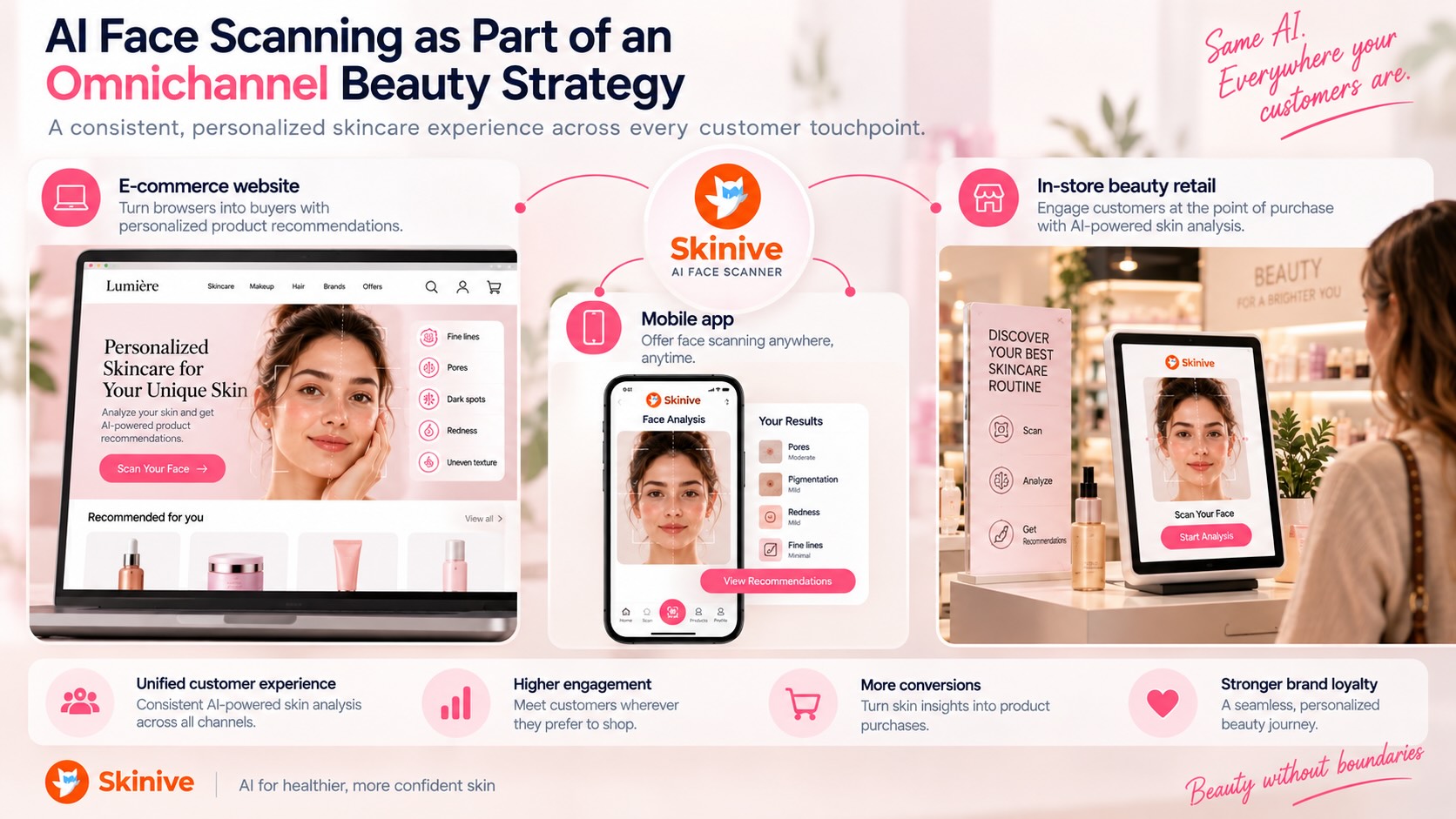
A customer could encounter the same approach to face analysis and skincare recommendations whether they are shopping online, using a retailer’s mobile app, or visiting a physical store.
What Should Beauty Retailers Consider Before Implementing AI Face Scanning?
Before choosing a face scanning solution, businesses should evaluate more than the AI model itself.
Important questions include:
- Which facial beauty concerns can the technology analyze?
- Can it connect results with our own product catalog?
- How quickly can it be integrated into our website?
- Does it support our catalog size?
- Can product data be updated regularly?
- What analytics are available?
- How are facial images and customer data processed?
- Can the technology later be expanded to mobile and in-store experiences?
- What technical support is available?
- How does pricing change as scan volume grows?
For larger retailers, scalability and the ability to support an omnichannel customer journey may be as important as the initial web implementation.
How Much Does an AI Face Scanner for E-Commerce Cost?
Skinive uses a subscription plus usage-based pricing model.
| Plan | Monthly Fee | Price per Scan | Product Catalog |
|---|---|---|---|
| Starter | €99/month | €0.20 | Up to 1,000 products |
| Growth | €199/month | €0.15 | Up to 5,000 products |
| Enterprise | Custom | Custom | Custom |
Enterprise plans are available for businesses with larger product catalogs, higher scanning volumes, or custom integration requirements.
Businesses can also start with a free trial to evaluate the Face Scanner before selecting the appropriate plan.
Measuring the Performance of an AI Face Scanner
Like any e-commerce feature, an AI Face Scanner should be evaluated based on measurable customer behavior rather than engagement alone.
Useful metrics include:
- Number of face scans
- Unique users completing scans
- Scan completion rate
- Product recommendation clicks
- Click-through rate to product pages
- Add-to-cart rate after scanning
- Conversion rate after scanning
- Revenue generated by users who interact with recommendations
- Repeat usage
- Differences between customers who use the Face Scanner and those who do not
Skinive provides dashboard statistics covering scans, users, product clicks, and sales conversions.
For larger implementations, businesses can combine these insights with their existing e-commerce analytics to evaluate the Face Scanner across the full customer journey.
Getting Started with Skinive Face Scanner
For beauty brands and cosmetics retailers, the simplest way to start is to test the Face Scanner on an existing website.
With Skinive, businesses can register, start a free trial, generate a token, add the web widget, and upload their skincare catalog.
The ready-to-use widget can be deployed in around five minutes, while the Web SDK and API provide options for businesses that require more customized integration.
Skinive Face Scanner is designed specifically for beauty, cosmetics, and personalized skincare experiences. It analyzes visible facial characteristics to support product discovery and is separate from Skinive’s medical solutions for dermatological assessment.
It’s Time to Bring Personalized Skincare to Your Online Store
Turn AI-powered face analysis into personalized product discovery. Explore Skinive Face Scanner and see how easily it can be integrated into your beauty e-commerce experience.