
AI face analysis uses artificial intelligence and computer vision to evaluate facial images for supported visible cosmetic characteristics. In beauty and skincare, the technology can turn facial images into understandable beauty-focused insights and connect those results with personalized product discovery. The key is not simply detecting visual patterns, but creating a clear journey from image capture to useful results and an appropriate next step.
Key Takeaways
- AI face analysis uses computer vision to evaluate supported visible cosmetic characteristics from facial images.
- The process typically moves from image capture and facial positioning to computer-vision analysis, structured results, and a customer-facing next step.
- With Skinive Face Scanner, users capture front, left, and right facial images to provide visual coverage from multiple angles.
- Image quality matters because lighting, framing, movement, visibility, and facial angle affect the visual information available for analysis.
- Beauty face analysis should communicate cosmetic findings without presenting them as medical diagnoses.
- Analysis becomes more useful commercially when results connect with relevant skincare products or other personalized beauty experiences.
- Skinive Face Scanner can support beauty experiences across e-commerce, apps, and physical retail through available integration options.
What Is AI Face Analysis?
AI face analysis is the use of artificial intelligence and computer vision to process facial images and evaluate supported visible characteristics.
In a beauty context, its purpose is to help customers better understand visible cosmetic concerns and create a more personalized skincare or product-discovery experience.
Instead of relying only on a questionnaire or asking customers to describe what they see, face analysis adds visual input to the personalization process.
A typical experience begins when a customer captures facial images. The software processes those images, identifies relevant facial areas, evaluates the visual characteristics it is designed to analyze, and converts the output into information that can be presented through a customer-facing interface.
The important boundary is purpose.
Beauty-oriented AI face analysis focuses on cosmetic characteristics and personalization. It should not be presented as diagnosing diseases or replacing professional medical assessment.
How Does AI Face Analysis Work?
Although the underlying computer vision can be technically complex, the customer journey should remain simple.
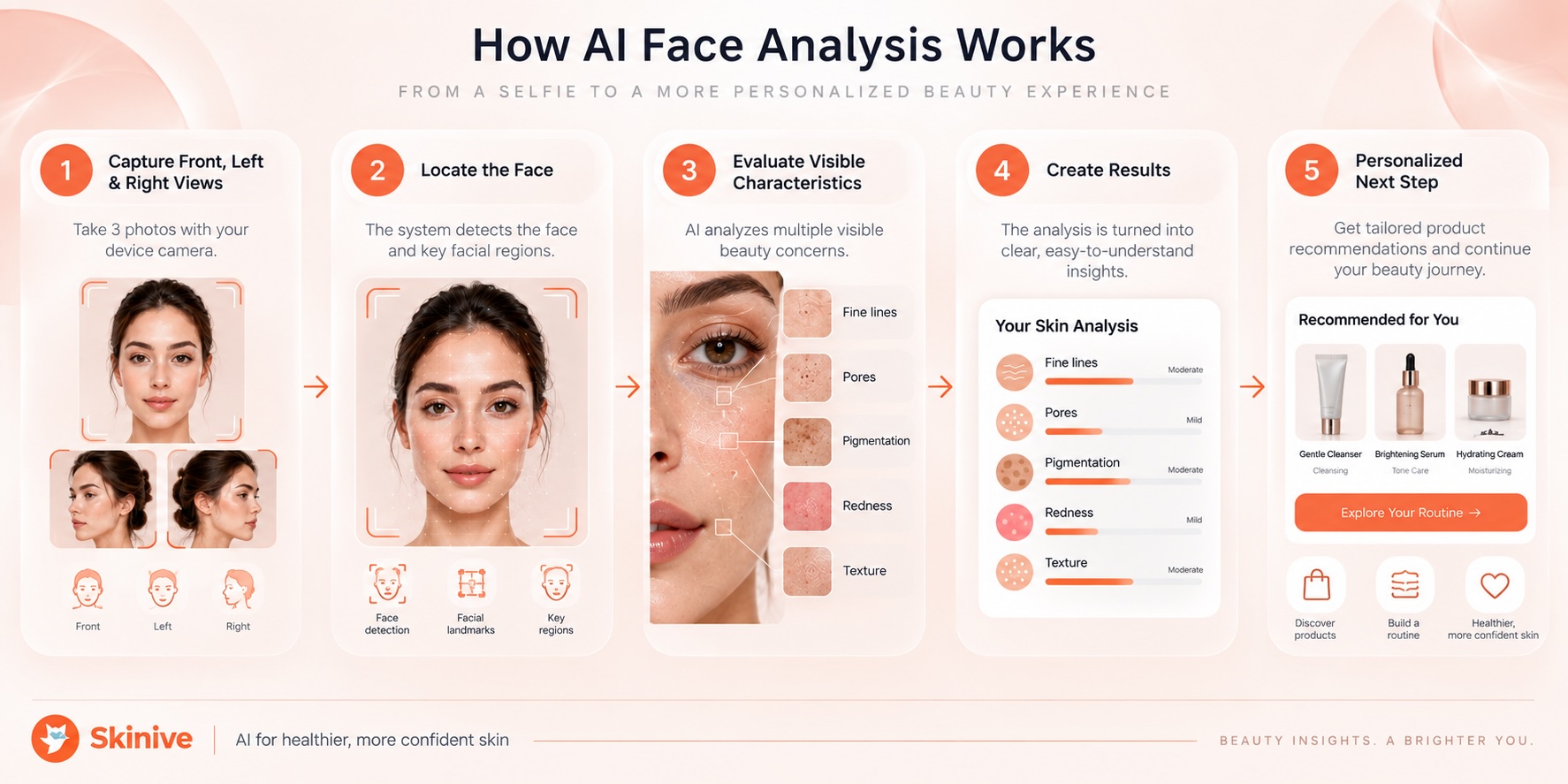
At a high level, AI face analysis moves through several stages:
Facial Image Capture → Face Localization → Visual Analysis → Structured Results → Customer-Facing Insights → Personalized Next Step
Capture Facial Images
The process begins with images.
Depending on the implementation, customers can interact with the Face Scanner through a compatible digital experience using a camera-enabled device.
With Skinive Face Scanner, the customer captures three facial views:
- Front
- Left
- Right
The capture experience should make it clear which view is required and help the user position their face appropriately.
Locate the Face and Relevant Areas
Before cosmetic characteristics can be evaluated, the software needs to identify the face within the image and work with the relevant facial areas.
This creates a consistent basis for subsequent computer-vision processing.
For the customer, this stage should largely remain invisible. The interface should focus on making capture straightforward rather than exposing unnecessary technical complexity.
Evaluate Supported Visible Characteristics
Computer-vision models process the captured images for the visible cosmetic characteristics the system has been designed to support.
With Skinive Face Scanner, these include concerns such as:
- Fine lines and wrinkles
- Visible or enlarged pores
- Blackheads
- Whiteheads
- Acne-related imperfections and blemishes
- Dark spots
- Pigmentation
- Redness
- Uneven-looking facial texture
The analysis is limited to supported visible characteristics. An image cannot provide every piece of information relevant to a customer’s skincare needs, preferences, routine, or goals.
Convert Analysis Into Understandable Results
Raw model output is not useful to most beauty customers.
The next step is therefore presentation: translating analysis into understandable beauty-focused information that helps the user see which supported concerns are relevant.
Good UX matters here.
A customer should not need to understand computer-vision terminology to understand the result.
Connect Results With a Useful Next Step
Analysis alone is rarely the end goal of a commercial beauty experience.
Once supported visible concerns have been presented, the customer can move toward an appropriate next step, such as:
- Exploring relevant skincare products
- Continuing a personalized beauty journey
- Discussing results with a beauty advisor
- Adding other customer-provided information to personalization
This is what turns AI face analysis from an interesting visual feature into part of a broader customer experience.
What Types of Visible Beauty Concerns Can AI Face Analysis Evaluate?
The exact capabilities depend on the face-analysis system being used.
Skinive Face Scanner supports multiple visible cosmetic characteristics, including fine lines and wrinkles, pores, blackheads, whiteheads, acne-related imperfections, dark spots, pigmentation, redness, and uneven-looking texture.
These outputs should be understood as beauty-focused visual analysis rather than medical findings.
This distinction matters both for customer communication and for the wider content architecture around beauty AI.
For a detailed breakdown of individual supported concerns and how they can appear in a Face Scanner experience, see the dedicated resource on what an AI Face Scanner can identify.
Beauty AI Face Analysis Is Different From Medical Skin Assessment
Beauty AI and medical skin technology can both involve images, but the similarity largely ends there. Their purpose, claims, user expectations, and product requirements are different.
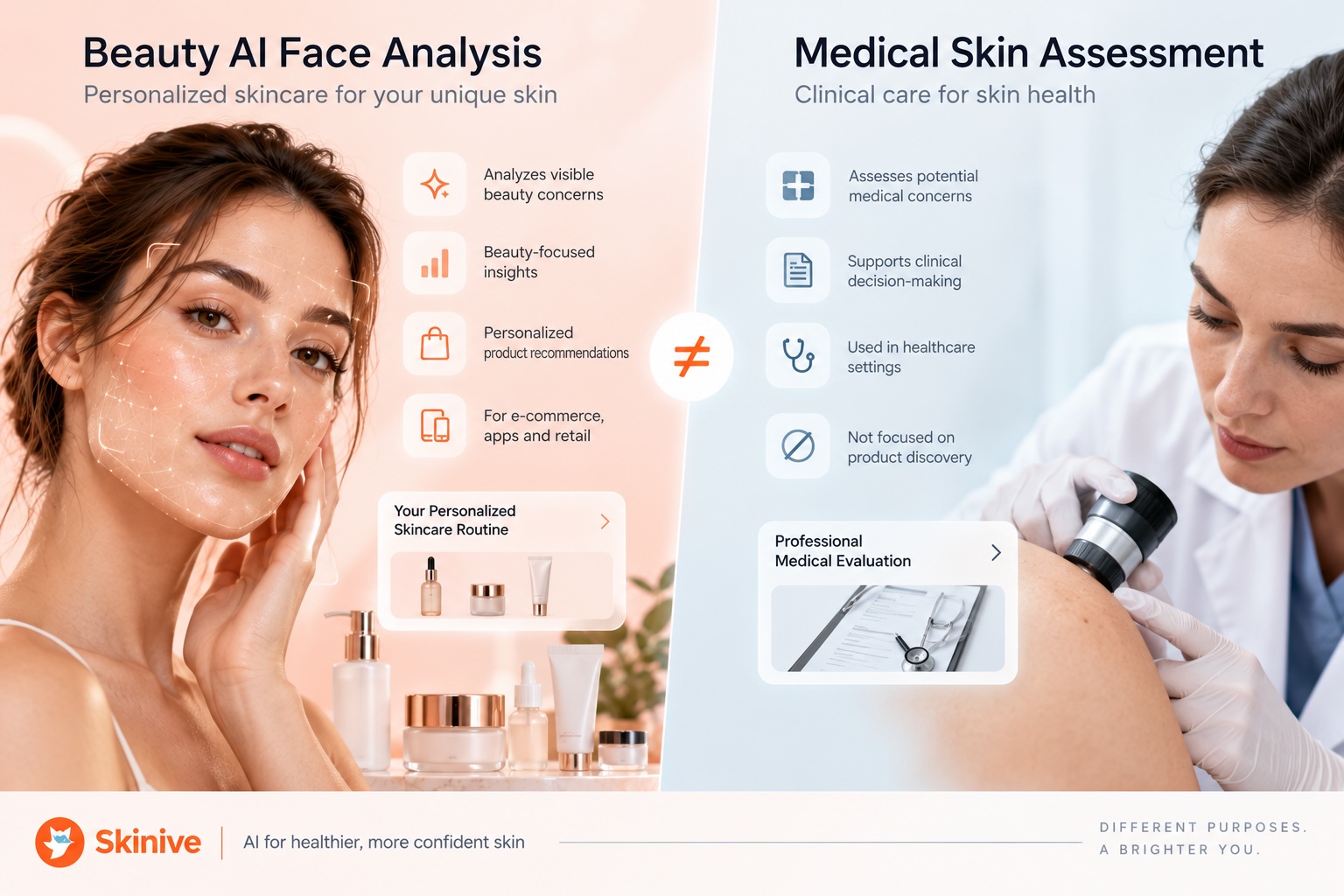
| Beauty AI Face Analysis | Medical Skin Assessment | |
|---|---|---|
| Primary purpose | Cosmetic personalization and beauty product discovery | Health-related or clinical assessment |
| Typical focus | Supported visible cosmetic characteristics | Medical concerns, depending on the regulated solution |
| Customer output | Beauty-focused insights and personalization | Medical or clinical information, depending on the product |
| Typical environment | Beauty websites, apps and cosmetics retail | Healthcare and regulated medical workflows |
| Product discovery | Can connect with cosmetics and skincare catalogs | Not the primary purpose |
| Skinive product | Skinive Face Scanner | Separate Skinive medical solutions |
For Skinive, this separation is intentional.
Skinive Face Scanner belongs to the beauty and cosmetics experience. Skinive’s medical solutions are separate products with a different purpose.
Keeping this boundary clear prevents a cosmetic result from being interpreted as a medical diagnosis.
Why Does Image Quality Matter in AI Face Analysis?
Computer vision can only work with the visual information available in the images it receives.
If important facial areas are difficult to see because of poor lighting, movement, framing, obstruction, or an incorrect angle, the image provides less useful visual information for analysis.
A good capture experience should therefore help users:
- Position their face clearly within the camera frame
- Use adequate and reasonably even lighting
- Minimize movement and excessive blur
- Follow the requested facial angles
- Keep relevant facial areas visible
- Understand when another image needs to be captured
The objective is not to teach customers photography.
The interface should make suitable image capture feel like a natural part of the beauty experience.
Why Does Skinive Use Front, Left, and Right Facial Views?
A face is three-dimensional, while an individual photograph captures only one perspective.
Skinive Face Scanner uses front, left, and right facial images to provide visual coverage from multiple angles.
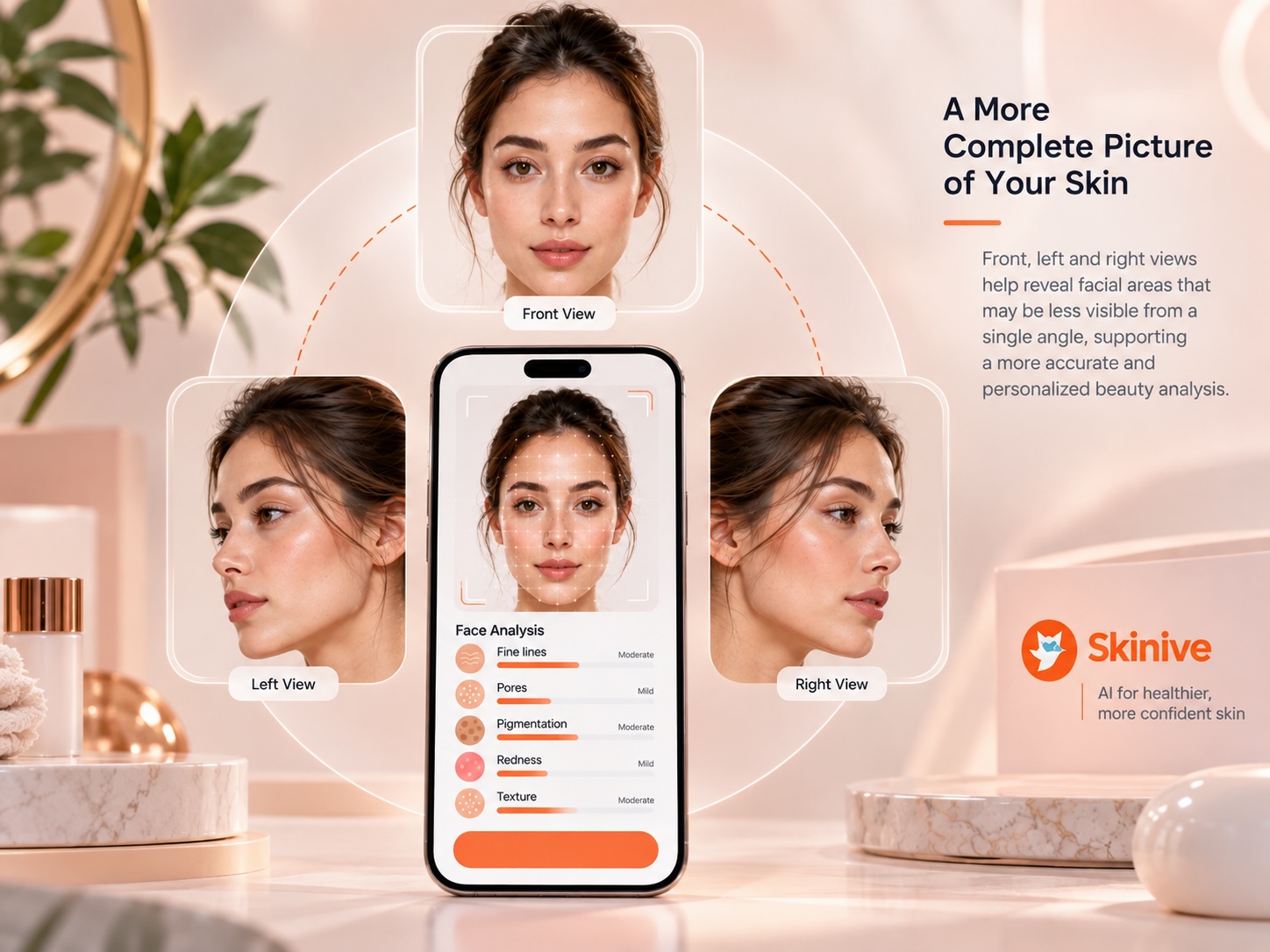
A frontal image provides a direct view of the face, while the left and right views expose areas that may be less visible from the front alone.
For customers, however, the experience should still feel simple.
The interface should clearly indicate which view is required, guide the user through capture, and move naturally into analysis and results.
The technical process can be sophisticated without making the customer journey complicated.
From AI Face Analysis to Personalized Skincare
Once analysis is complete, the natural customer question is:
What should I do with this information?
This is where AI face analysis can become part of personalized skincare.
Supported visible concerns can serve as inputs into product discovery. Instead of presenting every product in a skincare assortment equally, a beauty business can use relevant facial insights as one signal for narrowing the customer’s journey.
For example, visible concerns related to pores, pigmentation, fine lines, redness, blackheads, or texture can become starting points for exploring relevant product categories or products.
The journey becomes:
Capture → Analysis → Understandable Beauty Insights → Relevant Products → Product Discovery
Skinive Face Scanner can connect supported face-analysis results with products from a beauty brand or retailer’s own skincare catalog.
For a deeper look at how product recommendations work, see the dedicated resource on AI skincare recommendations.
How Does Product Matching Fit Into Face Analysis?
Face analysis and product recommendation are related, but they are not the same process.
Face analysis provides information about supported visible cosmetic characteristics.
The recommendation layer uses that information to help connect customers with relevant products from the beauty business’s assortment.
Skinive Face Scanner can work with a business’s existing skincare catalog. Product information can be supplied in CSV or XML format and synchronized as the assortment changes.
Rather than reproducing the complete catalog-integration process here, see AI Face Scanner for E-Commerce: How to Personalize Skincare Shopping for a more detailed explanation of catalog-based product discovery.
Where Can AI Face Analysis Be Used?
The underlying face-analysis concept can support different beauty customer journeys.
| Channel | Role of Face Analysis | Typical Next Step |
|---|---|---|
| E-commerce | Add visual personalization to online product discovery | Explore relevant products |
| Beauty or skincare app | Add face analysis to a mobile beauty journey | Continue personalized discovery |
| Physical beauty retail | Support self-service or advisor-assisted experiences | Explore products in store |
| Omnichannel beauty | Provide a common visual-personalization layer across touchpoints | Continue across channels |
The interface should be adapted to the context.
An online shopper, mobile-app user, and customer standing at a beauty counter may use the same underlying Face Scanner concept for different reasons.
AI Face Analysis and Skincare Quizzes Collect Different Information
AI face analysis and skincare quizzes should not automatically be treated as competing approaches.
They collect different types of information.
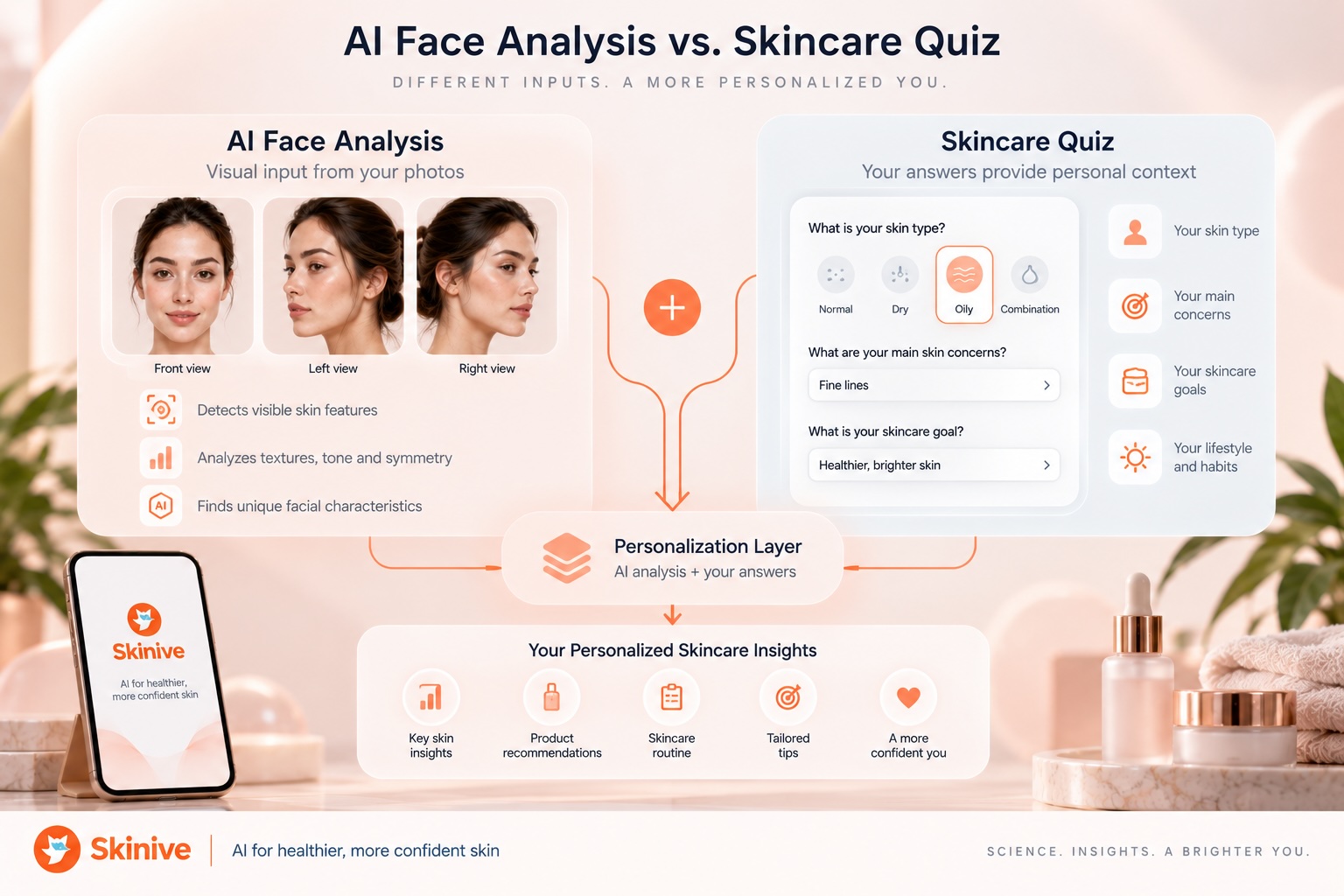
| AI Face Analysis | Skincare Quiz | |
|---|---|---|
| Primary input | Facial images | Customer answers |
| Visible cosmetic characteristics | AI-assisted visual evaluation | Self-reported |
| Preferences | Not visible from an image | Can be collected directly |
| Routine and habits | Not determined from facial images | Can be collected directly |
| Customer goals | Limited to what the customer provides elsewhere | Can be asked directly |
| Can support personalization | Yes | Yes |
Face analysis contributes visual information. A quiz contributes customer-provided context.
For some beauty experiences, combining these inputs may provide a richer basis for personalization than relying on either one alone.
For a detailed comparison, see AI Face Scanner vs. Skincare Quiz.
What Makes an AI Face Analysis Experience Useful?
The quality of a beauty face-analysis experience depends on more than the underlying AI model.
Customers interact with the entire journey.
Clear Purpose
Users should understand why facial images are being captured and what the beauty experience is designed to provide.
Simple Image Capture
Instructions should make front, left, and right image capture easy to follow.
Understandable Results
Results should use customer-friendly beauty language rather than unnecessary technical terminology.
Relevant Information
The interface should prioritize useful information rather than overwhelming customers with excessive metrics.
Actionable Next Steps
Analysis should lead somewhere useful, such as relevant product discovery or another personalized beauty experience.
Clear Beauty Boundary
Cosmetic analysis should not be presented as medical diagnosis.
Appropriate Customer Context
Facial images cannot reveal preferences, routines, budgets, product formats, or every customer goal. Other inputs can complement visual analysis when needed.
What Should Beauty Businesses Evaluate When Choosing AI Face Analysis Technology?
Businesses should evaluate the entire customer and technical experience rather than comparing solutions only by the number of supported concerns.
Important questions include:
- Which visible cosmetic characteristics are supported?
- How are facial images captured?
- How many views are required?
- How does the experience guide users through capture?
- How are results explained to customers?
- Can analysis connect with the business’s own skincare assortment?
- Which integration options are currently available?
- Can the technology support the intended beauty channels?
- Which analytics are provided by the Face Scanner platform?
- How are privacy and customer communication handled?
- Is the beauty-versus-medical boundary clear?
- Can the implementation support the expected catalog and usage scale?
The right technology should fit both the customer’s beauty journey and the business’s technical environment.
Skinive Face Scanner Integration Options
Skinive provides several current integration options for beauty businesses.
| Integration | Status | Typical Use |
|---|---|---|
| Web Widget | Available | Ready-to-use Face Scanner experience for websites |
| Web SDK | Available | More customized web and web-based implementations |
| API | Available | Custom workflows and deeper system integration |
| Native iOS SDK | Planned | Native iOS implementations |
| Native Android SDK | Planned | Native Android implementations |
The ready-to-use Web Widget can be launched quickly, while the Web SDK and API provide more flexibility for businesses building Face Scanner into their own customer journey.
Native iOS and Android SDKs are planned rather than currently available.
How Should Businesses Measure an AI Face Analysis Experience?
Measurement should distinguish between metrics available directly from Skinive and metrics generated by the business’s own website, app, commerce platform, or retail systems.
Skinive’s dashboard provides statistics for:
- Scans
- Users
- Product clicks
- Sales conversions
Businesses may combine these with their own analytics to evaluate other parts of the customer journey, such as entry-point performance, add-to-cart behavior, repeat engagement, app usage, or store outcomes.
This distinction matters because not every commercial metric belongs to the Face Scanner itself.
The useful question is whether face analysis contributes to a customer journey that moves from engagement to relevant product discovery and, where appropriate, conversion.
Privacy, Transparency, and Customer Trust
Facial images require clear customer communication.
Users should understand why images are being captured, what the analysis is intended to do, and where they can review relevant privacy information.
Beauty businesses should also evaluate the privacy and compliance requirements of their particular implementation, including how facial images and related customer information fit into their own systems and customer journey.
Trust also depends on accurate claims.
A beauty Face Scanner should communicate supported cosmetic analysis as cosmetic analysis and should not imply that its beauty results constitute a medical diagnosis.
The Role of AI Face Analysis in Personalized Beauty
AI face analysis is most useful when it becomes an input into personalization rather than an isolated novelty.
Visual analysis contributes information about supported visible cosmetic characteristics.
Other sources can contribute information that facial images cannot provide, including preferences, routines, goals, previous purchases, browsing behavior, or other customer context available to the beauty business.
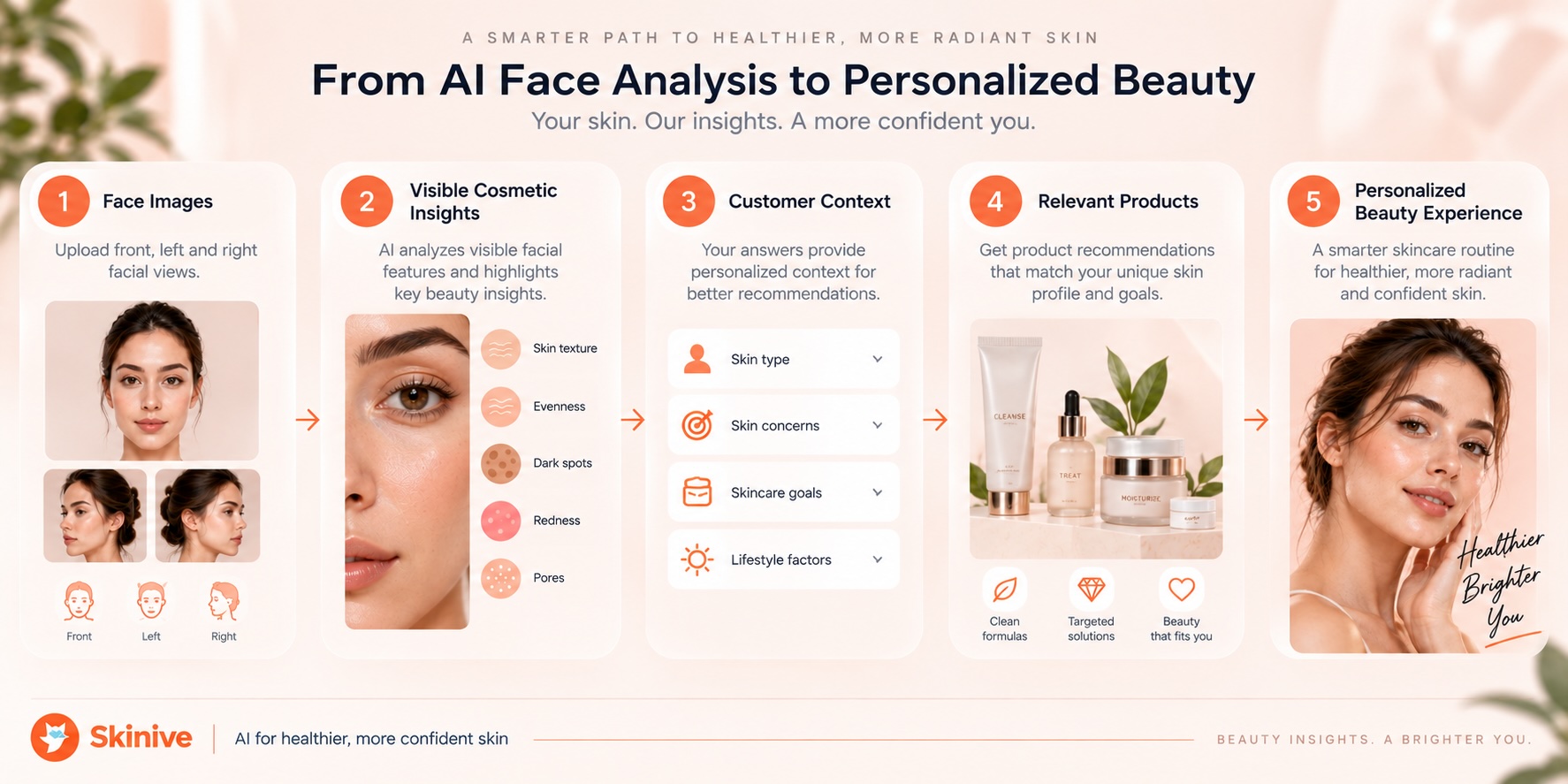
Together, these inputs can support a broader personalization journey:
Understand Visible Concerns → Add Customer Context → Discover Relevant Products → Continue the Beauty Journey
For beauty brands and retailers, the opportunity is therefore larger than displaying an AI-generated result.
The goal is to use visual analysis as one useful personalization layer within a coherent customer experience.
Related Resources
- AI Face Scanner for E-Commerce: How to Personalize Skincare Shopping
- AI Face Scanner for Beauty & Skincare Apps: Integration and Use Cases
- AI Face Scanner for In-Store Beauty Retail: Personalized Beauty Consultations at the Point of Sale
Turn AI Face Analysis Into a Personalized Beauty Experience
Move from facial images to understandable beauty insights and relevant skincare product discovery across digital and physical customer journeys.