
1. Scientific Evidence Overview
Advancing AI-Powered Skin Analysis Through Scientific Research and Validation
Skinive is a European digital health technology company specializing in artificial intelligence for skin image analysis. Our proprietary AI technology is developed to support skin health awareness, documentation, and monitoring by analysing visible skin characteristics in smartphone photographs.
Since 2020, Skinive has continuously advanced its technology through AI development, dermatologist-annotated datasets, systematic performance validation, scientific research, and clinical assessments.
Our scientific evidence base combines internal technical validation, independent clinical evaluation, peer-reviewed research, and extensive real-world experience, providing complementary insights into the technology’s performance, capabilities, and limitations.
Key Scientific Highlights
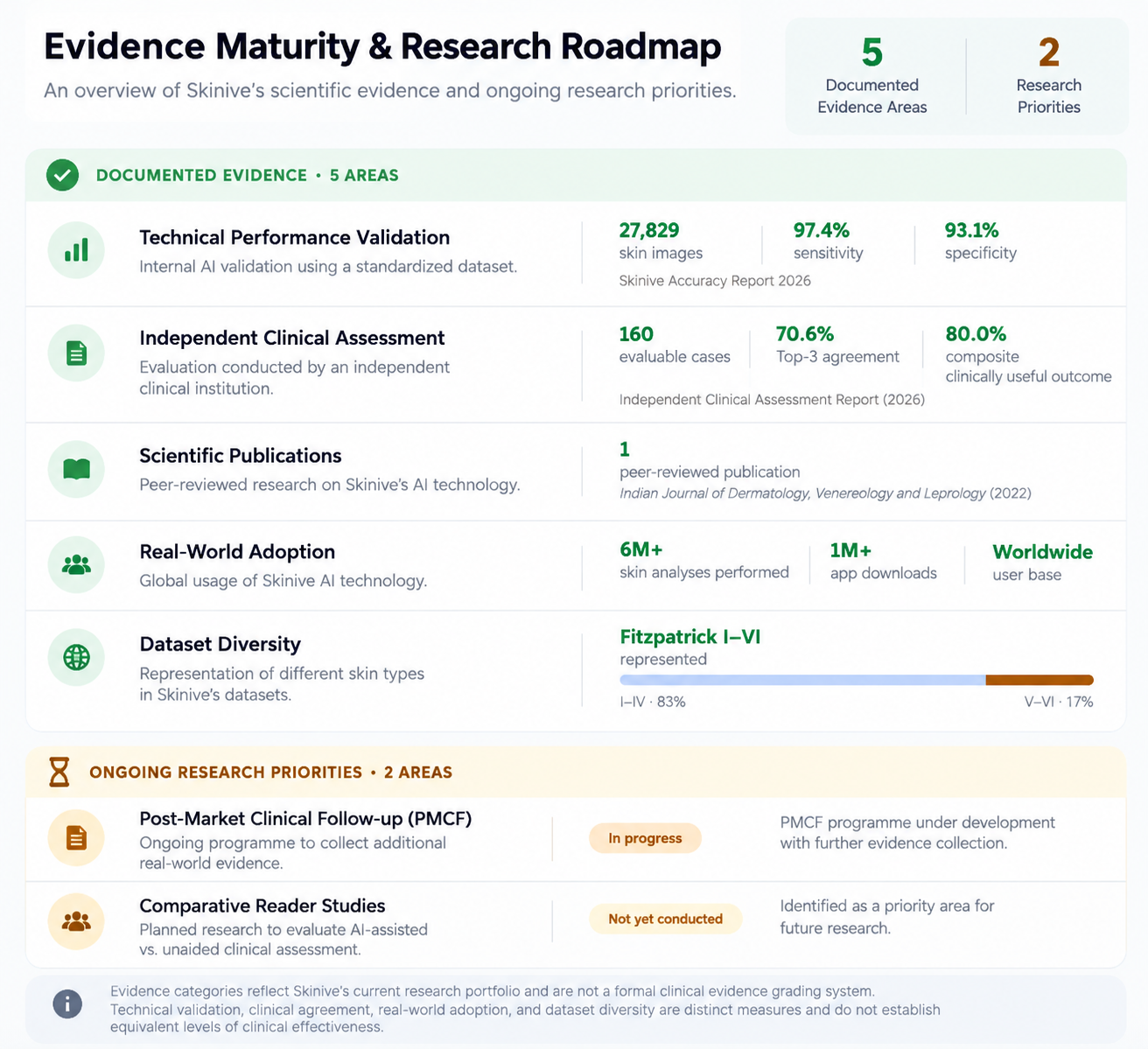
- 27,829 skin images evaluated in the 2026 internal AI validation.
- 97.4% sensitivity and 93.1% specificity achieved under defined internal validation conditions.
- 160 clinical cases evaluated in an independent clinical assessment, with 70.6% Top-3 agreement and an 80.0% composite clinically useful outcome.
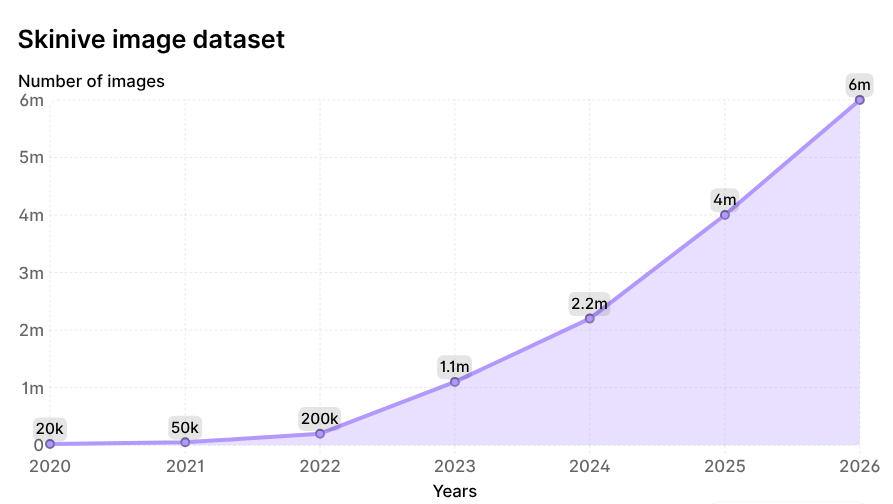
- 250,000 dermatologist-annotated images used in AI model development.
- 6 million+ skin analyses performed worldwide using Skinive technology.
- CE-marked Class I medical device under Regulation (EU) 2017/745 (MDR).
Performance results reflect different evaluation methods and endpoints. Internal validation metrics should not be interpreted as independently established diagnostic accuracy, while the composite clinically useful outcome is not a measure of diagnostic accuracy.
Our Commitment to Scientific Transparency
Skinive is committed to the responsible development of AI-powered skin analysis technology. We continuously evaluate algorithm performance, review emerging scientific evidence, and assess the limitations of AI-based image analysis.
This Scientific Evidence Hub provides an overview of our validation results, clinical assessments, scientific publications, and regulatory status, with references to supporting documentation.
Skinive technology is intended to support skin health awareness and monitoring, not to replace professional medical evaluation or provide independent medical diagnoses.
2. Clinical Evidence at a Glance
Key Findings from Skinive’s Scientific and Clinical Evaluations
Skinive’s scientific evidence combines internal AI performance validation, independent clinical assessment, and real-world technology usage. Each provides complementary insights into the capabilities and limitations of AI-powered skin image analysis.
Key Scientific Results
| Evidence | Key Result | Evaluation |
| Internal AI Validation | 27,829 images | Standardized validation dataset (2026) |
| Sensitivity | 97.4% | Internal technical validation |
| Specificity | 93.1% | Internal technical validation |
| Independent Clinical Assessment | 160 cases | Clinical evaluation of complex skin lesions |
| Top-3 Agreement | 70.6% | Agreement with clinical reference findings |
| Clinically Useful Composite | 80.0% | Study-specific composite outcome |
Understanding the Evidence
Internal Technical Validation: The validation dataset comprised 27,829 dermatological images sourced from dermatologists and Skinive’s clinical partners. These images were excluded from model training and used to evaluate AI performance under standardized testing conditions.
Independent Clinical Assessment: A separate clinical evaluation assessed agreement between Skinive AI classifications and clinical reference findings in 160 complex skin lesion cases.
These evaluations use different methodologies and endpoints. Their results are not directly comparable and should not be interpreted as independently established diagnostic accuracy.
3. AI Performance & Technical Validation
Evaluating AI Performance Through Standardized Testing
Skinive evaluates its AI models using a standardized validation dataset of 27,829 dermatological images sourced from dermatologists and clinical partners.
The validation images were excluded from model training, enabling consistent performance comparisons across AI model versions developed between 2021 and 2026.
Internal Validation Results — 2026
According to the Skinive Accuracy Report 2026, the latest AI model achieved the following results:
| Performance Metric | Result |
| Sensitivity | 97.4% |
| Specificity | 93.1% |
| Overall Accuracy | 94.2% |
| Precision | 82.2% |
| F1 Score | 89.1% |
| Validation Dataset | 27,829 images |
AI Model Development & Dataset Preparation
Skinive’s AI development process is supported by extensive dermatological image datasets:
- 3.5M+ images reviewed during dataset selection.
- 250,000 dermatologist-annotated images selected for AI model development.
- 27,829 separate validation images used to evaluate algorithm performance.
Dermatologist annotations and standardized validation support the continuous development and technical evaluation of Skinive’s AI technology.
Interpretation & Limitations
These results represent internal technical validation, not independent clinical diagnostic validation.
Performance may vary depending on image quality, skin characteristics, and the conditions being evaluated. The reported sensitivity and specificity are aggregate metrics and should not be interpreted as disease-specific diagnostic accuracy, including melanoma or skin cancer detection.
Source: Skinive Accuracy Report 2026
4. Independent Clinical Assessment
Clinical Evaluation of Skinive AI in an Oncology-Enriched Patient Population
Skinive’s underlying AI technology was evaluated in a clinical assessment conducted by an independent clinical institution unaffiliated with Skinive.
The study focused on a highly selective population with predominantly suspected malignant and precancerous skin lesions, including melanoma, basal cell carcinoma, squamous cell carcinoma, Bowen’s disease, and atypical melanocytic lesions. Common benign conditions were minimally represented.
Study Methodology
Of 241 examinations, 160 cases with complete AI results were included in the primary analysis. Clinical reference findings were established independently of AI-generated results using:
- Histopathology: 117 cases (73.1%).
- Cytology: 22 cases (13.8%).
- Dermatologist assessment: 21 cases (13.1%).
Overall, 86.9% of cases had histopathological or cytological reference findings.
Clinical Assessment Results
| Evaluation Metric | Result |
| Top-1 Agreement | 54.4% |
| Top-3 Agreement | 70.6% |
| Disease-Group Agreement Beyond Top-3 | 3.8% |
| Referral-Category Agreement Beyond Top-3 | 5.6% |
| Composite Clinically Useful Outcome | 80.0% |
The 80.0% composite outcome (128/160 cases) combines Top-3 agreement (113 cases), broader disease-group agreement (6 cases), and referral-category agreement (9 cases). It represents a study-specific measure of potential clinical usefulness, not diagnostic accuracy.
Interpretation & Limitations
The oncology-enriched sample, limited representation of common benign lesions, relatively small sample size, and exclusion of 81 examinations without complete AI results limit the generalizability of these findings.
This research evaluated Skinive’s underlying AI technology. Its results do not establish additional diagnostic claims or intended uses for commercially available Skinive products.
5. Scientific Research & Publications
Advancing AI Dermatology Through Scientific Research
Skinive’s AI technology is supported by scientific research in machine learning, computer vision, and dermatological image analysis.
Our evidence base combines peer-reviewed research, internal algorithm validation, and independent clinical assessments to support the ongoing development and evaluation of our technology.
Peer-Reviewed Publication
Dynamics of the Neural Network Accuracy in the Context of Modernization of the Algorithms of Skin Pathology Recognition. Indian J Dermatol. 2022 May-Jun;67(3):312. doi: 10.4103/ijd.ijd_1070_21. PMID: 36386072; PMCID: PMC9644746.
Sokolov K, Shpudeiko V.
This publication explores the application of artificial intelligence to dermatological image analysis and contributes to the scientific foundation of Skinive’s technology.
Preprints & Non-Peer-Reviewed Research
Skinive also shares research findings through scientific preprint platforms, including SSRN, to make emerging evidence accessible before formal journal peer review.
1. Dynamics of the Neural Network Accuracy in the Context of Modernization of the Algorithms of Skin Pathology Recognition (November 30, 2021). Available at SSRN. doi: dx.doi.org/10.2139/ssrn.3974784. Sokolov K, Shpudeiko V.
2. Artificial intelligence in solving dermatological problems. Dermatology Review/Przegląd Dermatologiczny. 2022;109(5):361-367. doi: 10.5114/dr.2022.125685. Sokolov K, Shpudeiko V, Sidaruk H.
3. Application of artificial intelligence algorithms in pediatric dermatology. Eur. J. Pediat. Dermatol. 2023; 33 (3):135-7. doi: 10.26326/2281-9649.33.3.2464. Sokolov K, Shpudeiko V, Sidaruk H, Koval M.
Preprints and non-peer-reviewed reports have not undergone formal journal peer review. Their findings should be interpreted as preliminary research evidence.
Technical & Clinical Research Reports
Skinive AI Accuracy Report 2026
Internal technical validation involving 27,829 dermatological images.
Skinive AI Accuracy Report 2022
Internal technical validation involving 25,688 dermatological images.
Ongoing Scientific Research
Skinive continues to collaborate with dermatologists and clinical institutions to evaluate AI performance, improve skin image analysis, and investigate the technology’s capabilities and limitations.
6. Real-World Experience & Global Adoption
Trusted by Users and Healthcare Partners Worldwide
Beyond scientific validation, Skinive has gained extensive real-world experience through consumer applications and professional healthcare integrations.
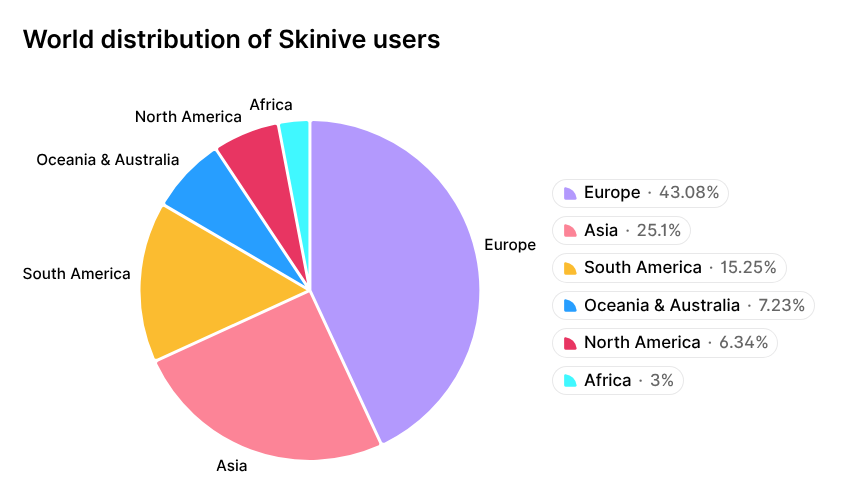
Our AI technology is used internationally to support skin health awareness, monitoring, and digital health services.
Skinive in Numbers
| Key Metric | Global Reach |
| App Downloads | 1M+ |
| AI Skin Analyses Performed | 6M+ |
| Markets | Worldwide |
| Applications | Consumer & Professional Healthcare |
Real-World Applications
Skinive technology supports a range of digital health use cases, including:
- Consumer Skin Health: Helping individuals document and monitor visible skin changes.
- Healthcare Professionals: Supporting structured skin image assessment and documentation.
- Digital Health Platforms: Enabling partners to integrate AI-powered skin analysis into their services.
Continuous Improvement
Real-world experience helps Skinive identify usability challenges, improve image analysis workflows, and guide further research and technology development.
Adoption figures reflect product usage and market reach, not independently verified clinical effectiveness.
Real-World Pilot Deployments
Evaluating Skinive AI in Healthcare and Community Settings
Beyond technical and clinical validation, Skinive participates in real-world pilot projects to evaluate the practical integration of AI-powered skin analysis into healthcare workflows and community health initiatives.
🇫🇷 France — Pharmacy-Based Skin Health Assessment
In 2026, Skinive MD entered pilot testing at Pharmacie Notre-Dame in Roquefort-les-Pins, France, combining AI-assisted skin image analysis with FireFly Pro digital dermoscopy.
Approximately 50 participants have taken part in the initial phase, with plans to expand the pilot to around 300 participants.
The project explores how pharmacists can support skin health awareness and facilitate referrals to medical specialists. Clinical diagnosis remains the responsibility of qualified healthcare professionals.
🇲🇿 Mozambique — Skin Health Support for People with Albinism
In partnership with Kanimambo, an organization supporting people with albinism in Mozambique, Skinive is exploring the use of AI-assisted skin analysis in community health initiatives.
The pilot focuses on skin health awareness, documentation, and monitoring in a population with elevated skin cancer risk and limited access to specialist dermatological care.
Pilot Status & Evidence
Both initiatives represent real-world pilot deployments. Their outcomes are being evaluated and should not be interpreted as established evidence of clinical effectiveness or diagnostic accuracy.
7. Regulatory Status & Intended Purpose
EU MDR Compliance & Responsible Use
Skinive App is a CE-marked Class I medical device under Regulation (EU) 2017/745 (EU MDR).
The device is manufactured by Skinive LTD (Malta), a subsidiary of Skinive B.V. (Netherlands), and is registered in the European Database on Medical Devices (EUDAMED).
Regulatory Information
| Regulatory Detail | Information |
| Legal Manufacturer | Skinive LTD, Malta |
| Regulatory Framework | Regulation (EU) 2017/745 (EU MDR) |
| Medical Device Classification | Class I |
| Conformity Assessment | Manufacturer’s EU Declaration of Conformity |
| EUDAMED Manufacturer SRN | MT-MF-000047900 |
| CE Marking | CE-marked |
Intended Purpose
Skinive App is intended to support skin health awareness, documentation, and monitoring through AI-assisted analysis of smartphone images of visible skin lesions and conditions.
The application provides informational results to help adult users better understand and track visible skin changes.
Skinive App does not provide medical diagnoses, prescribe treatments, or replace professional medical evaluation.
Regulatory Scope of Research
Skinive’s scientific research also includes evaluations of its underlying AI technology under experimental and clinical research conditions.
Research findings do not automatically establish additional intended uses or regulatory claims for commercially available Skinive products.
8. Safety, Limitations & Responsible Use
Understanding the Capabilities and Limitations of Skinive AI
Skinive is committed to the responsible development and use of AI-powered skin analysis technology. While AI can support skin health awareness and monitoring, its results must be interpreted within the technology’s intended purpose and known limitations.
Key Safety Considerations
- Not a Medical Diagnosis: Skinive App provides informational results and does not diagnose skin diseases or replace professional medical evaluation.
- AI Limitations: Results may be inaccurate or incomplete. Skinive may fail to recognize certain conditions or produce incorrect classifications.
- Image Quality: Lighting, focus, camera quality, and image positioning can affect analysis results.
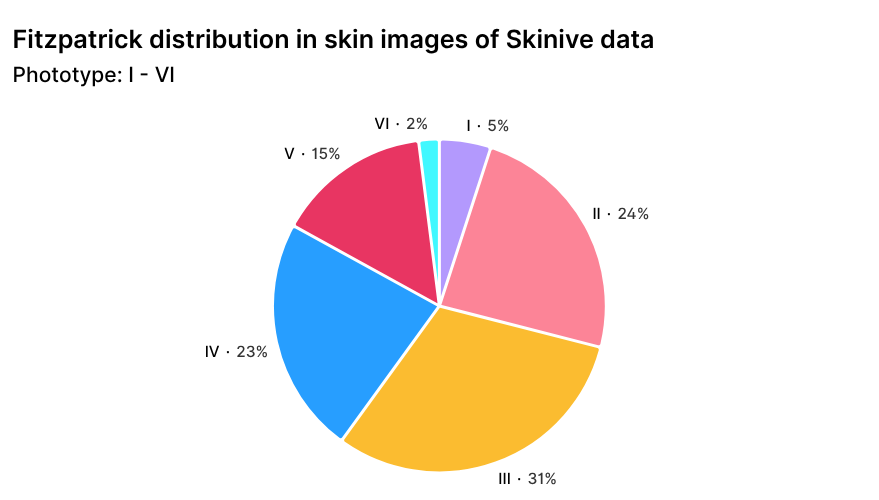
- Individual Variability: AI performance may vary depending on skin characteristics, lesion appearance, and the conditions being evaluated.
- Professional Consultation: Users should seek medical advice for suspicious, changing, or persistent skin lesions, regardless of AI-generated results.
Responsible AI Development
Skinive supports responsible AI development through dermatologist-annotated datasets, technical validation, clinical research, and ongoing performance evaluation.
AI-generated results should not be used as the sole basis for medical decisions or to delay professional healthcare.
9. Integrate Skinive AI into Your Product
Bring AI-Powered Skin Analysis to Your Healthcare Platform
Turn scientific innovation into practical digital health solutions with Skinive API.
Integrate Skinive’s proprietary AI technology into your healthcare application, telemedicine platform, or digital health service without developing your own skin analysis algorithms.
Why Choose Skinive API?
- Research-Driven AI: Technology supported by scientific research, technical validation, and clinical evaluation.
- Easy Integration: REST API designed for integration into existing digital platforms.
- Flexible Applications: Suitable for digital health platforms, telemedicine services, and healthcare applications, subject to applicable intended-use and regulatory requirements.
- Scalable Infrastructure: Built to support growing analysis volumes and business needs.
Build with Skinive AI
Explore our integration options, technical documentation, and partnership opportunities.