
An AI face scanner for in-store beauty retail can turn a digital touchpoint into a personalized beauty consultation at the point of sale. Customers capture facial images, AI evaluates supported visible cosmetic concerns, and the results can guide them toward relevant skincare products from the retailer’s own assortment. For beauty retailers, this creates a practical connection between visual personalization, beauty-advisor support, product discovery, and the physical shopping experience.
Key Takeaways
- AI face scanning can support personalized beauty consultations in cosmetics stores, pharmacies, department stores, brand boutiques, and other beauty retail environments.
- Face scanning can be offered as a self-service experience or incorporated into an advisor-assisted consultation.
- The strongest in-store use case connects supported visible facial concerns with relevant products from the retailer’s actual skincare assortment.
- A useful retail journey is short: capture facial images, review visible beauty concerns, explore relevant products, and continue to the shelf or consultation.
- Skinive Face Scanner can work with a retailer’s own skincare catalog using product data supplied in CSV or XML format.
- Placement matters: consultation counters, skincare departments, brand counters, and dedicated discovery areas can serve different customer needs.
- Success should be measured beyond scan volume through product interactions, advisor usage, sales outcomes, and the wider retail journey.
Why Is In-Store Beauty Retail a Natural Use Case for AI Face Scanning?
Physical beauty retail gives customers something online shopping cannot fully reproduce: immediate access to products, beauty advisors, testers, packaging, and a purchase opportunity in the same environment.
But physical access to products does not automatically make choosing them easier.
A customer may know they want to improve the appearance of pores, fine lines, dark spots, redness, blackheads, or uneven-looking texture but still face dozens or hundreds of possible skincare products.
An AI Face Scanner can add a visual personalization layer at this decision point. Instead of beginning only with shelves, categories, a questionnaire, or a conversation, the customer can use supported visible facial characteristics as another starting point for product discovery.
The technology does not need to replace beauty advisors. In advisor-assisted retail, it can add a consistent digital analysis step while the advisor contributes customer preferences, routine information, budget, product knowledge, and human guidance.
What Is an AI Face Scanner for In-Store Beauty Retail?
An AI face scanner for in-store beauty retail is a computer-vision experience used as part of a physical shopping journey to evaluate supported visible facial beauty characteristics and help guide customers toward relevant skincare products or personalized beauty experiences.
Depending on the retailer’s technical setup and customer journey, face scanning can form part of:
- A beauty advisor-assisted consultation
- A customer-facing self-service experience
- A beauty-counter digital experience
- A suitable smartphone or tablet experience
- A retailer’s digital experience used while the customer is inside the store
The exact device and implementation depend on the retailer’s technical environment. Skinive provides Web SDK and API integration options, while native iOS and Android SDKs are planned.
Skinive Face Scanner is designed for beauty, cosmetics, and personalized skincare applications. It is not intended to diagnose skin diseases or replace consultation with a healthcare professional.
How Does an In-Store AI Beauty Consultation Work?
A successful in-store Face Scanner experience should fit naturally into the existing shopping journey. The goal is not simply to complete a scan, but to help the customer move from visual analysis to a useful next step inside the store.
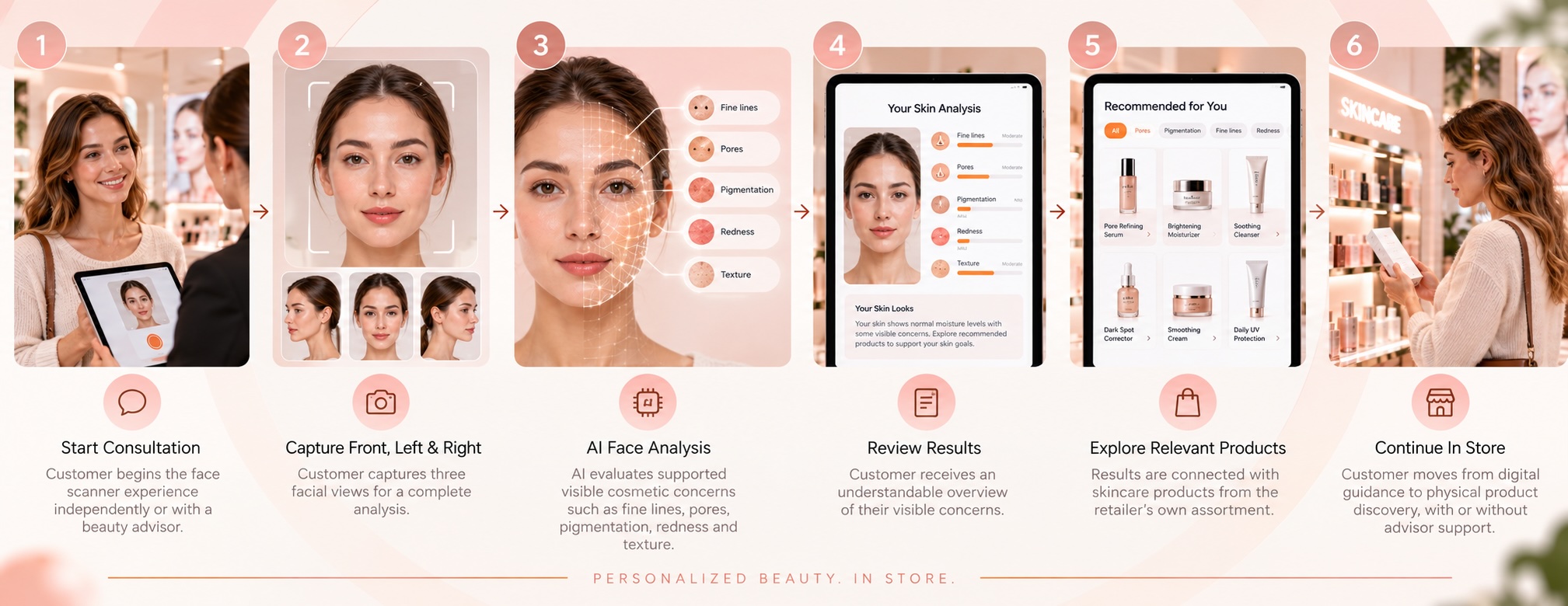
Start the Beauty Consultation
The customer enters the Face Scanner experience independently or with assistance from a beauty advisor.
The purpose should be clear before image capture begins: the experience evaluates supported visible cosmetic characteristics and can help personalize product discovery.
Capture Front, Left, and Right Facial Images
With Skinive Face Scanner, the customer captures front, left, and right facial images.
These different views provide the visual input for the face-analysis experience.
Review Supported Visible Beauty Concerns
AI evaluates supported cosmetic characteristics such as:
- Fine lines and wrinkles
- Visible or enlarged pores
- Blackheads and whiteheads
- Acne-related imperfections and blemishes
- Dark spots and pigmentation
- Redness
- Uneven-looking facial texture
- Other supported visible cosmetic characteristics
The customer receives an understandable beauty-focused result rather than technical AI output.
Continue Independently or With a Beauty Advisor
In a self-service experience, the customer can continue toward relevant product recommendations.
In an assisted consultation, the Face Scanner results can become a starting point for a conversation about skincare goals, preferences, routine, budget, and product format.
Explore Relevant Products
Supported visible concerns can be connected with relevant products from the retailer’s skincare catalog.
This is where face scanning becomes part of the retail journey rather than an isolated technology demonstration.
Move From Digital Guidance to the Physical Store
The final step is specific to in-store retail: helping the customer move from digital recommendations toward products they can explore, compare, discuss with an advisor, or purchase.
The exact connection with store inventory, shelf locations, merchandising, or point-of-sale systems depends on the retailer’s own infrastructure and implementation.
Self-Service vs. Beauty Advisor-Assisted Face Scanning
There is no single correct format for in-store face scanning. The right approach depends on the store format, customer journey, staffing model, and purpose of the experience.
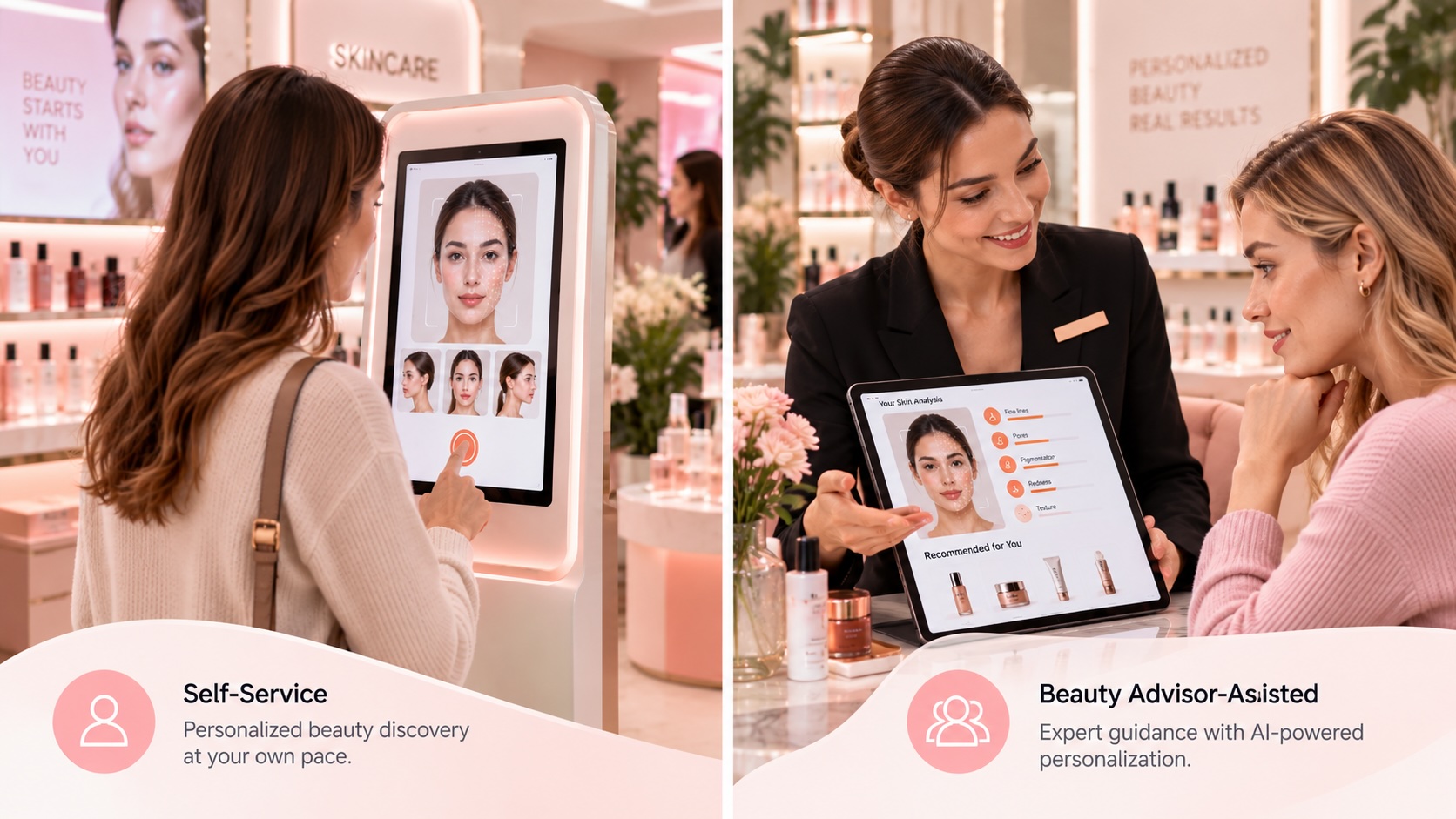
| Model | How It Works | Best Suited For | Main Advantage |
|---|---|---|---|
| Self-service | Customer completes the experience independently | High-traffic stores, discovery areas, interactive retail concepts | Scalable personalized discovery |
| Beauty advisor-assisted | Advisor guides the customer through the experience and discusses results | Premium beauty counters and consultative retail | Human guidance plus AI-supported personalization |
| Customer’s own device | Customer accesses the retailer’s digital experience on a suitable personal device | Retailers seeking a lower-hardware approach | Uses a familiar customer device |
| Hybrid | Customer begins independently and can involve staff when useful | Larger retailers and flexible store concepts | Balances self-service with human assistance |
Different formats can also coexist.
A flagship beauty store may use an advisor-assisted experience at a consultation counter while another location focuses on self-service product discovery.
The important question is not which model is universally better, but which model fits the intended customer moment.
Where Should a Face Scanner Be Placed in a Physical Beauty Store?
The most useful Face Scanner placement is usually where customers already need help making a skincare decision. High foot traffic alone does not necessarily mean high-quality engagement.
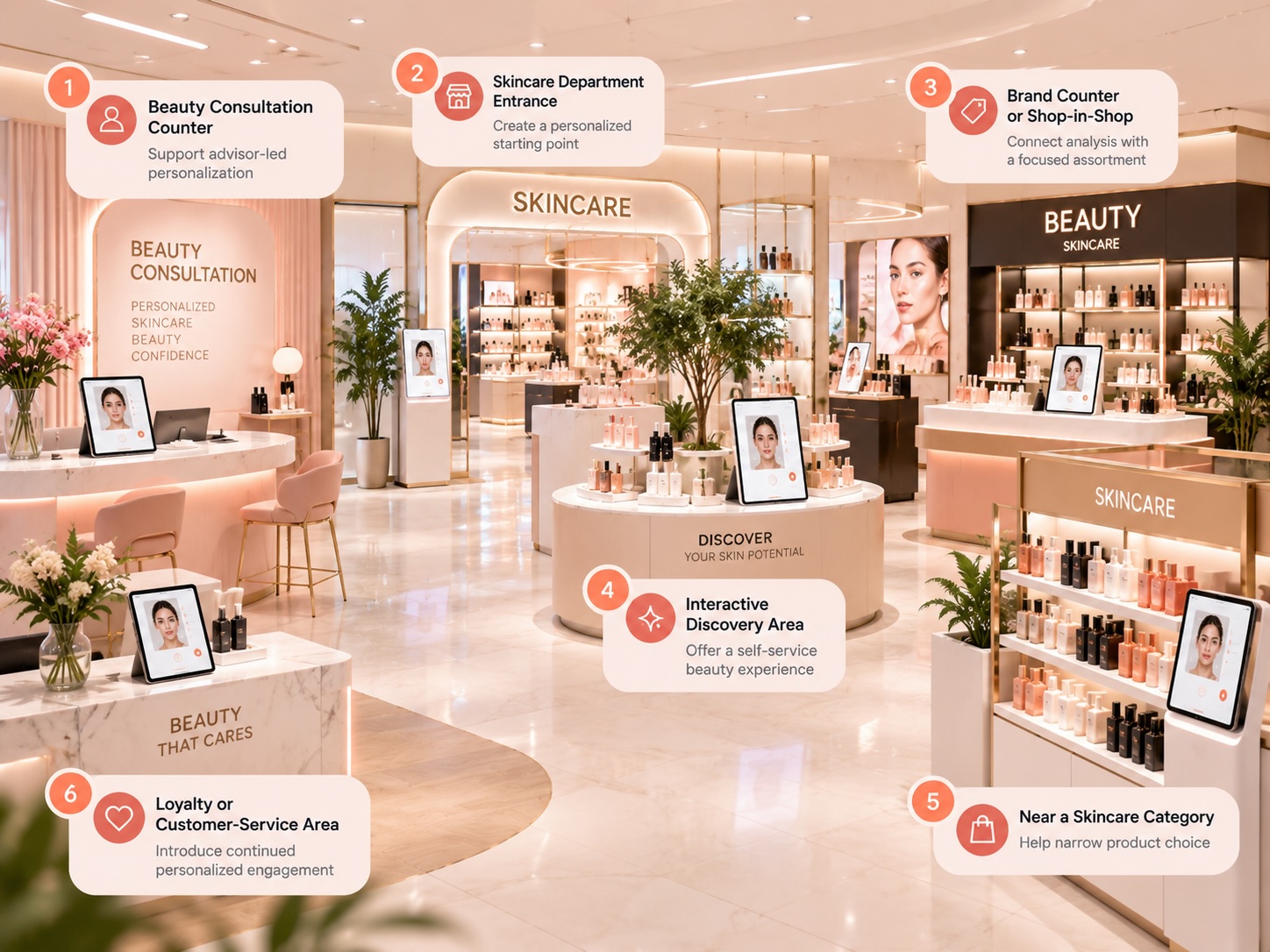
| Store Location | Role of the Face Scanner | Typical Customer Moment |
|---|---|---|
| Beauty consultation counter | Support advisor-led personalization | Customer asks for help choosing skincare |
| Skincare department entrance | Create a personalized starting point | Customer is unsure where to begin |
| Brand counter or shop-in-shop | Connect analysis with a focused assortment | Customer is exploring one brand |
| Interactive discovery area | Offer self-service beauty discovery | Customer wants to explore independently |
| Near a skincare category | Help narrow product choice | Customer is comparing multiple options |
| Loyalty or customer-service area | Introduce continued personalized engagement | Customer is entering a wider loyalty or digital ecosystem |
Retailers should test placement rather than assuming that the busiest location will automatically perform best.
A consultation counter may produce fewer interactions than an entrance display but lead to more meaningful product conversations. A self-service experience near a high-intent skincare category may behave differently from one positioned primarily as an innovation feature.
Placement should therefore be evaluated against the customer behavior the retailer actually wants to encourage.
From Face Analysis to Products on the Shelf
The defining difference between online and in-store face scanning is what happens after the recommendation.
In physical retail, the customer eventually needs to connect digital guidance with real products they can explore inside the store.
A useful journey can look like this:
Face Scan → Visible Beauty Concerns → Relevant Products → Physical Product Discovery → Consultation or Purchase
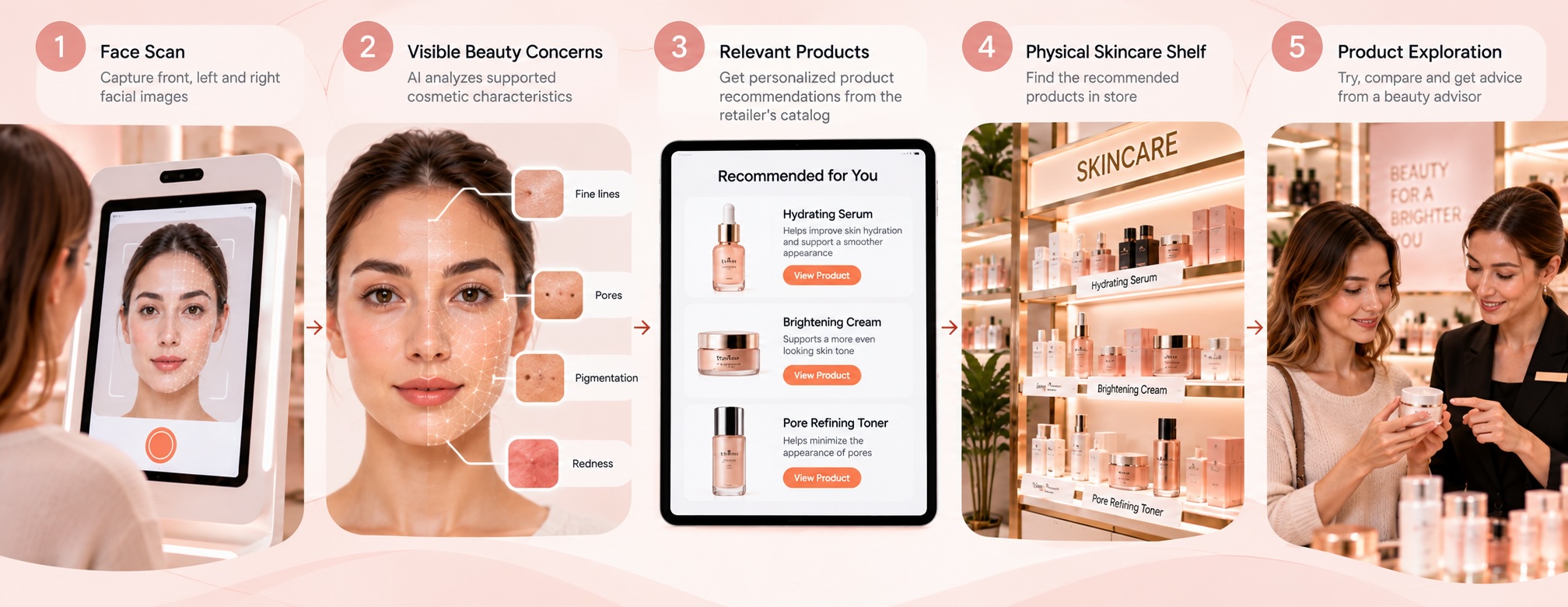
For example, supported results related to visible pores, pigmentation, blackheads, fine lines, redness, or texture can help narrow a large skincare assortment.
Skinive Face Scanner can connect those supported concerns with relevant products from the retailer’s connected catalog.
From that point, the physical retail experience becomes important.
A beauty advisor might discuss the suggested options with the customer. A self-service shopper might continue toward the relevant product category. A retailer may also design its own digital-to-store journey around existing merchandising or retail systems.
Skinive should not be assumed to provide real-time store inventory, shelf-location, or point-of-sale functionality unless those capabilities are separately connected through the retailer’s implementation.
The role of Face Scanner is to help create a more relevant starting point for product discovery; the retailer determines how that recommendation connects with the physical store environment.
How Does Skinive Connect With a Retailer’s Skincare Catalog?
Skinive Face Scanner can work with a retailer’s own skincare catalog rather than relying on a generic product database.
Product data can be supplied in CSV or XML format and synchronized as the assortment changes. Relevant catalog information includes product name, description, ingredients, price, and product-page URL.
For physical retail, the additional consideration is how digital recommendations connect with the retailer’s store environment. Product availability by location, shelf placement, inventory, and point-of-sale processes depend on the retailer’s own retail infrastructure.
For a more detailed explanation of catalog-based product personalization, see AI Face Scanner for E-Commerce: How to Personalize Skincare Shopping.
How Can Beauty Advisors Use an AI Face Scanner?
An AI Face Scanner can function as a consultation aid rather than a replacement for store staff.
The scan can establish a visual starting point, while the advisor adds information that facial analysis alone cannot provide.
A beauty advisor can:
- Introduce the Face Scanner and explain its beauty-focused purpose
- Help the customer follow the facial-image capture process
- Review supported visible cosmetic concerns with the customer
- Ask about skincare goals, preferences, routine, and budget
- Discuss relevant products from the retailer’s assortment
- Help compare different product options
- Continue the interaction toward physical product discovery or purchase
This creates a useful division of roles.
AI contributes visual information about supported cosmetic characteristics. The advisor contributes conversation, context, customer preferences, and product expertise.
For retailers with an established consultation model, this means Face Scanner functionality can be incorporated into the existing advisor workflow rather than creating a completely separate customer journey.
AI Face Scanner vs. Traditional In-Store Beauty Consultation
AI face scanning does not need to replace a traditional beauty consultation. It adds a visual and digital layer that can complement advisor expertise and customer conversation.
| Feature | Traditional Consultation | AI-Assisted Consultation |
|---|---|---|
| Starting point | Conversation and customer description | Conversation plus facial analysis |
| Visible concerns | Observed or described by customer/advisor | Supported concerns evaluated through AI |
| Consultation structure | Depends on advisor and store process | Adds a consistent digital analysis step |
| Product discovery | Advisor knowledge and store assortment | Advisor knowledge plus catalog-linked recommendations |
| Self-service option | Limited | Possible depending on implementation |
| Digital continuity | Depends on retailer systems | Can form part of wider digital beauty experiences |
| Human interaction | Central | Can remain central in advisor-assisted mode |
For many retailers, the relevant question is therefore not whether AI should replace a beauty advisor.
It is how visual AI can support the consultation while preserving the human interaction that makes physical beauty retail valuable.
In-Store Use Cases for Beauty Brands and Retailers
The strongest in-store use cases solve a specific customer or advisor problem rather than introducing technology simply for novelty.
Personalized Skincare Consultations
A beauty counter can use face scanning near the beginning of a consultation to establish which supported visible cosmetic concerns may be relevant to the conversation.
The advisor can then add the customer’s goals, preferences, current routine, and budget before discussing products.
Self-Service Product Discovery
Customers who prefer to explore independently can use face scanning as a personalized entry point into the skincare assortment.
Instead of beginning with an entire category, they can start with supported visible concerns and move toward relevant products.
Product Discovery in Large Assortments
Beauty retailers may carry hundreds or thousands of skincare products.
AI-supported personalization can help narrow that assortment and make the first stage of product discovery more manageable.
Brand Counters and Shop-in-Shop Concepts
A cosmetics brand operating inside a department store or another retailer can connect Face Scanner functionality with its own product assortment.
This can create a focused beauty-tech experience around the brand without requiring customers to navigate the retailer’s entire skincare selection.
Assisted Selling
Store staff can incorporate face scanning into a digital consultation workflow, combining AI-supported visual information with product knowledge and customer preferences.
This is particularly relevant where beauty advisors already play an active role in product selection.
Loyalty and Digital Follow-Up
An in-store consultation can also become an entry point into a longer customer relationship.
Depending on the retailer’s implementation, customers can continue product discovery through its website, beauty app, loyalty ecosystem, or customer account after leaving the store.
For retailers developing app-based customer journeys, see the dedicated resource on AI Face Scanner for Beauty & Skincare Apps.
How Does In-Store Face Scanning Fit an Omnichannel Beauty Strategy?
An in-store Face Scanner does not have to operate as an isolated retail experience.
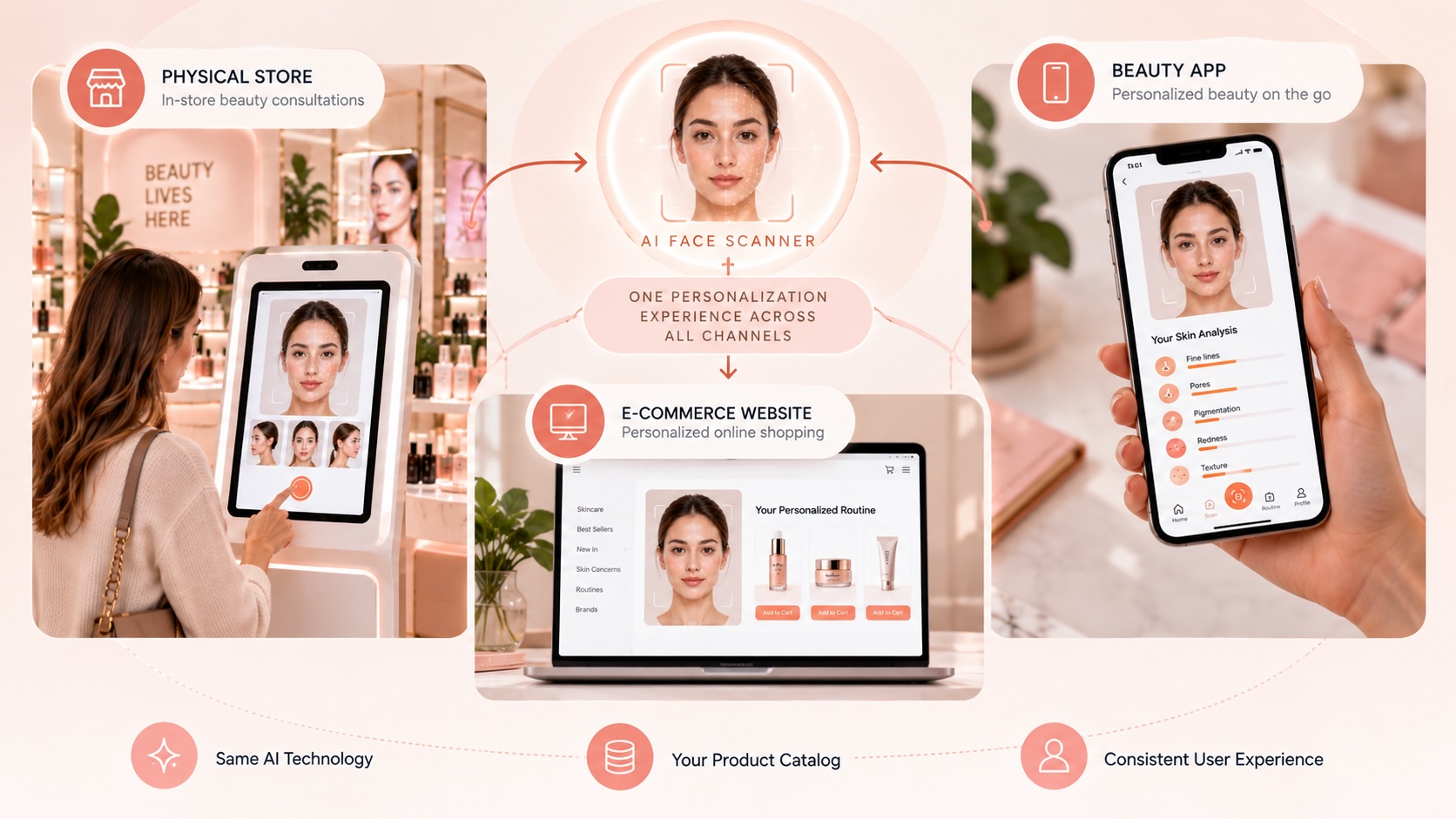
Beauty retailers can extend the same personalization concept across physical stores, e-commerce websites, and mobile beauty experiences while adapting the interface and customer journey to each channel.
In-store experiences may emphasize advisor support and physical product discovery, while other channels serve different customer moments.
For a deeper look at connecting these touchpoints, see the dedicated resource on omnichannel beauty strategy.
What Should Retailers Consider Before Launching an In-Store Face Scanner?
A successful implementation requires more than placing a digital device in a store.
Retailers should define the customer journey, staff role, product connection, privacy approach, and measurement plan before launch.
Important questions include:
- Who will initiate the experience: the customer, a beauty advisor, or both?
- Which suitable device and integration approach will be used?
- Where will the Face Scanner appear in the store?
- What should happen immediately after the scan?
- How will customers understand what the experience does and does not do?
- How will recommendations connect with the retailer’s skincare assortment?
- How will customers move from digital recommendations to physical products?
- Will beauty advisors need training on how to introduce and discuss the experience?
- How will privacy information and facial-image processing be communicated?
- Which metrics will define a successful deployment?
- Should the experience connect with e-commerce, a beauty app, loyalty, or other customer touchpoints?
Defining these decisions before launch makes it easier to evaluate whether Face Scanner functionality is improving the customer journey rather than simply generating interactions.
Privacy and Customer Trust in Physical Stores
Face scanning is a visible customer interaction, so privacy communication should be part of the experience rather than hidden in the background.
Customers should understand why facial images are being captured, what the beauty analysis is intended to do, and where they can review relevant privacy information.
Skinive Face Scanner uses EU-hosted cloud infrastructure and is positioned as GDPR compliant. Retailers should still review the processing, storage, security, consent, and other applicable requirements for their specific implementation as part of their technical and compliance assessment.
The in-store experience should also preserve the boundary between beauty and medicine.
Skinive Face Scanner is intended for cosmetic and personalized skincare applications, not for diagnosing skin diseases.
How Should Retailers Measure an In-Store Face Scanner?
Scan volume alone does not show whether an in-store Face Scanner improves the retail journey.
Measurement should distinguish between Face Scanner activity and the wider store or point-of-sale outcomes that depend on the retailer’s own systems.
| Measurement Layer | Example Metrics | Typical Data Source |
|---|---|---|
| Face Scanner activity | Scans, users, product clicks, sales conversions | Skinive dashboard |
| Store experience | Consultation starts, completion, advisor adoption, self-service usage | Retailer analytics |
| Product interaction | Recommendations viewed, products explored or selected | Skinive and/or retailer systems depending on implementation |
| Retail outcome | POS conversion, basket value, category mix, products purchased | Retailer’s POS and analytics |
| Wider journey | Subsequent web, app, loyalty, or account engagement | Retailer’s digital analytics |
Skinive provides dashboard statistics for:
- Scans
- Users
- Product clicks
- Sales conversions
Other retail-specific measures depend on the retailer’s implementation and analytics infrastructure.
For example, advisor usage, point-of-sale transactions, average order value, basket composition, store-level comparisons, and loyalty engagement would normally require data from the retailer’s own systems.
The goal is not simply to maximize scans. It is to understand whether Face Scanner interactions contribute to useful consultations, product discovery, and commercial outcomes.
Getting Started With Skinive Face Scanner for In-Store Beauty Retail
The best starting point is one clearly defined store journey rather than trying to redesign the entire retail experience at once.
A retailer might begin with an advisor-assisted skincare consultation at selected locations, a self-service experience in a high-intent skincare area, or a focused implementation at a brand counter.
Before launch, the retailer should define:
- The primary customer use case
- Store placement
- Advisor involvement
- The product assortment connected with the experience
- The expected next step after recommendations
- Privacy and customer communication
- The metrics used to evaluate performance
Starting with a focused implementation makes it easier to understand how customers engage, how advisors use the experience, and which store environment is most appropriate before considering wider deployment.
Skinive Face Scanner can connect supported visible facial beauty concerns with products from the retailer’s own catalog, while current Web SDK and API options support integration into digital experiences.
Related Resources
- AI Face Scanner for E-Commerce: How to Personalize Skincare Shopping
- AI Face Scanner for Beauty & Skincare Apps: Integration and Use Cases
- Omnichannel Beauty: One AI Face Scanner Across Web, App and In-Store
Bring Personalized AI Beauty Consultations In Store
Turn facial beauty analysis into a more personalized product-discovery experience at the beauty counter, through self-service retail experiences, or across your physical retail network.