
AI face scanners can support beauty e-commerce conversion by reducing friction between a shopper’s visible beauty concerns and relevant products. Instead of forcing customers to navigate a large skincare assortment on their own, face analysis can provide a personalized starting point and connect supported cosmetic insights with products from the retailer’s catalog.
The commercial value does not come from the scan itself. It comes from what happens next: completing the experience, understanding the results, discovering relevant products and continuing toward a purchase. Actual conversion impact depends on implementation and should be measured rather than assumed.
Key Takeaways
- AI face scanning can reduce uncertainty during skincare product discovery.
- Conversion should be evaluated as a complete funnel from Face Scanner entry to downstream shopping behavior.
- A high number of scans does not necessarily mean the experience contributes to sales.
- The strongest conversion journey minimizes friction between analysis, recommendations and product pages.
- Face Scanner placement should be tested at moments where customers genuinely need help choosing products.
- Skinive provides dashboard analytics for scans, users, product clicks and sales conversions.
- Additional commerce metrics such as add-to-cart behavior depend on the retailer’s own analytics environment.
- Conversion uplift should be established through the retailer’s own measurement and controlled testing where practical.
Why Is Conversion Difficult in Beauty E-Commerce?
Beauty e-commerce combines large assortments with highly personal purchase decisions.
A shopper may encounter dozens or hundreds of cleansers, serums, moisturizers and targeted skincare products while still being unsure where to begin.
Search works well when customers already know what they want.
Filters help narrow products by attributes such as category, brand or price.
Bestsellers show what other customers buy.
But none of these necessarily answers a more personal question:
Which part of this assortment is relevant to me?
An AI Face Scanner creates another path into the catalog.
Instead of beginning with the product assortment, the journey can begin with supported visible cosmetic characteristics and then move toward relevant product discovery.
That change in starting point is where Face Scanner technology can contribute to conversion.
How Can an AI Face Scanner Influence E-Commerce Conversion?
A Face Scanner does not create conversion automatically.
It can influence several points of friction that occur before a purchase.
| Conversion Barrier | Face Scanner Role | What to Evaluate |
|---|---|---|
| Shopper does not know where to start | Creates a personalized discovery entry point | Entry and start behavior |
| Large assortment creates choice overload | Narrows the product-discovery path | Recommendation interaction |
| Shopper is uncertain about visible concerns | Adds AI-assisted visual beauty insights | Results engagement |
| Recommendations feel generic | Connects supported insights with relevant products | Product clicks |
| Analysis becomes a dead end | Creates a route toward product discovery | Product-page continuation |
| Commercial impact is unclear | Connects scanner activity with measurable downstream actions | Sales conversion and retailer analytics |
The important point is that conversion happens across a sequence.
Improving one step while creating friction in another can limit the overall impact.
The Face Scanner Conversion Funnel
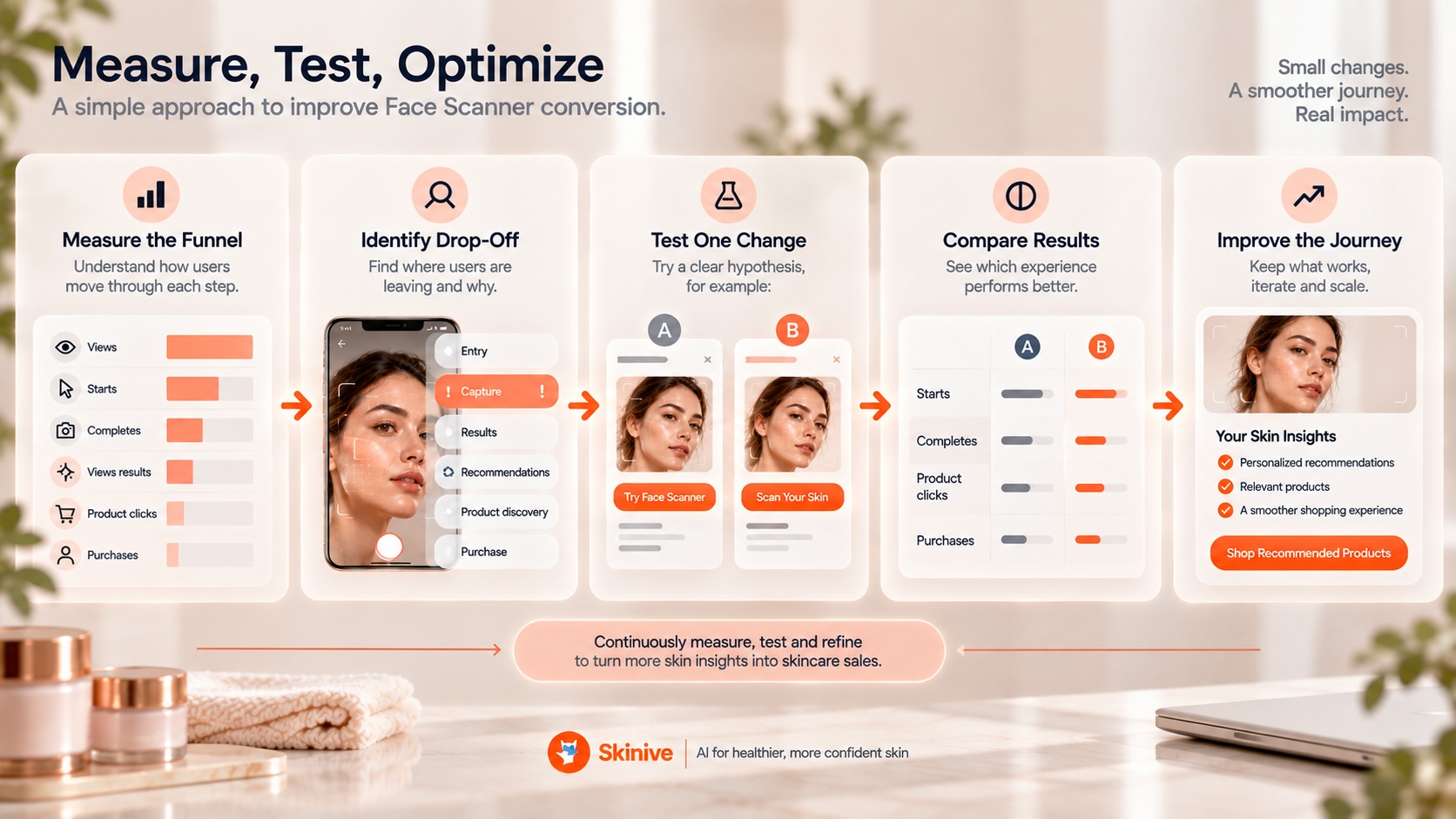
The most useful way to evaluate a Face Scanner in e-commerce is as a funnel.
Entry → Start → Image Capture → Results → Recommendations → Product Discovery → Commerce Action
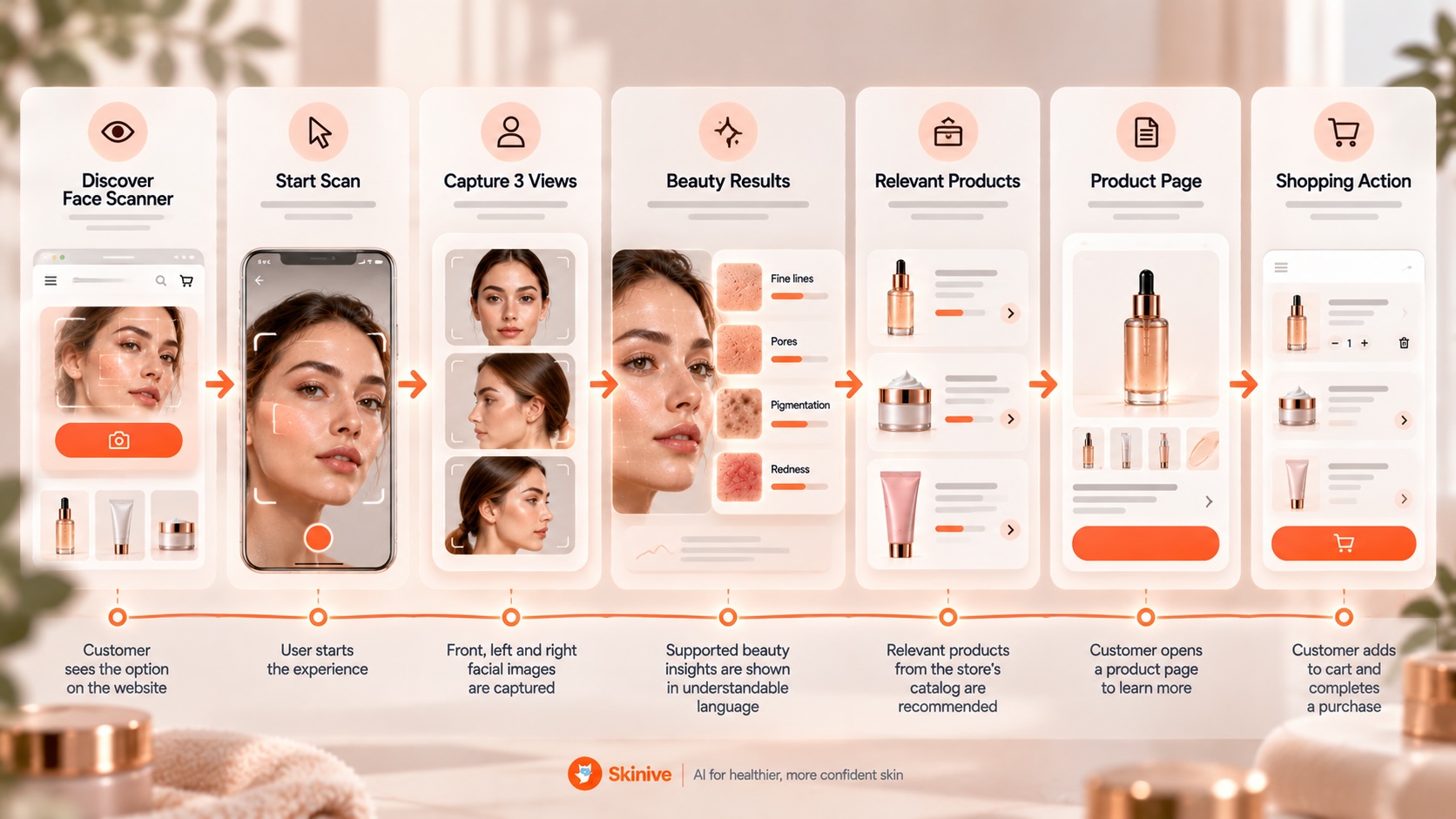
Entry
The shopper first needs to notice the Face Scanner and understand why using it may be useful.
A weak or confusing entry point can prevent the personalization journey from starting at all.
Start
The customer chooses to begin.
At this stage, the value proposition should already be clear enough to justify the additional interaction.
Image Capture
With Skinive Face Scanner, the customer provides front, left and right facial images.
Capture friction matters because customers who abandon here never reach personalized product discovery.
Results
Supported visible cosmetic characteristics need to be presented in understandable beauty-focused language.
The objective is not to overwhelm the customer with analysis. It is to create useful context for the next decision.
Recommendations
The experience connects the relevant beauty insights with products from the retailer’s assortment.
Product Discovery
Customers continue toward product information and shopping actions.
Commerce Outcome
The retailer evaluates what happens after the personalized journey using Skinive analytics together with its own commerce analytics where appropriate.
This funnel creates a more useful CRO framework than simply asking how many people completed a scan.
Reduce Choice Overload Before Trying to Increase Conversion
One of the clearest opportunities for Face Scanner personalization is reducing the size of the decision set.
Large skincare assortments create flexibility, but they also create more decisions.
A customer may need to determine:
- Which visible concern matters
- Which category is relevant
- Which products within that category deserve attention
- Which product page to open next
Skinive Face Scanner can analyze supported visible cosmetic characteristics including fine lines and wrinkles, pores, blackheads, whiteheads, acne-related imperfections, dark spots, pigmentation, redness and uneven-looking texture.
Those insights can provide a starting point for narrowing product discovery.
The objective is not to hide the wider assortment.
It is to move the customer from:
“I don’t know where to start”
toward:
“These are the products most relevant to explore next.”
For the broader implementation of Face Scanner technology in online stores, see AI Face Scanner for E-Commerce: How to Personalize Skincare Shopping.
Make the Recommendation Explainable
Personalization becomes less useful when customers cannot understand why a product has been recommended.
A generic label such as “Recommended for you” provides little context by itself.
A stronger flow maintains continuity:
Visible Beauty Insight → Relevant Product → Clear Next Action
The recommendation experience should help the shopper understand the relationship between the analysis and the product being shown.
That does not require a long explanation.
The goal is simply to avoid making the recommendation feel arbitrary.
A conversion-oriented result should generally:
- Use understandable cosmetic language
- Keep the product selection focused
- Make product relevance clear
- Provide an obvious route toward product discovery
- Avoid unnecessary steps between recommendation and product page
Shorten the Distance Between Personalization and Shopping
A personalized result becomes less commercially useful if the customer has to restart product discovery afterward.
Once relevant products have been identified, the next step should be easy to understand.
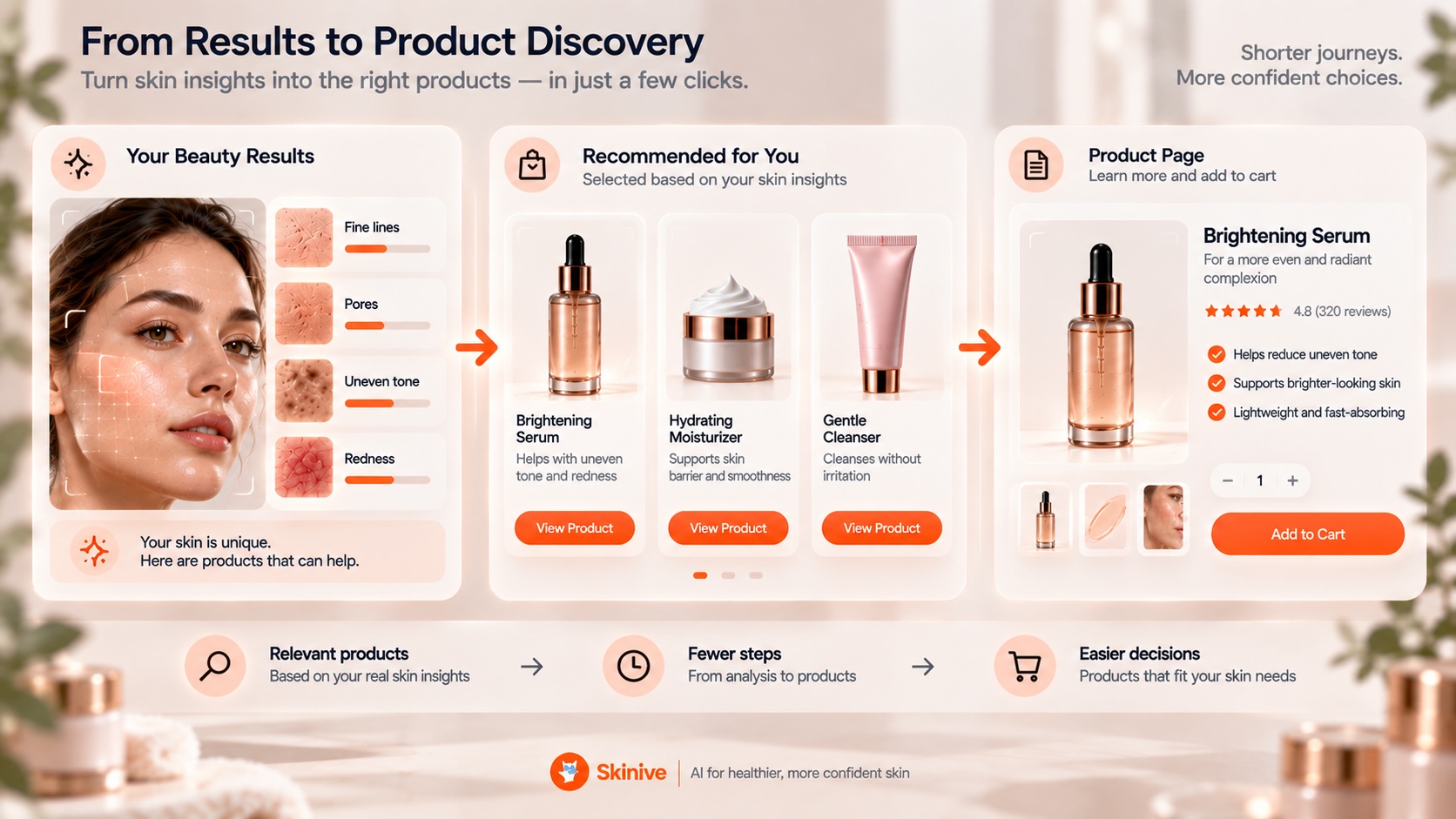
Skinive Face Scanner can work with a beauty brand or retailer’s own skincare catalog.
The minimum product information includes:
- Product name
- Product description
- Ingredients
- Price
- Product-page URL
Product information can be provided through CSV or XML, and catalog synchronization is unlimited.
For conversion, the important element is the product-page destination.
It allows the personalized journey to continue into the retailer’s existing commerce environment rather than ending with the analysis.
The deeper catalog and matching logic is covered in AI Skincare Recommendations: From Face Analysis to the Right Products and AI Product Recommendation Engine for Beauty and Skincare Brands rather than repeated here.
Where Should a Face Scanner Appear on an E-Commerce Website?
Placement should reflect customer intent.
The most visible location is not automatically the most effective location.
A Face Scanner can be particularly relevant where customers are already deciding what to buy.
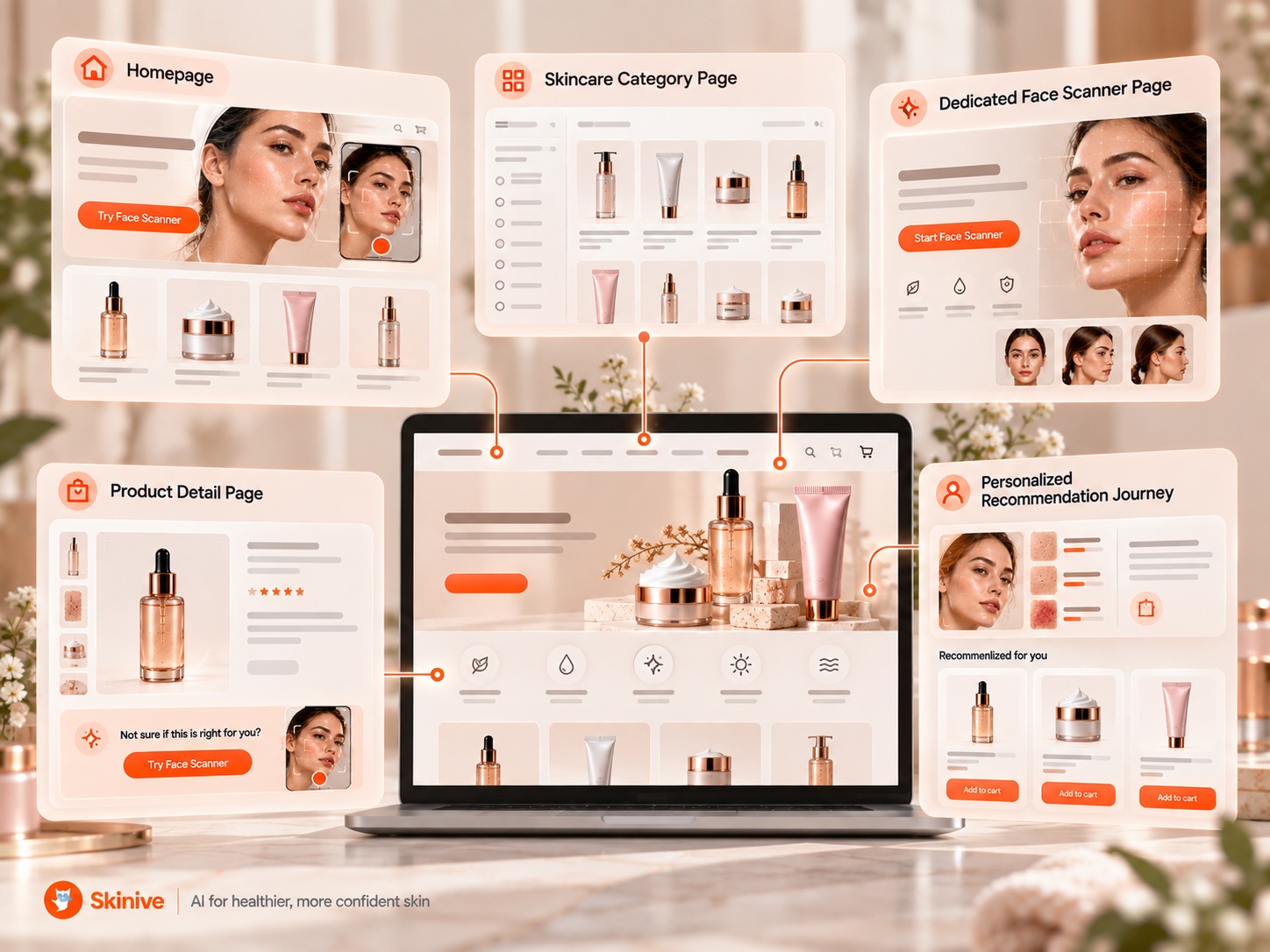
| E-Commerce Touchpoint | Why Test It | Primary Question |
|---|---|---|
| Homepage | Introduces personalized discovery early | Do visitors engage with the entry point? |
| Skincare category | Helps when customers face a large assortment | Does personalization reduce browsing friction? |
| Dedicated Face Scanner page | Gives space to explain the experience | Do informed visitors start and complete it? |
| Product detail page | Offers additional discovery while evaluating products | Do shoppers continue into personalized discovery? |
| Personalized recommendation journey | Keeps analysis close to products | Do users interact with recommended products? |
Retailers should test rather than assume which placement performs best.
A category page may have lower traffic than the homepage but stronger personalization intent.
The relevant metric is not simply visibility. It is whether the placement moves useful customers into the next stage of the funnel.
Optimize Face Scanner Entry Before Optimizing Results
Conversion optimization begins before the camera opens.
Customers need to understand what they are about to receive in exchange for completing the experience.
An effective entry point should answer three questions quickly:
What is this?
Why should I use it?
What happens afterward?
The CTA should describe the customer benefit rather than relying only on the novelty of AI.
For example, the purpose might be framed around personalized skincare product discovery rather than simply “Try our AI.”
The precise wording should then be tested within the retailer’s own audience.
Reduce Friction During Image Capture
If customers abandon image capture, recommendation quality becomes irrelevant.
With Skinive Face Scanner, users capture front, left and right facial images.
The capture experience should make that sequence understandable and manageable.
Useful principles include:
- Explain the purpose before capture begins
- Keep instructions concise
- Make the required view clear
- Guide framing and image quality
- Show progress through the sequence
- Make another capture understandable when needed
- Move directly toward useful results after completion
The objective is not to remove necessary steps.
It is to remove unnecessary uncertainty around those steps.
Treat the Results Page as a Transition, Not a Destination
A common personalization mistake is treating the analysis itself as the final product.
For beauty e-commerce, the results page is usually more valuable as a bridge.
The customer has already invested effort in completing the Face Scanner.
The next question is:
What can I do with these results?
A conversion-oriented journey should therefore connect the supported beauty insights with an obvious next action.
That might be exploring a focused product selection or continuing to relevant product pages.
The results should provide enough explanation to establish relevance without becoming a dead end between the scan and the store.
Design Recommendations for Decisions
More recommendations do not necessarily create more conversion opportunity.
A long personalized list can recreate the same choice overload the customer had before using the Face Scanner.
The recommendation experience should instead help customers make the next decision.
That means asking:
- Is the number of products manageable?
- Is their relevance understandable?
- Can the customer compare the options?
- Is the next action obvious?
- Can the customer return to normal browsing if desired?
This is where conversion design and recommendation design meet.
Use Additional Customer Signals Only When They Reduce Friction
Face analysis is not the only possible personalization input.
Customer-provided preferences or behavioral information may add useful context within a retailer’s broader personalization environment.
But additional inputs also create additional interaction.
From a conversion perspective, every extra question should justify itself.
A useful principle is:
collect additional context when it materially changes the product decision.
If a question does not affect what the customer sees next, it may simply add friction.
This makes the conversion objective different from maximizing the amount of customer data collected.
How Should Beauty Retailers Measure the Face Scanner Funnel?
Measurement should distinguish Skinive analytics from the retailer’s wider e-commerce analytics.
Skinive provides dashboard statistics for:
- Scans
- Users
- Product clicks
- Sales conversions
These provide visibility into important parts of the Face Scanner journey.
Retailers may use their own analytics environment for additional metrics.
| Funnel Stage | Example Measurement |
|---|---|
| Entry | Face Scanner entry interaction |
| Start | Start behavior |
| Capture | Completion and abandonment |
| Results | Results interaction |
| Recommendations | Recommendation interaction |
| Product discovery | Product-page behavior |
| Commerce | Add-to-cart, checkout and purchase behavior |
| Return behavior | Repeat engagement where measurable |
Not every metric in this table is provided by Skinive.
Metrics beyond scans, users, product clicks and sales conversions depend on the retailer’s own analytics implementation.
Keeping that distinction clear prevents the product from being credited with analytics capabilities that belong to the retailer’s commerce stack.
Which Conversion Metrics Matter Most?
The answer depends on where the largest funnel problem occurs.
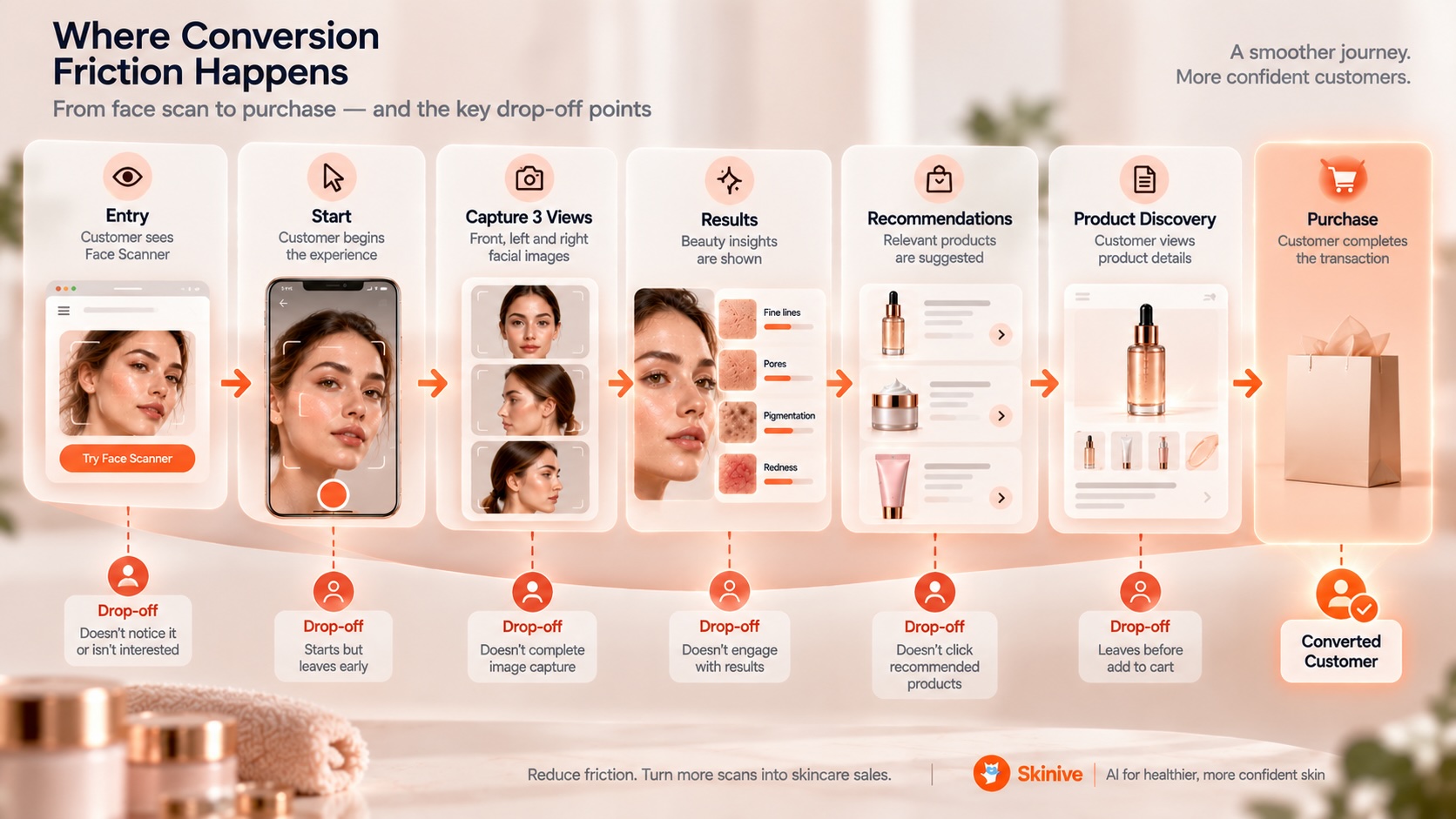
A low start rate may indicate weak placement or messaging.
A high start rate combined with low completion may indicate capture friction.
High completion with low product interaction may indicate that results or recommendations are not creating a clear next step.
Product clicks without downstream commerce may indicate another problem later in the shopping journey.
This means conversion optimization should focus on drop-offs between stages, not just absolute numbers.
A useful analysis asks:
Where are customers leaving the personalized journey, and what could be causing that friction?
How Can Retailers Test Whether Face Scanning Improves Conversion?
Conversion impact should be established with the retailer’s own data.
Define the Conversion Event
Decide what success means before testing.
For one implementation it may be product interaction. For another, it may be completed purchases.
Establish the Funnel
Track the relevant stages from Face Scanner entry through downstream behavior.
Create an Appropriate Comparison
Where practical, compare the personalized journey with an appropriate alternative or control.
Test Specific Changes
Instead of changing placement, copy, capture flow and recommendation design simultaneously, isolate meaningful variables where traffic permits.
Segment When Useful
Device, market, traffic source and customer type can produce different behavior.
Allow Enough Time
Short tests can be distorted by traffic fluctuations, promotions or seasonality.
Interpret Correlation Carefully
Customers who voluntarily use a Face Scanner may already differ from customers who do not.
Higher conversion among scanner users alone does not prove that the scanner caused the difference.
Controlled experimentation can provide stronger evidence where practical.
What Should Beauty Retailers A/B Test?
Not every part of the experience needs to be tested simultaneously.
Useful experiments can include:
Entry-Point Placement
Compare where the personalization journey is introduced.
Value Proposition
Test how clearly the entry point explains the customer benefit.
CTA Language
Compare different ways of describing the next action.
Recommendation Density
Evaluate whether a smaller or larger recommendation set helps customers continue.
Result-to-Product Transition
Test how directly the analysis leads into product discovery.
Mobile vs. Desktop Presentation
Customer behavior and available screen space can differ substantially between devices.
A/B testing should answer a defined question rather than simply produce more dashboard data.
Avoid Unsupported Conversion Claims
Conversion claims need context.
An implementation that performs well for one retailer does not establish a universal uplift for another.
Traffic quality, assortment, brand strength, pricing, merchandising, UX, device mix and promotions can all affect results.
Skinive should therefore explain how Face Scanner personalization can contribute to conversion and provide measurable analytics rather than promise a fixed percentage improvement.
A strong future case study should make the evidence interpretable by reporting information such as:
- What was tested
- Which customer population was included
- Test period
- Comparison methodology
- Conversion-event definition
- Relevant implementation differences
Without that context, an impressive percentage can be misleading.
How Skinive Face Scanner Supports a Measurable E-Commerce Journey
Skinive Face Scanner provides the components needed to connect beauty-focused face analysis with product discovery.
| Capability | Skinive Face Scanner |
|---|---|
| Face capture | Front, left and right facial images |
| Beauty analysis | Multiple supported visible cosmetic characteristics |
| Product catalog | CSV or XML |
| Minimum catalog data | Name, description, ingredients, price, product-page URL |
| Catalog synchronization | Unlimited |
| Web Widget | Available; launch can take around five minutes |
| Web SDK | Available |
| API | Available |
| Native iOS / Android SDKs | Planned |
| Dashboard analytics | Scans, users, product clicks, sales conversions |
The ready-to-use Web Widget can support faster web deployment, while the Web SDK and API provide options for more customized implementations.
A Practical Face Scanner Conversion Optimization Framework
A beauty retailer does not need to optimize the entire experience at once.
A practical sequence is:
Start With One High-Intent Placement
Choose a part of the website where customers genuinely need product guidance.
Make the Benefit Clear
Explain why completing the Face Scanner helps the shopper.
Reduce Capture Friction
Make the front, left and right image sequence easy to follow.
Keep Results Focused
Show useful beauty insights without unnecessary complexity.
Connect Results Directly With Products
Avoid forcing customers to restart product discovery after completing the analysis.
Measure Funnel Drop-Off
Identify where customers stop progressing.
Test One Meaningful Change
Improve the largest friction point rather than redesigning everything simultaneously.
Expand From Evidence
Use observed customer behavior to decide whether and where the experience should expand.
The principle is straightforward:
Face Scanner → Less Uncertainty → More Relevant Product Discovery → Easier Shopping Decision
Whether that produces a measurable conversion increase should then be established from the retailer’s own data.
Related Resources
- AI Face Scanner for E-Commerce: How to Personalize Skincare Shopping
- AI Face Scanner for Beauty & Skincare Apps: Integration and Use Cases
- AI Face Scanner for In-Store Beauty Retail: Personalized Beauty Consultations at the Point of Sale
- AI Face Analysis: How It Works for Beauty & Skincare
- AI Skincare Recommendations: From Face Analysis to Relevant Products
- Personalized Skincare with AI: How Beauty Brands Can Move Beyond Generic Routines
- AI Product Recommendation Engine for Beauty and Skincare Brands
- Omnichannel Beauty: One AI Face Scanner Across Web, App and In-Store
- Virtual Beauty Consultation: How AI Is Changing the Beauty Advisor Experience
- AI Face Scanner vs. Skin Quiz: Which Creates Better Skincare Personalization?
- What Can an AI Face Scanner Detect? Wrinkles, Pores, Blackheads, Dark Spots and More
- How to Integrate an AI Face Scanner Into a Website in Minutes
- How to Connect a Cosmetics Product Catalog to AI Skincare Recommendations
- The Business Case for AI Beauty Technology: Conversion, Engagement and Customer Retention
Turn Face Analysis Into a Measurable Shopping Journey
Connect supported facial beauty insights with products from your own skincare assortment and measure what happens from scan to product interaction and sales conversion.