
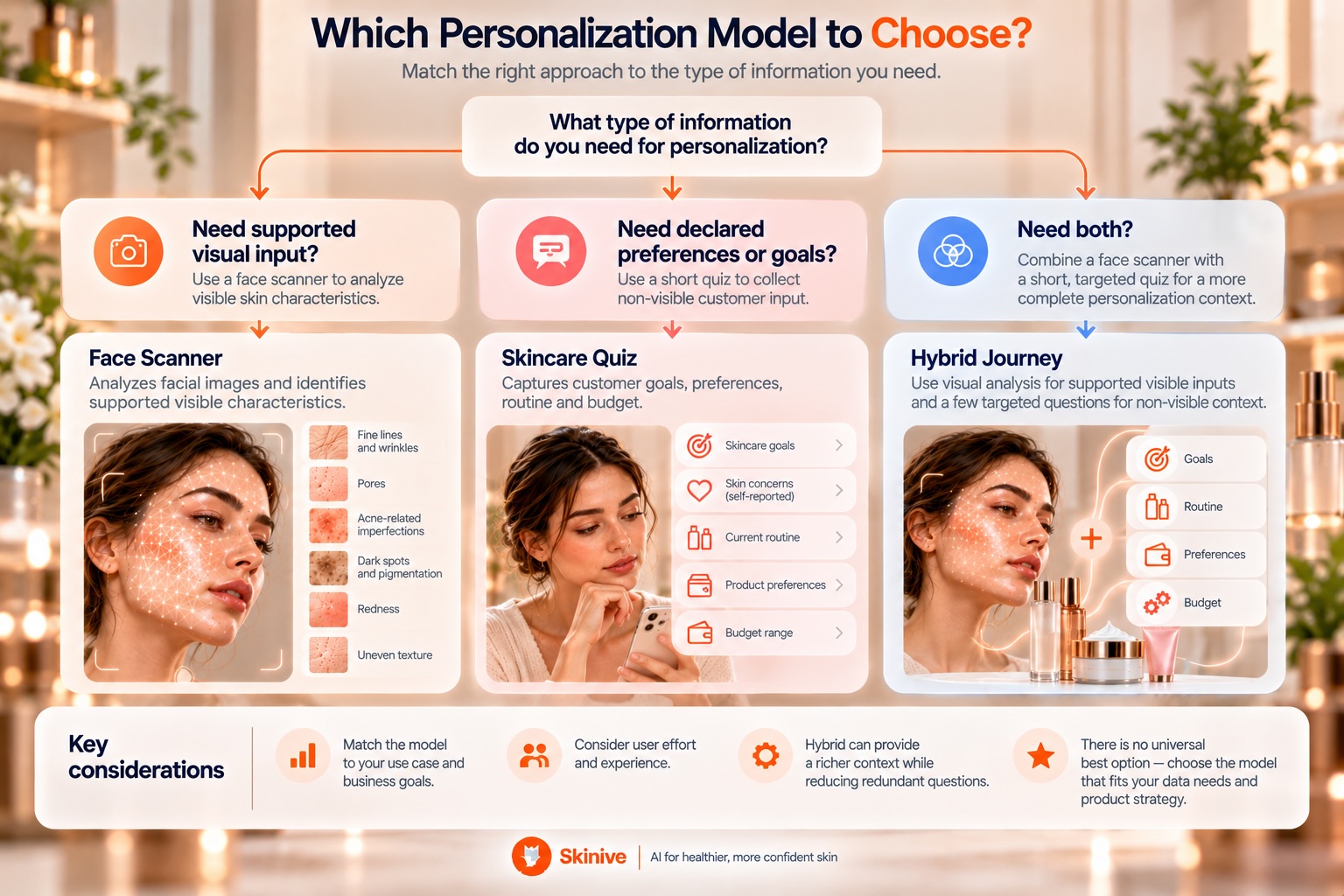
An AI Face Scanner and a skincare quiz personalize beauty product discovery using different types of information. A Face Scanner contributes visual information about supported cosmetic characteristics, while a quiz collects information the customer provides directly, such as goals, preferences, routine and budget.
For many beauty experiences, the practical choice is not Face Scanner versus quiz. A hybrid journey can use face analysis for supported visual inputs and a small number of targeted questions for context that cannot be determined from facial images.
Key Takeaways
- AI Face Scanners and skincare quizzes collect fundamentally different personalization inputs.
- A Face Scanner contributes visual information about supported cosmetic characteristics.
- A skincare quiz collects declared information such as goals, preferences, routine and budget.
- Face analysis can reduce the need to ask customers to self-identify every supported visible concern.
- A quiz remains useful for information that cannot be reliably inferred from facial images.
- A hybrid journey can combine visual analysis with a short set of high-value questions.
- The right model depends on what information the product recommendation actually requires.
- Performance should be evaluated through customer behavior and business outcomes rather than assuming one interface will always perform better.
What Is the Difference Between an AI Face Scanner and a Skincare Quiz?
The fundamental difference is the source of information.
AI Face Scanner = visual input
Skincare Quiz = declared customer input
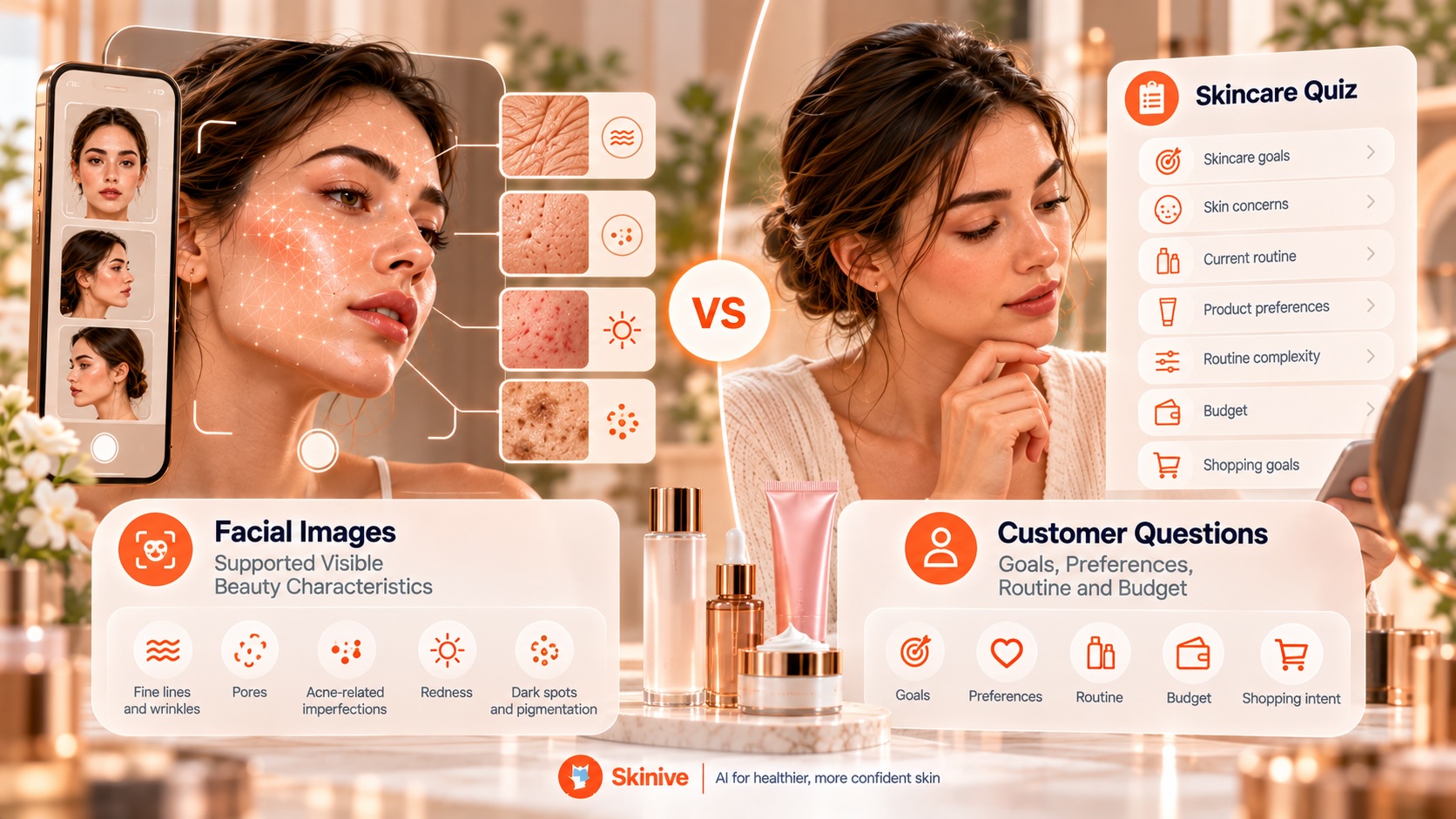
| AI Face Scanner | Skincare Quiz | |
|---|---|---|
| Primary input | Facial images | Customer answers |
| Information type | Supported visible cosmetic characteristics | Goals, preferences and other declared context |
| Visible concerns | AI-assisted analysis | Customer self-identification |
| Preferences | Cannot be reliably inferred from an image | Can be asked directly |
| Routine | Not reliably visible | Can be collected |
| Budget | Not visible | Can be collected |
| Customer interaction | Image capture | Question answering |
| Product discovery | Can connect analysis with catalog | Can connect answers with catalog |
The two approaches therefore solve different personalization problems.
They can compete in some customer journeys, but they can also complement each other.
How Does an AI Face Scanner Personalize Skincare?
An AI Face Scanner provides a visual personalization input.
With Skinive Face Scanner, the customer captures front, left and right facial images. AI then evaluates supported visible cosmetic characteristics.
These can include:
- Fine lines and wrinkles
- Visible or enlarged pores
- Blackheads
- Whiteheads
- Acne-related imperfections
- Dark spots and pigmentation
- Redness
- Uneven-looking facial texture
The results can then contribute to product discovery using products from the beauty brand or retailer’s own skincare catalog.
This can reduce the need for customers to manually identify every supported visible concern before receiving relevant product guidance.
For a deeper explanation of the technology, see AI Face Analysis: How It Works and What It Can Identify for Beauty & Skincare.
How Does a Skincare Quiz Personalize Product Discovery?
A skincare quiz works through explicit customer answers.
Depending on the journey, questions can collect information such as:
- Skincare goals
- Self-reported concerns
- Current routine
- Desired routine complexity
- Product preferences
- Previous product experience
- Budget or price preference
- Shopping priorities
The main advantage is access to information that cannot be determined from a facial image.
The trade-off is customer effort.
Every additional question adds another interaction before the customer receives value, so a useful quiz should collect information because it changes the personalization outcome—not simply because the information is available.
Face Scanner vs. Skincare Quiz: Side-by-Side Comparison
| Criterion | AI Face Scanner | Skincare Quiz | Hybrid |
|---|---|---|---|
| Supported visible facial characteristics | AI-assisted visual input | Self-reported | Visual + declared context |
| Goals | Limited from images | Directly collected | Available |
| Preferences | Not reliably visible | Directly collected | Available |
| Routine information | Not reliably visible | Can be collected | Available |
| Budget | Not visible | Can be collected | Available |
| Customer interaction | Three-view capture | Questions | Capture + selected questions |
| Visual experience | Strong visual component | Primarily text / choice based | Visual + contextual |
| Concern input | Standardized analysis process | Depends on customer interpretation | AI input + customer context |
| Catalog connection | Supported | Possible depending on quiz implementation | Combined inputs can inform discovery |
| Primary role | Visual personalization | Declared personalization | Combined personalization |
The important question is not which technology has more inputs.
It is which inputs are relevant to the customer’s decision.
Where Does an AI Face Scanner Have an Advantage?
A Face Scanner is particularly relevant when the customer’s uncertainty is visual.
The customer may know they want skincare guidance but may not know which supported beauty concern best describes what they see.
Instead of beginning with questions such as:
Do you notice visible pores?
Do you have dark spots?
Do you see fine lines?
face analysis can contribute those supported visual inputs directly.
This can create several UX advantages:
- Less reliance on customer interpretation of beauty terminology
- A visual and interactive personalization entry point
- Structured supported beauty insights early in the journey
- A direct bridge from visible characteristics toward product discovery
- A reusable visual personalization concept across different beauty touchpoints
These advantages apply within the supported cosmetic scope.
Skinive Face Scanner should not be presented as diagnosing skin disease.
Where Does a Skincare Quiz Have an Advantage?
A quiz becomes important when the recommendation depends on information that is not visible.
A facial image cannot tell a retailer that the customer wants a two-step routine, prefers a particular product format or has a specific shopping budget.
Questions can collect these inputs directly.
Useful quiz topics can include:
- Goals and priorities
- Routine complexity
- Product preferences
- Budget
- Shopping intent
- Previous product experience
- Desired product categories
The key is to ask questions that materially affect the next step.
A short purposeful quiz can be more useful than a long questionnaire that collects information the recommendation logic barely uses.
What Can’t an AI Face Scanner Learn From a Photo?
Facial analysis should not be treated as a complete customer profile.
Some commercially important personalization inputs require another source.
| Not Reliably Available From Facial Images | More Appropriate Source |
|---|---|
| Budget | Customer question or commerce context |
| Desired routine length | Customer question |
| Product-format preference | Customer question |
| Products already owned | Customer input or business systems |
| Brand preference | Customer input or observed behavior |
| Purchase history | Retailer’s commerce / CRM systems |
| Current shopping intent | Customer input or behavior |
| Other personal preferences | Customer input |
This is why asking a small number of questions can complement face analysis.
The purpose is not to collect as much information as possible.
It is to collect the information the visual input cannot provide.
What Can’t a Skincare Quiz Observe Directly?
A quiz has the opposite limitation.
It can ask customers whether they notice pores, pigmentation, redness, blackheads or fine lines, but the answers remain self-reported.
Customers may:
- Interpret beauty terminology differently
- Be uncertain which concern applies
- Overlook visible characteristics
- Choose the closest available answer even when unsure
AI face analysis provides a separate visual input for supported cosmetic characteristics.
That does not make every AI-derived input inherently more useful than a customer answer. It means the two methods obtain information differently.
Is Face Analysis More Objective Than a Skincare Quiz?
Calling one method simply “objective” and the other “subjective” is misleading.
They measure different things.
A Face Scanner applies a standardized analysis process to supported visual inputs.
A quiz records customer answers.
For visible cosmetic characteristics, standardization can reduce differences caused by customers interpreting the same question differently.
For preferences, goals or budget, however, the customer’s subjective answer is exactly the information the business needs.
The correct source depends on the question.
Why Combine a Face Scanner With a Short Skincare Quiz?
A hybrid journey can assign each input to the method best suited to collect it.
A simple principle is:
Use AI for supported visual inputs.
Ask customers about genuinely non-visible context.
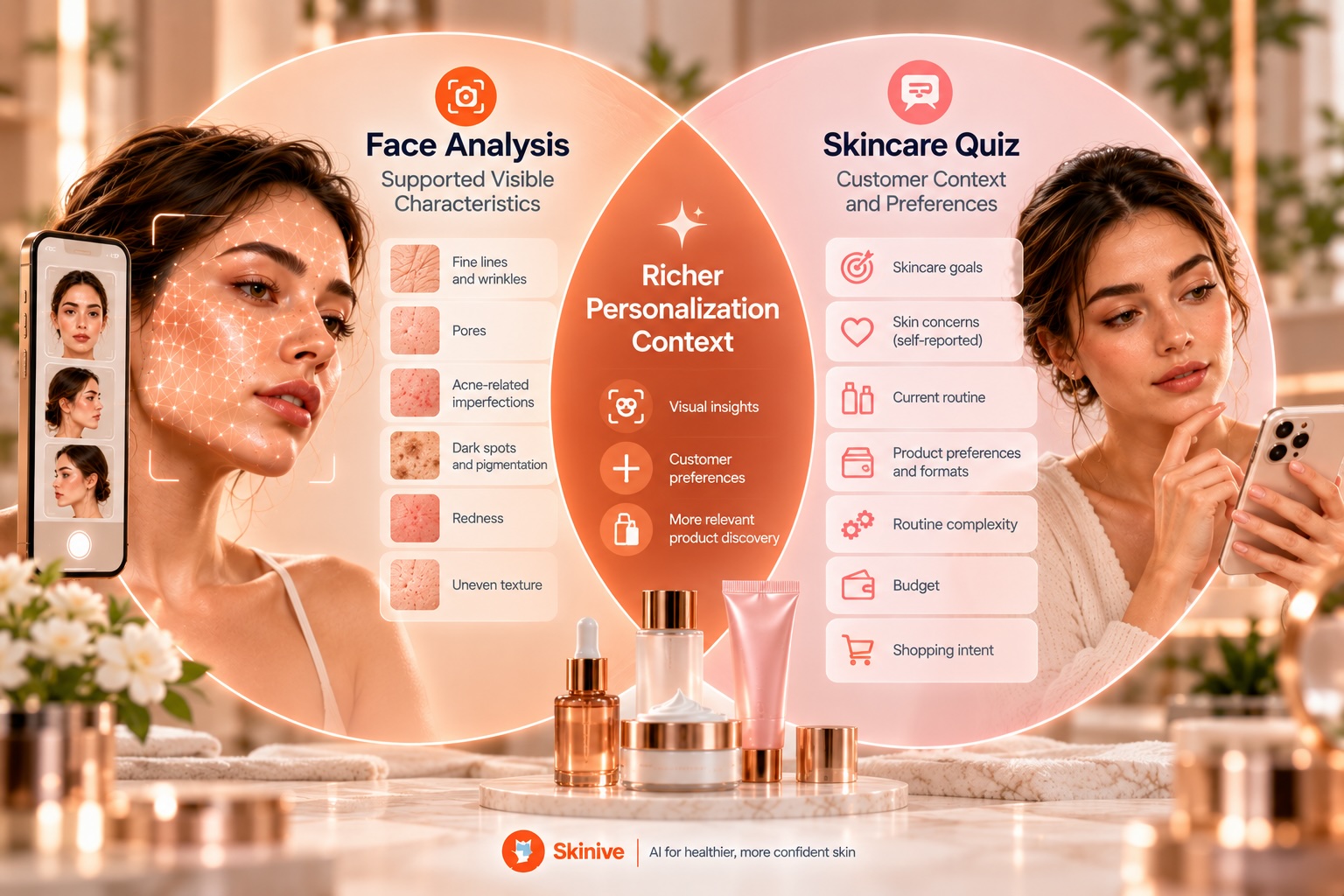
This can create a journey such as:
Face Scan → Immediate Beauty Insights → Targeted Questions → Product Discovery
The important word is targeted.
Adding a Face Scanner before an unchanged 20-question quiz does not necessarily reduce friction.
Instead, the business can evaluate which questions become redundant once visual analysis is available.
Example: Turning a Long Quiz Into a Hybrid Journey
Consider a traditional skincare quiz that asks customers to identify several visible concerns themselves.
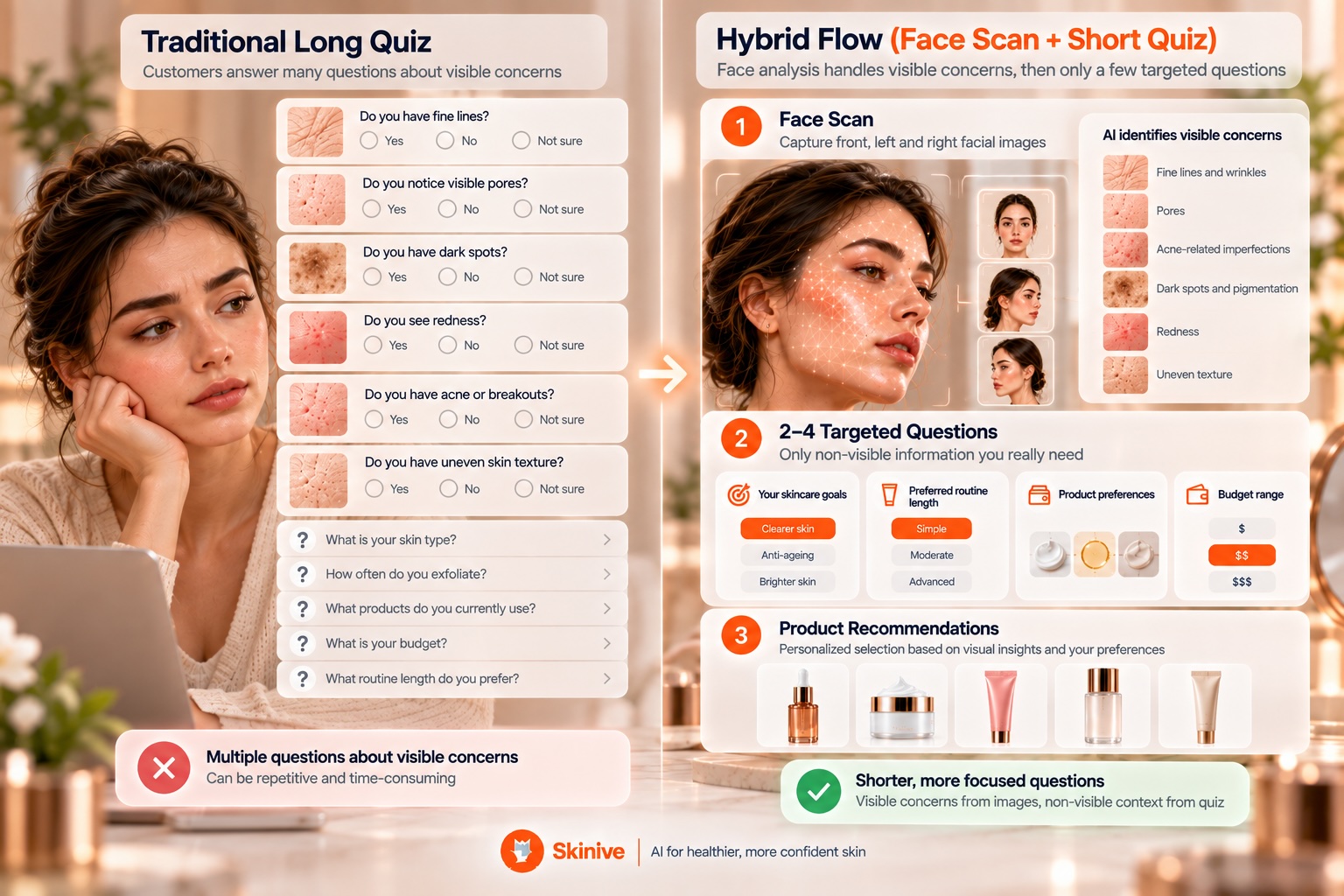
| Traditional Quiz | Hybrid Journey |
|---|---|
| Which facial concerns do you have? | Face Scanner contributes supported visual inputs |
| Do you notice visible pores? | Potentially unnecessary if the analysis already covers the relevant characteristic |
| Do you notice dark spots? | Potentially unnecessary if already represented by the supported analysis |
| Do you have fine lines? | Potentially unnecessary if already represented by the supported analysis |
| How complex should your routine be? | Ask the customer if relevant |
| Which product formats do you prefer? | Ask the customer if relevant |
| What is your budget? | Ask the customer if relevant |
| Which products should you explore? | Use relevant visual + declared inputs with product data |
The exact questions depend on the business.
The goal is not to prescribe one universal hybrid quiz.
It is to remove questions that no longer provide useful additional information.
How Should a Hybrid Face Scanner + Quiz Journey Work?
A practical hybrid experience can follow six stages.
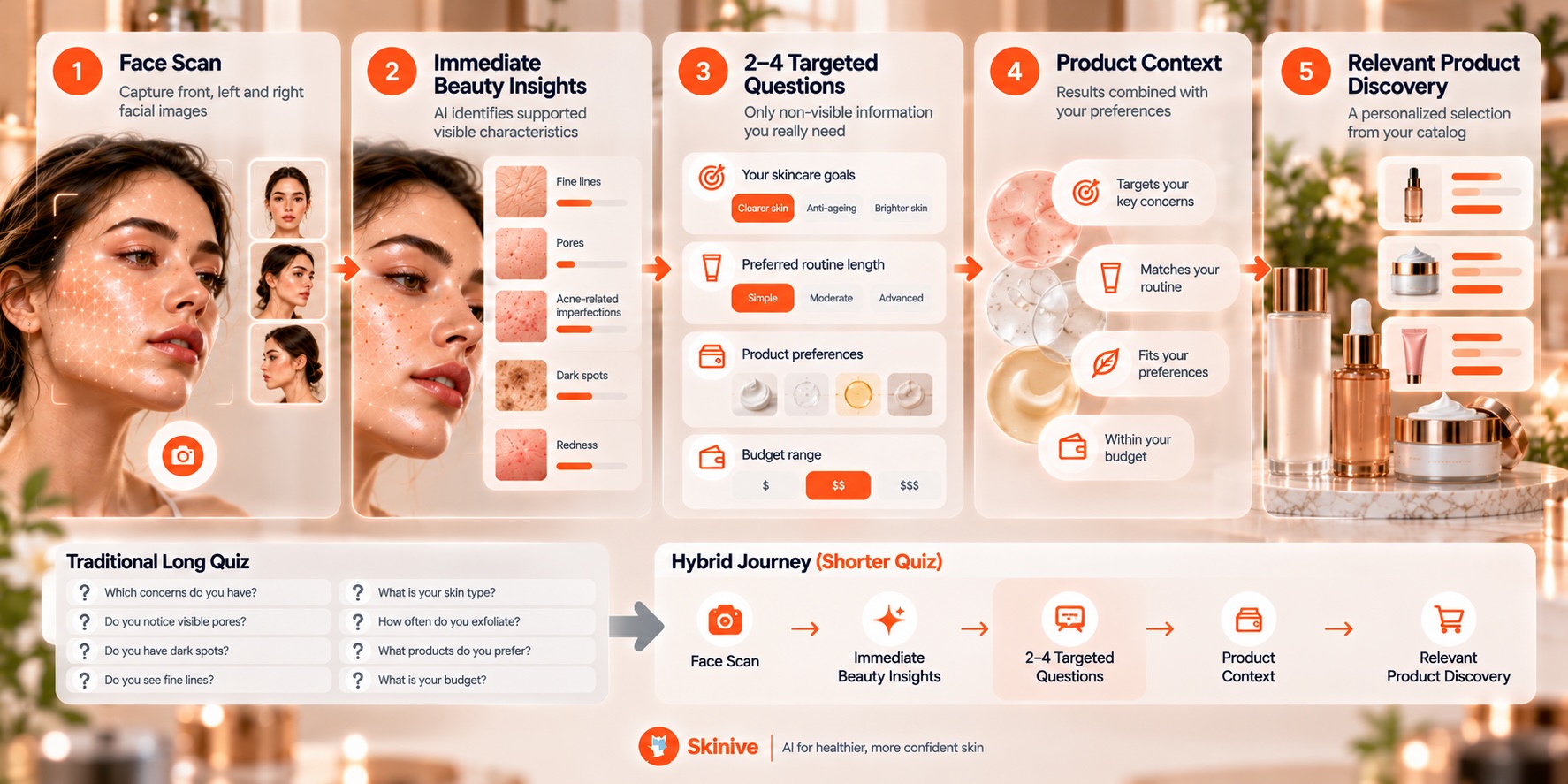
Start With Face Analysis
Let the customer complete the visual part of the experience.
Provide Value Early
Present useful beauty-focused results before requesting a large amount of additional information.
Identify Missing Context
Determine which recommendation inputs still cannot be answered from the visual analysis.
Ask Only High-Value Questions
Each follow-up question should have a reason to exist.
If removing the question would not materially affect the product-discovery experience, consider whether it is necessary.
Connect the Combined Context With Products
Use relevant visual and declared inputs to support discovery within the retailer’s assortment.
Measure Whether the Questions Help
Do not assume that additional personalization inputs improve the journey.
Evaluate whether they improve useful customer behavior without introducing excessive abandonment.
Which Approach Creates Better Product Recommendations?
There is no universal winner.
Recommendation quality depends on whether the system has the information needed for the specific product decision.
If product discovery primarily depends on supported visible facial characteristics, a Face Scanner can provide relevant visual input.
If it depends heavily on goals, preferences, routine or budget, customer questions become important.
If both categories matter, a hybrid approach can provide both forms of context.
Product information is another part of the equation.
Even strong customer inputs cannot create useful commerce recommendations if the underlying product information is incomplete or poorly maintained.
For the deeper recommendation architecture, see AI Product Recommendation Engine for Beauty and Skincare Brands.
How Does Product Catalog Integration Affect the Comparison?
Both visual and declared personalization ultimately need a useful connection to products.
Skinive Face Scanner can work with a beauty brand or retailer’s own skincare catalog.
Product information can be provided through CSV or XML.
Minimum product information includes:
- Product name
- Description
- Ingredients
- Price
- Product-page URL
Catalog synchronization is unlimited.
Starter supports up to 1,000 products, Growth up to 5,000 products, while Enterprise can address custom requirements.
The detailed journey from analysis to products is covered in AI Skincare Recommendations: From Face Analysis to the Right Products.
Face Scanner vs. Quiz Across Different Beauty Journeys
The balance between visual analysis and customer questions can change according to context.
E-Commerce
A Face Scanner can provide a visual product-discovery entry point, while selected questions can add non-visible shopping context.
The hybrid approach may be particularly useful when the retailer wants to reduce a long concern-identification questionnaire.
Mobile Beauty Experiences
Face analysis and selected questions can be incorporated into a broader mobile experience using the available integration approach.
Skinive currently provides Web SDK and API options, while native iOS and Android SDKs are planned.
Any persistent customer profile, saved preference or account functionality depends on the business’s surrounding implementation and should not be assumed to be provided by Skinive.
Physical Retail
A beauty advisor can effectively provide much of the contextual input that a digital quiz would otherwise collect.
A possible interaction is:
Face Analysis → Supported Beauty Insights → Advisor Questions → Product Conversation
This can make a separate long questionnaire unnecessary in some advisor-assisted experiences.
Which Approach Is Faster for the Customer?
There is no universal answer.
A Face Scanner requires image capture.
A quiz requires reading and answering questions.
A very short quiz may require less interaction than a three-view scan, while a long questionnaire may create substantially more effort.
Completion time alone is also an incomplete UX metric.
Businesses should consider:
- Start rate
- Completion
- Abandonment
- Product interaction
- Downstream shopping behavior
The objective is not simply to create the shortest experience.
It is to remove unnecessary effort while collecting the inputs that matter.
Which Approach Is Easier to Integrate?
A simple quiz can often be implemented using forms, rules and product mappings.
Face analysis requires image capture and an analysis layer.
Skinive reduces some of that implementation work by providing:
- A ready-to-use Web Widget
- Web SDK
- API
The Web Widget can be launched in around five minutes.
Native iOS and Android SDKs are planned.
The appropriate approach depends on how much control the business needs over the customer experience and surrounding architecture.
How to Choose Between Face Scanner, Quiz and Hybrid Personalization
Start with the information requirement rather than the technology.
| If Your Main Need Is… | Consider |
|---|---|
| Help customers identify supported visible beauty characteristics | AI Face Scanner |
| Collect goals, preferences, routine or budget | Skincare quiz |
| Reduce repetitive visual-concern questions | Face Scanner + targeted questions |
| Create a visual personalization entry point | AI Face Scanner |
| Build a simple preference-based journey | Skincare quiz |
| Combine visible characteristics with customer preferences | Hybrid |
| Support an advisor-led consultation | Face Scanner + advisor context |
The choice can also differ between customer journeys within the same business.
A retailer does not need one personalization format for every interaction.
How Should Brands Test Face Scanner vs. Skincare Quiz?
The comparison should be based on customer behavior rather than assumptions about which experience appears more innovative.
Define the Objective
Decide what the personalization experience is intended to improve.
Create Comparable Journeys
Keep downstream product and commerce conditions as comparable as practical.
Measure Entry and Completion
Determine whether customers begin and successfully finish each experience.
Measure Product Interaction
Evaluate what happens after personalization.
Measure Downstream Commerce
Where reliable attribution is available, examine relevant shopping outcomes.
Test the Hybrid Separately
A hybrid should not automatically be assumed to outperform either standalone approach.
Additional questions can add context, but they can also add friction.
Watch for Selection Bias
Customers who voluntarily choose an image-based experience may differ from customers who choose a questionnaire.
Use Controlled Testing Where Practical
A/B or other controlled experimentation can provide stronger evidence than comparing unrelated user groups.
Skinive provides dashboard analytics for scans, users, product clicks and sales conversions.
Additional quiz, website and commerce metrics depend on the business’s own analytics systems.
Privacy and Customer Trust
Face Scanners and quizzes collect different types of customer information.
A Face Scanner uses facial images as part of the analysis experience.
A quiz may collect preferences and other customer-provided information.
Businesses should clearly explain what information is requested and why it contributes to the experience.
Implementation-specific requirements relating to consent, processing, storage, retention, security and applicable privacy obligations should be reviewed for the particular deployment.
Data minimization is useful for both methods.
Do not ask for additional information merely because it can be collected.
Skinive Face Scanner is designed for beauty, cosmetics and personalized skincare rather than medical diagnosis.
How Skinive Supports Face-Analysis Personalization
| Capability | Skinive Face Scanner |
|---|---|
| Face capture | Front, left and right facial images |
| Beauty analysis | Multiple supported visible cosmetic characteristics |
| Product catalog | CSV or XML |
| Minimum catalog data | Name, description, ingredients, price, product-page URL |
| Catalog synchronization | Unlimited |
| Web Widget | Available; launch can take around five minutes |
| Web SDK | Available |
| API | Available |
| Native iOS SDK | Planned |
| Native Android SDK | Planned |
| Analytics | Scans, users, product clicks, sales conversions |
| Starter | €99/month + €0.20/scan; up to 1,000 products |
| Growth | €199/month + €0.15/scan; up to 5,000 products |
| Enterprise | Custom |
The Practical Answer: Face Scanner, Quiz or Both?
The most useful personalization method depends on the information required.
Use a Face Scanner when supported visual characteristics are an important input.
Use questions when the business needs customer-declared information that cannot be reliably inferred from facial images.
Combine them when both types of information materially improve the journey.
The practical principle is:
Face Scanner for visual context → Questions for missing context → Product data for relevant discovery
For many beauty brands, this can mean starting with visual analysis, providing immediate value and then asking fewer, more purposeful questions.
The result should not be more personalization steps.
It should be a more efficient way to collect the right inputs.
Related Resources
- AI Face Scanner for E-Commerce: How to Personalize Skincare Shopping
- AI Face Scanner for Beauty & Skincare Apps: Integration and Use Cases
- AI Face Scanner for In-Store Beauty Retail: Personalized Beauty Consultations at the Point of Sale
- AI Face Analysis: How It Works for Beauty & Skincare
- AI Skincare Recommendations: From Face Analysis to Relevant Products
- Personalized Skincare with AI: How Beauty Brands Can Move Beyond Generic Routines
- AI Product Recommendation Engine for Beauty and Skincare Brands
- How AI Face Scanners Can Increase Conversion in Beauty E-Commerce
- Omnichannel Beauty: One AI Face Scanner Across Web, App and In-Store
- Virtual Beauty Consultation: How AI Is Changing the Beauty Advisor Experience
- What Can an AI Face Scanner Detect? Wrinkles, Pores, Blackheads, Dark Spots and More
- How to Integrate an AI Face Scanner Into a Website in Minutes
- How to Connect a Cosmetics Product Catalog to AI Skincare Recommendations
- The Business Case for AI Beauty Technology: Conversion, Engagement and Customer Retention
Add Visual Personalization to Your Skincare Journey
Use AI-powered face analysis alongside customer questions and your own skincare assortment to create a more visual and purposeful product-discovery experience.