
An AI product recommendation engine for beauty connects customer signals with structured product information to decide which products should be prioritized in a particular customer journey. In skincare, AI face analysis can contribute supported visible cosmetic insights, while product data defines what the brand or retailer can actually offer. The recommendation layer connects these inputs and turns them into a focused product-discovery experience.
Key Takeaways
- A beauty recommendation engine connects customer understanding with product understanding.
- AI face analysis can provide an immediate visual signal about supported cosmetic characteristics.
- Product data is a core part of the recommendation system, not simply a technical feed.
- Recommendation logic determines how customer signals and product information are matched and prioritized.
- Business rules can work alongside AI to maintain control over the products customers see.
- Face analysis should be one input rather than an attempt to infer preferences or other non-visible customer context.
- Skinive Face Scanner can connect supported facial beauty insights with products from a beauty brand or retailer’s own catalog.
- Recommendation performance should be evaluated through product interaction and downstream customer behavior.
What Is an AI Product Recommendation Engine for Beauty?
An AI product recommendation engine is a system that connects information about a customer with information about products to determine which products are most relevant to present.
In beauty and skincare, the customer side of that system can contain different signals.
These might include supported facial beauty insights, customer-provided preferences, questionnaire answers or behavioral information available within the business’s customer journey.
The product side describes the assortment the business can recommend.
Between them sits the recommendation layer.
Its job is to answer a practical question:
given the customer signals available now, which products from this assortment should be prioritized?
The output does not need to be a long list. Depending on the experience, it might be one product, a focused shortlist, a relevant category or another product-discovery path.
That distinction is important.
The purpose of a recommendation engine is not to maximize the number of recommendations. It is to reduce unnecessary choice and make the next product decision more relevant.
How Does an AI Beauty Recommendation Engine Work?
At a high level, a beauty recommendation engine moves through five connected stages:
Customer Signals → Structured Customer Context → Product Data → Matching & Prioritization → Relevant Products
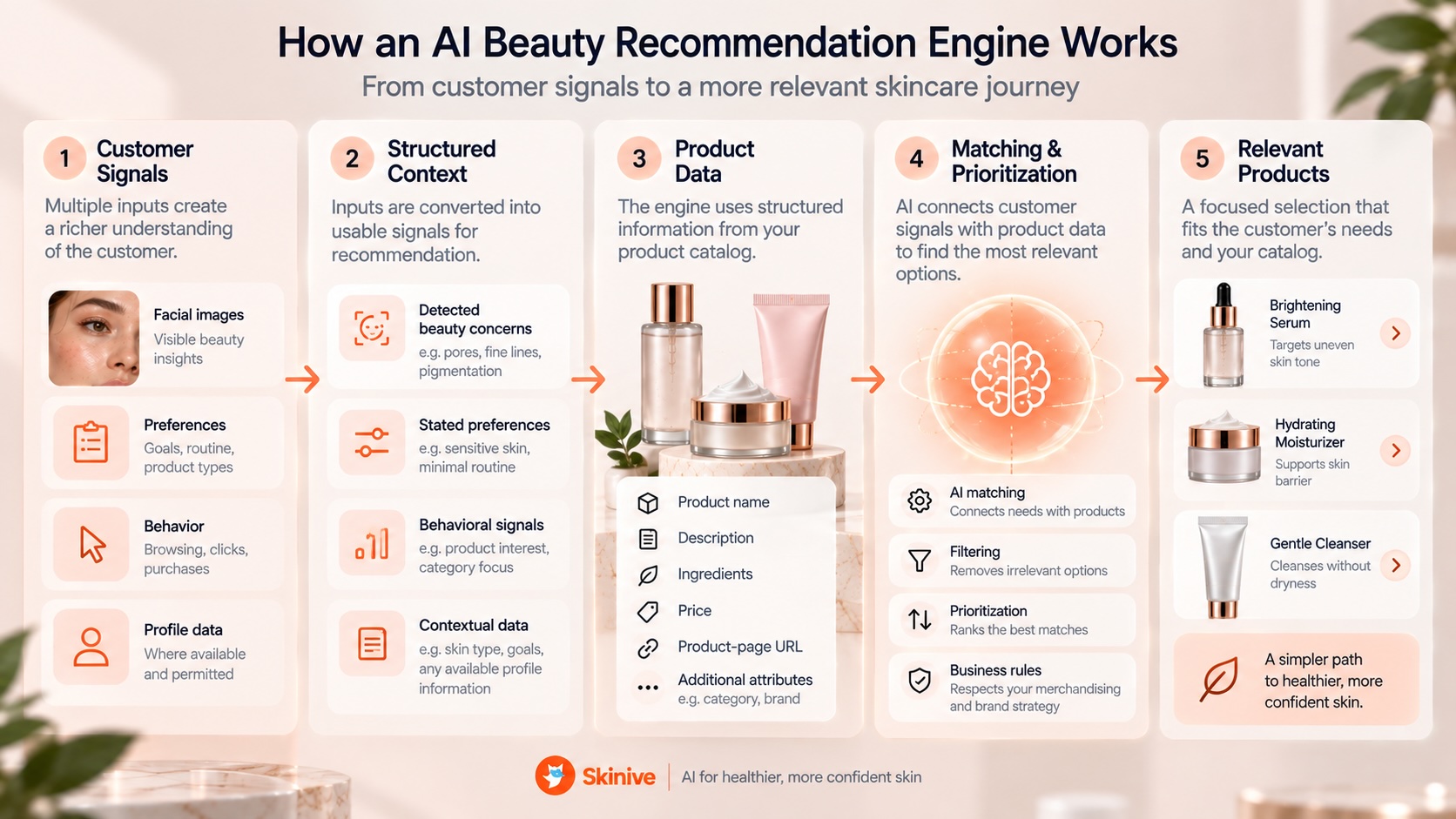
Collect Relevant Customer Signals
The engine first needs information that can differentiate one customer journey from another.
With Skinive Face Scanner, facial images can provide visual input about supported cosmetic characteristics.
Other customer information may come from the beauty business’s own experience where appropriate.
Turn Inputs Into Usable Context
Raw inputs need to become information that can contribute to recommendation decisions.
For Face Scanner, this means converting facial images into supported beauty-focused insights.
The recommendation system can then work with those insights rather than treating the image itself as the recommendation.
Understand the Available Products
The system also needs structured information about the products the business can offer.
Without useful product data, even strong customer signals cannot create useful product matching.
Match and Prioritize
The recommendation layer connects the available customer context with relevant products.
This is where matching logic, prioritization and appropriate business rules shape what should be shown.
Present a Focused Result
The customer should receive a manageable next step rather than another overwhelming catalog.
Measure What Happens Next
Product interaction and downstream behavior help the business understand whether the recommendation experience is actually useful.
The Three Core Layers of a Beauty Recommendation Engine
A useful way to understand recommendation architecture is through three connected layers.
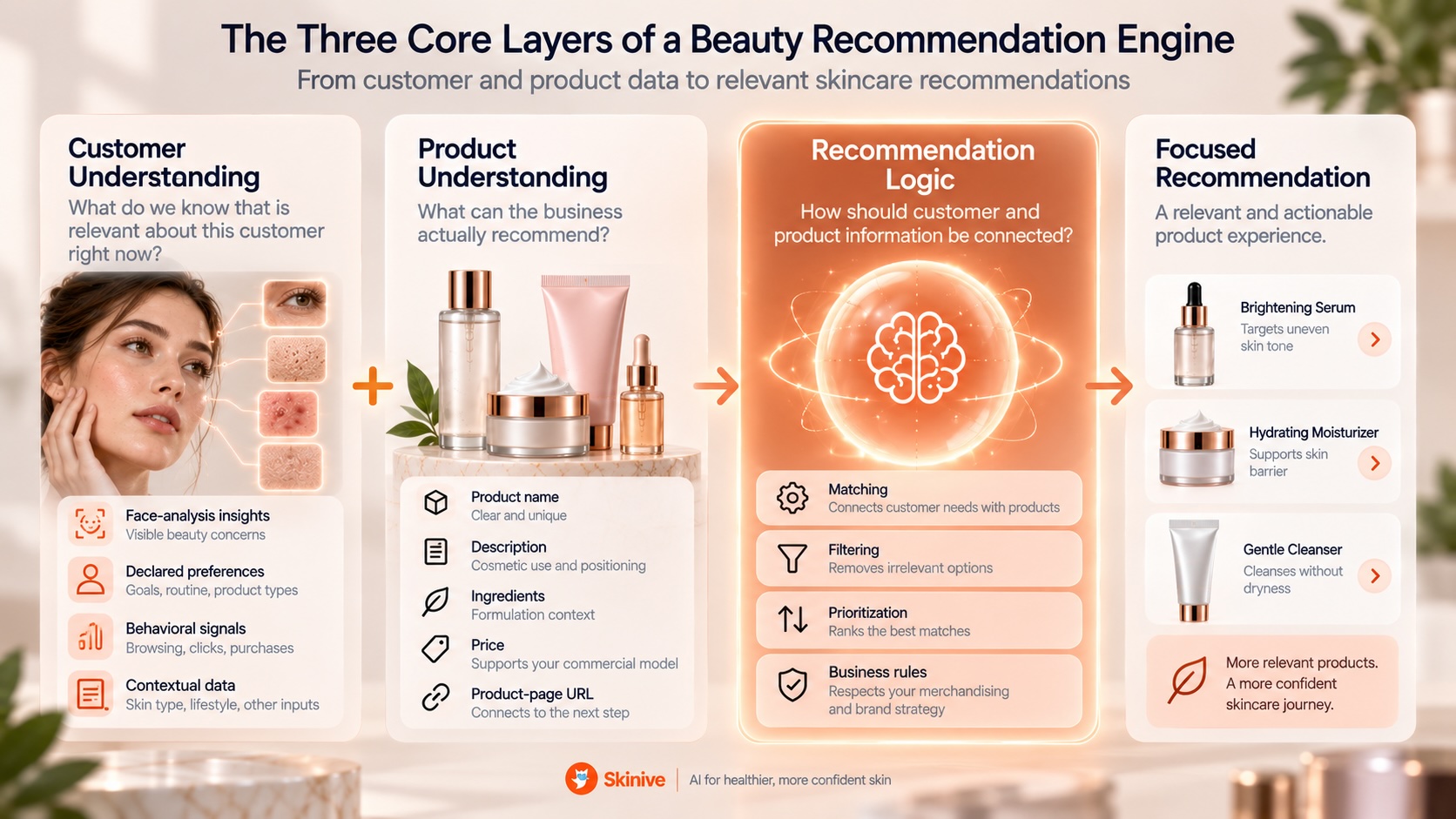
| Layer | Core Question | Example Inputs |
|---|---|---|
| Customer Understanding | What do we know that is relevant about this customer right now? | Face-analysis insights, declared preferences, behavioral signals |
| Product Understanding | What can the business actually recommend? | Product name, description, ingredients, price, URL |
| Recommendation Logic | How should customer and product information be connected? | Matching, prioritization and business rules |
All three matter.
Strong face analysis cannot compensate for poor product information.
A detailed catalog cannot create meaningful personalization if the customer signal is too generic.
And good inputs on both sides still need a clear mechanism for deciding which products should be surfaced.
This middle layer is what distinguishes the recommendation-engine topic from face analysis or personalization alone.
What Is the Role of AI Face Analysis in a Recommendation Engine?
AI face analysis can provide an immediate customer signal without requiring previous shopping history.
Skinive Face Scanner analyzes supported visible cosmetic characteristics including fine lines and wrinkles, pores, blackheads, whiteheads, acne-related imperfections, dark spots, pigmentation, redness and uneven-looking texture.
Those insights can contribute to product discovery.
For example, a supported visible concern can help the recommendation journey determine which part of a large skincare assortment should receive greater relevance.
But face analysis does not determine everything about the customer.
It does not independently reveal preferences, budget, desired routine complexity or other non-visible context.
For this reason, the Face Scanner is best understood as an input into the recommendation layer rather than as the entire recommendation engine.
For a detailed explanation of the analysis itself, see AI Face Analysis: How It Works and What It Can Identify for Beauty & Skincare.
Why Is Product Understanding Essential?
Recommendation systems need to understand both sides of the match.
The customer side answers:
What appears relevant to this customer?
The product side answers:
Which products could satisfy that relevance within this assortment?
This makes product information part of the recommendation architecture.
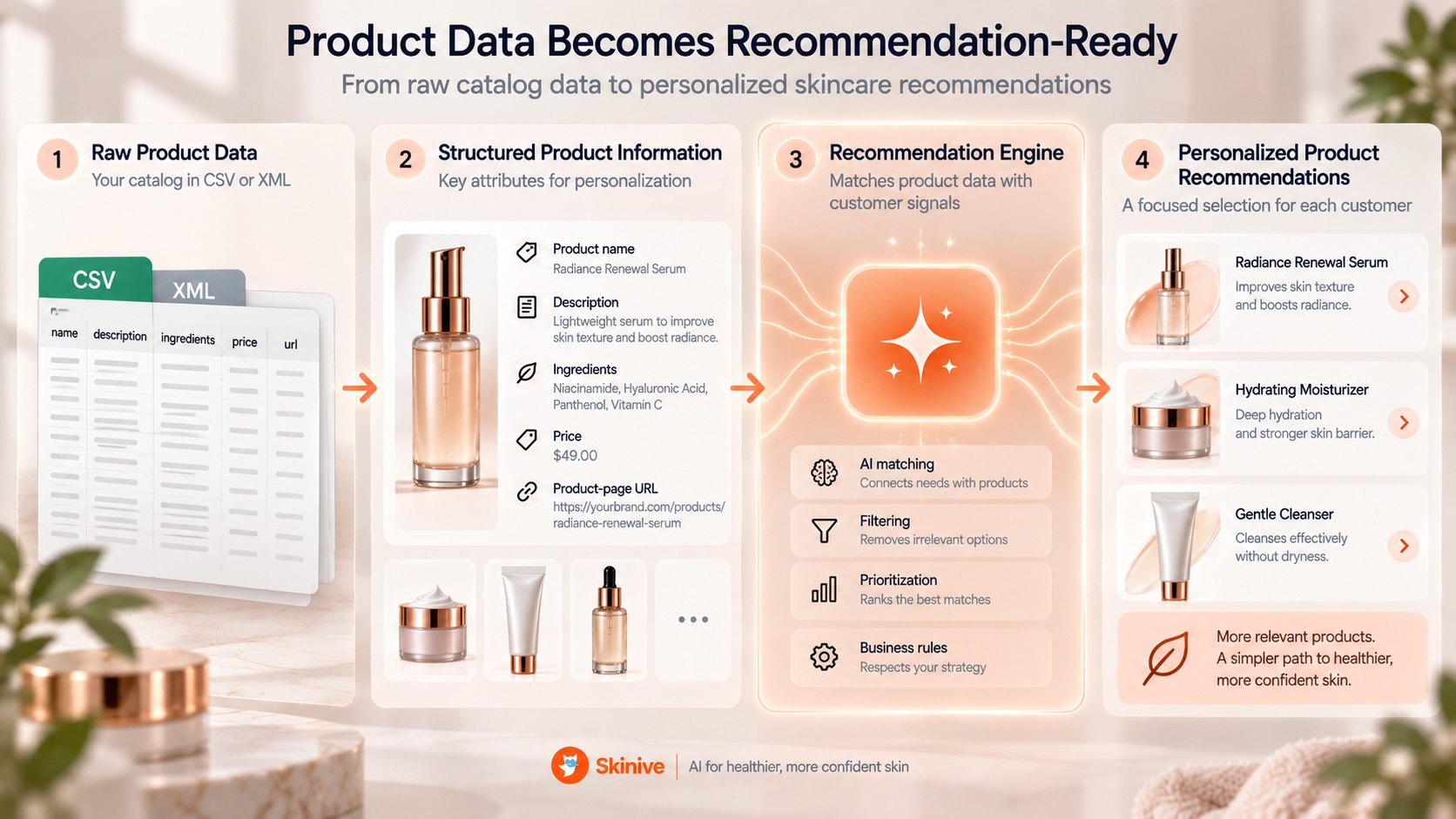
Skinive Face Scanner can work with a beauty brand or retailer’s own skincare catalog. Product information can be supplied in CSV or XML.
The minimum product information includes:
- Product name
- Product description
- Ingredients
- Price
- Product-page URL
Catalog synchronization is unlimited.
Rather than duplicating the complete catalog workflow here, see AI Skincare Recommendations: From Face Analysis to the Right Products for the customer-facing recommendation journey.
For e-commerce implementation specifically, see AI Face Scanner for E-Commerce: How to Personalize Skincare Shopping.
What Makes Product Data Recommendation-Ready?
Having a product feed does not automatically mean that the assortment is ready for useful personalization.
The information needs to make meaningful differences between products understandable.
Product Descriptions
Descriptions provide context about how products are positioned and what type of beauty need they are intended to address.
Ingredients
Ingredient information adds formulation context that can help distinguish products within the assortment.
Price
Price is part of the product information presented within the commercial journey.
Product URLs
A recommendation needs somewhere useful to lead the customer.
The product-page URL connects the recommendation with the next step in digital product discovery.
Current Information
Beauty assortments change.
Products may be added, removed, reformulated, repriced or moved to another page. Recommendation quality therefore depends partly on keeping the underlying catalog information current.
Skinive supports unlimited catalog synchronization so product information can be refreshed as the assortment changes.
The broader principle is simple:
recommendation quality depends not only on customer intelligence, but also on product intelligence.
How Does Matching and Prioritization Work?
Once customer and product information are available, the recommendation layer needs to determine which products deserve priority.
Conceptually, this can involve several operations.
Relevance Matching
Products need to be connected with the customer signals that are relevant to the journey.
Filtering
Products that do not belong in the current recommendation context can be excluded.
Prioritization
When multiple products are potentially relevant, the experience needs a way to determine which should appear first.
Business Constraints
A beauty business may also need commercial or merchandising rules around what can be presented in a particular experience.
The exact recommendation architecture depends on the implementation.
The important distinction is that the recommendation engine is not simply displaying every product associated with a broad category.
Its purpose is to create a more focused ordering of the available assortment.
Rules-Based vs. AI-Assisted Beauty Recommendations
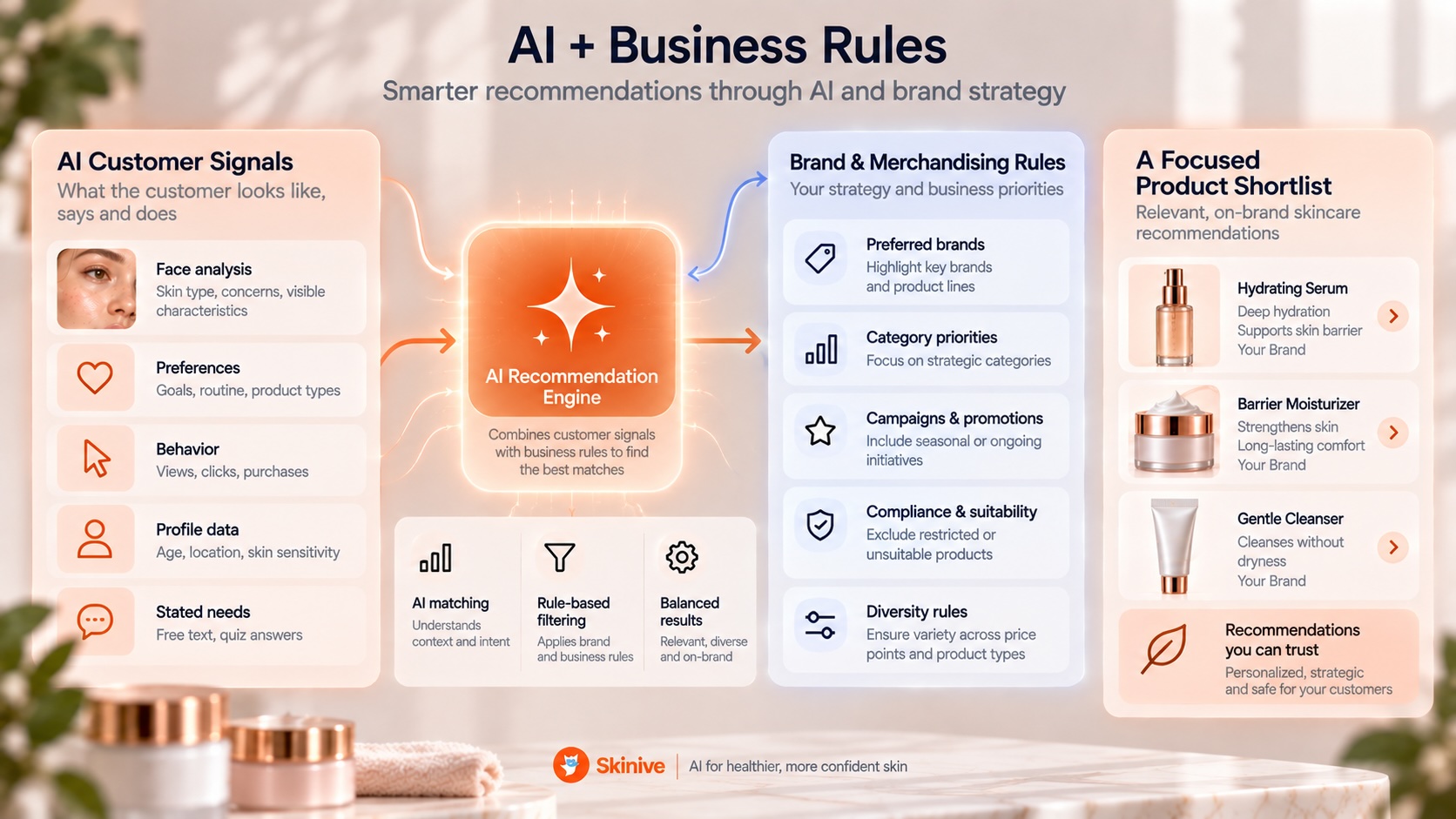
AI does not eliminate the need for business logic.
Beauty recommendation systems can combine AI-generated customer insights with explicit rules and merchandising controls.
| Approach | How It Works | Main Advantage | Main Consideration |
|---|---|---|---|
| Rules-based | Predefined rules connect customer context with products | High control and transparency | Rules require maintenance |
| AI-assisted | AI contributes signals used within recommendation decisions | Adds customer-specific information | Depends on input quality |
| Hybrid | AI signals operate alongside business rules | Combines personalization and control | Requires thoughtful configuration |
A hybrid model can be especially useful in beauty.
AI face analysis can contribute customer-specific visual information, while the business maintains control over the assortment and commercial logic surrounding recommendations.
The goal is not to choose between AI and rules.
It is to decide which decisions benefit from AI-generated customer context and which should remain explicitly controlled by the business.
How Is Face Analysis Different From Behavioral Recommendations?
Behavioral recommendation systems learn from what customers do.
Face analysis contributes information about supported visible cosmetic characteristics.
They therefore solve different information problems.
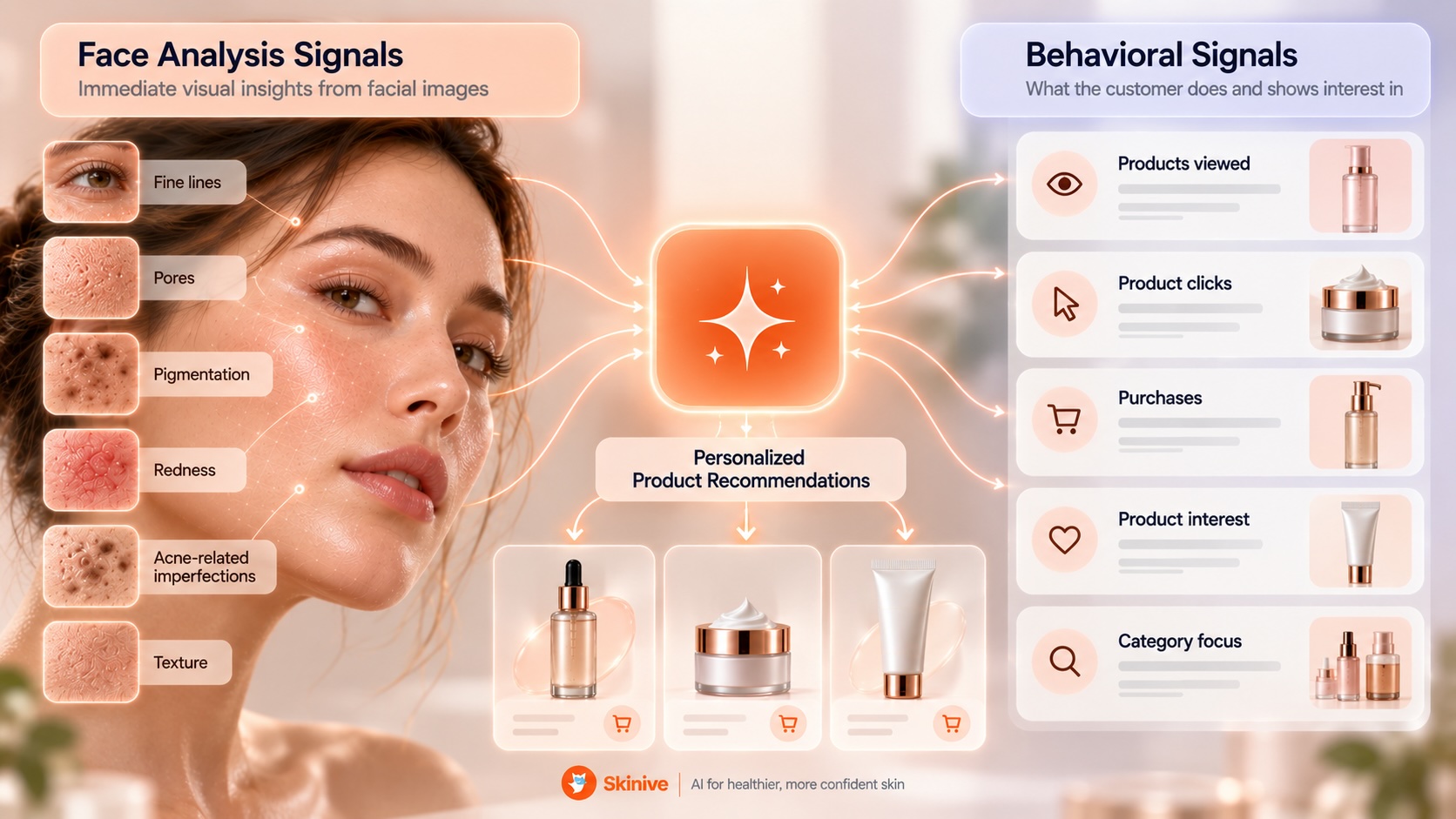
| Face-Analysis Signal | Behavioral Signal | |
|---|---|---|
| Primary input | Facial images | Clicks, views, purchases or other behavior |
| Requires previous behavior | No | Usually needs behavior to observe |
| Visible cosmetic insights | Can contribute directly | May only be inferred indirectly |
| Product interest | Not necessarily known | Can provide a strong signal |
| Non-visible preferences | Cannot determine them | Some may be inferred from behavior |
| Recommendation role | Visual personalization | Behavioral personalization |
One does not need to replace the other.
A recommendation architecture can use different signals when they are available and useful.
This is particularly relevant for new customers.
When little behavioral history exists, a Face Scanner can provide an immediate personalization input during the current journey.
What About Customer Preferences?
Not every recommendation decision can be made from facial images or behavioral data.
Customers may have preferences that need to be stated directly.
For example, a beauty experience may need to know something about a customer’s goals, preferred product formats, desired routine complexity or budget.
Those inputs can complement face analysis.
This does not require turning every recommendation journey into a long questionnaire.
A business can collect only the additional context that materially changes the recommendation.
The dedicated AI Face Scanner vs. Skincare Quiz resource explores the difference between visual and declared inputs in more detail.
Should a Recommendation Engine Return One Product or Several?
There is no universal output format.
The recommendation layer should return the type of result that makes sense for the journey and the amount of customer context available.
Possible outputs include:
- One relevant product
- A focused product shortlist
- A relevant product category
- A multi-product skincare routine
- An advisor-facing shortlist for physical retail
The principle is more important than the format:
prioritize relevance over quantity.
Showing twenty supposedly personalized products can recreate the same choice overload the recommendation engine was intended to reduce.
The detailed customer-facing design of these recommendation formats is covered in AI Skincare Recommendations: From Face Analysis to the Right Products.
How Can Recommendation Logic Support Different Beauty Channels?
The same basic recommendation architecture can support different customer environments.
The inputs, interface and next action may change, but the underlying logic remains:
Customer Signals + Product Understanding → Relevant Product Discovery
On an e-commerce website, the next action might be opening a product page.
In a beauty app, recommendations may appear within a broader mobile customer journey.
In physical retail, the result may support self-service discovery or give a beauty advisor a more focused starting point.
How Does Skinive Face Scanner Fit Into the Recommendation Architecture?
Skinive Face Scanner can provide the face-analysis and catalog-connected components of a beauty recommendation experience.
| Capability | Skinive Face Scanner |
|---|---|
| Face capture | Front, left and right facial images |
| Beauty analysis | Multiple supported visible cosmetic characteristics |
| Product catalog | CSV or XML |
| Minimum product information | Name, description, ingredients, price, product-page URL |
| Catalog synchronization | Unlimited |
| Ready-to-use web deployment | Web Widget |
| Custom web integration | Web SDK |
| Custom workflows | API |
| Native iOS and Android SDKs | Planned |
| Dashboard analytics | Scans, users, product clicks, sales conversions |
The ready-to-use Web Widget can be launched quickly, while the Web SDK and API support more customized implementations.
How Should a Beauty Recommendation Engine Be Evaluated?
A recommendation engine should be evaluated as a product-discovery system, not simply as an AI feature.
Several questions matter.
Are the Customer Signals Useful?
Does the system receive information that can meaningfully differentiate the recommendation journey?
Is the Product Data Strong Enough?
Can the system distinguish products based on current, useful information?
Is the Recommendation Focused?
Does personalization reduce choice or simply create another large product list?
Is Relevance Understandable?
Can the customer understand why the recommended products belong in their journey?
Can the Business Maintain Control?
Can appropriate product and merchandising constraints remain part of the experience?
Can the Catalog Stay Current?
A recommendation system built on stale product information will eventually produce a stale customer experience.
Can Performance Be Measured?
The business needs to understand what happens after recommendations are presented.
These questions are more useful than evaluating a recommendation engine only by the number of AI features it contains.
How Should Recommendation Performance Be Measured?
Recommendation performance begins after the engine produces an output.
Skinive provides dashboard statistics for:
- Scans
- Users
- Product clicks
- Sales conversions
A beauty business can combine these with its own analytics to evaluate additional stages such as:
- Recommendation exposure
- Recommendation interaction
- Product-page visits
- Add-to-cart behavior
- Products explored
- Repeat engagement
- Other commerce or channel-specific actions
Metrics outside the Skinive dashboard depend on the business’s own commerce, app, CRM, POS or analytics environment.
The key question is:
do the recommendations help customers move from uncertainty toward relevant product interaction?
Commercial impact should be measured in the actual implementation rather than assumed from generic industry claims.
Common Mistakes in Beauty Recommendation Engines
Treating Face Analysis as the Entire Engine
Face analysis provides a customer signal. Product understanding and recommendation logic are still required.
Using Weak Product Information
A sophisticated personalization layer cannot reliably distinguish products if the underlying catalog information is poor.
Recommending Too Many Products
A recommendation should narrow the decision rather than reproduce the catalog.
Ignoring Customer Context
Visual analysis cannot determine every preference or shopping constraint.
Hiding the Recommendation Logic From the Customer
The experience should make the relevance of recommendations understandable.
Treating the Catalog as Static
Product information needs to remain current as the assortment changes.
Assuming AI Must Control Every Decision
Business and merchandising rules can remain important parts of the recommendation architecture.
Measuring Only Face Scans
The recommendation itself should be evaluated through downstream product interaction.
Privacy, Transparency, and Customer Trust
A beauty recommendation journey may involve facial images and other customer information.
Customers should understand why information is being requested, what the Face Scanner is intended to do and how the information contributes to product discovery.
Businesses should review the privacy, consent, data-processing, storage, security and other requirements relevant to their particular implementation.
Recommendation language also matters.
Skinive Face Scanner is designed for beauty, cosmetics and personalized skincare experiences. Supported cosmetic face-analysis results should not be presented as medical diagnoses or treatment recommendations.
Building a Better Beauty Recommendation Engine
A useful recommendation system can begin with a relatively simple architecture.
Define the Customer Decision
Identify where customers experience too much choice or uncertainty.
Choose the Relevant Customer Signal
Determine whether face analysis, declared preferences or other available context can improve that decision.
Prepare the Product Catalog
Make sure the recommendation layer has useful, current information about the products it can present.
Define Matching and Business Logic
Decide how customer signals should influence product relevance and where explicit business rules are needed.
Keep the Output Focused
Return a manageable recommendation rather than another large catalog.
Explain Why Products Are Relevant
Make the connection between customer context and product discovery understandable.
Measure Downstream Behavior
Evaluate whether customers actually interact with the recommended products.
More complexity can be added later when it solves a specific problem.
The objective is not to build the most complicated recommendation engine.
It is to build one that makes a beauty assortment easier to understand and navigate.
Related Resources
- AI Face Scanner for E-Commerce: How to Personalize Skincare Shopping
- AI Face Scanner for Beauty & Skincare Apps: Integration and Use Cases
- AI Face Scanner for In-Store Beauty Retail: Personalized Beauty Consultations at the Point of Sale
- AI Face Analysis: How It Works for Beauty & Skincare
- AI Skincare Recommendations: From Face Analysis to Relevant Products
- Personalized Skincare with AI: How Beauty Brands Can Move Beyond Generic Routines
- How AI Face Scanners Can Increase Conversion in Beauty E-Commerce
- Omnichannel Beauty: One AI Face Scanner Across Web, App and In-Store
- Virtual Beauty Consultation: How AI Is Changing the Beauty Advisor Experience
- AI Face Scanner vs. Skin Quiz: Which Creates Better Skincare Personalization?
- What Can an AI Face Scanner Detect? Wrinkles, Pores, Blackheads, Dark Spots and More
- How to Integrate an AI Face Scanner Into a Website in Minutes
- How to Connect a Cosmetics Product Catalog to AI Skincare Recommendations
- The Business Case for AI Beauty Technology: Conversion, Engagement and Customer Retention
Connect Customer Insights With Your Beauty Catalog
Turn supported facial beauty insights into a more focused product-discovery experience using products from your own assortment.