
A beauty-focused AI Face Scanner can analyze supported visible facial characteristics including fine lines and wrinkles, pores, blackheads, whiteheads, acne-related imperfections, dark spots and pigmentation, redness, and uneven-looking texture.
The purpose is cosmetic personalization: helping customers understand visible beauty concerns and move toward relevant skincare products. In this context, “detect” means analyzing supported visual characteristics in facial images—not diagnosing skin disease or determining its medical cause.
Key Takeaways
- AI Face Scanners use facial images to analyze supported visible cosmetic characteristics.
- Skinive Face Scanner supports fine lines and wrinkles, pores, blackheads, whiteheads, acne-related imperfections, dark spots and pigmentation, redness, and uneven-looking texture.
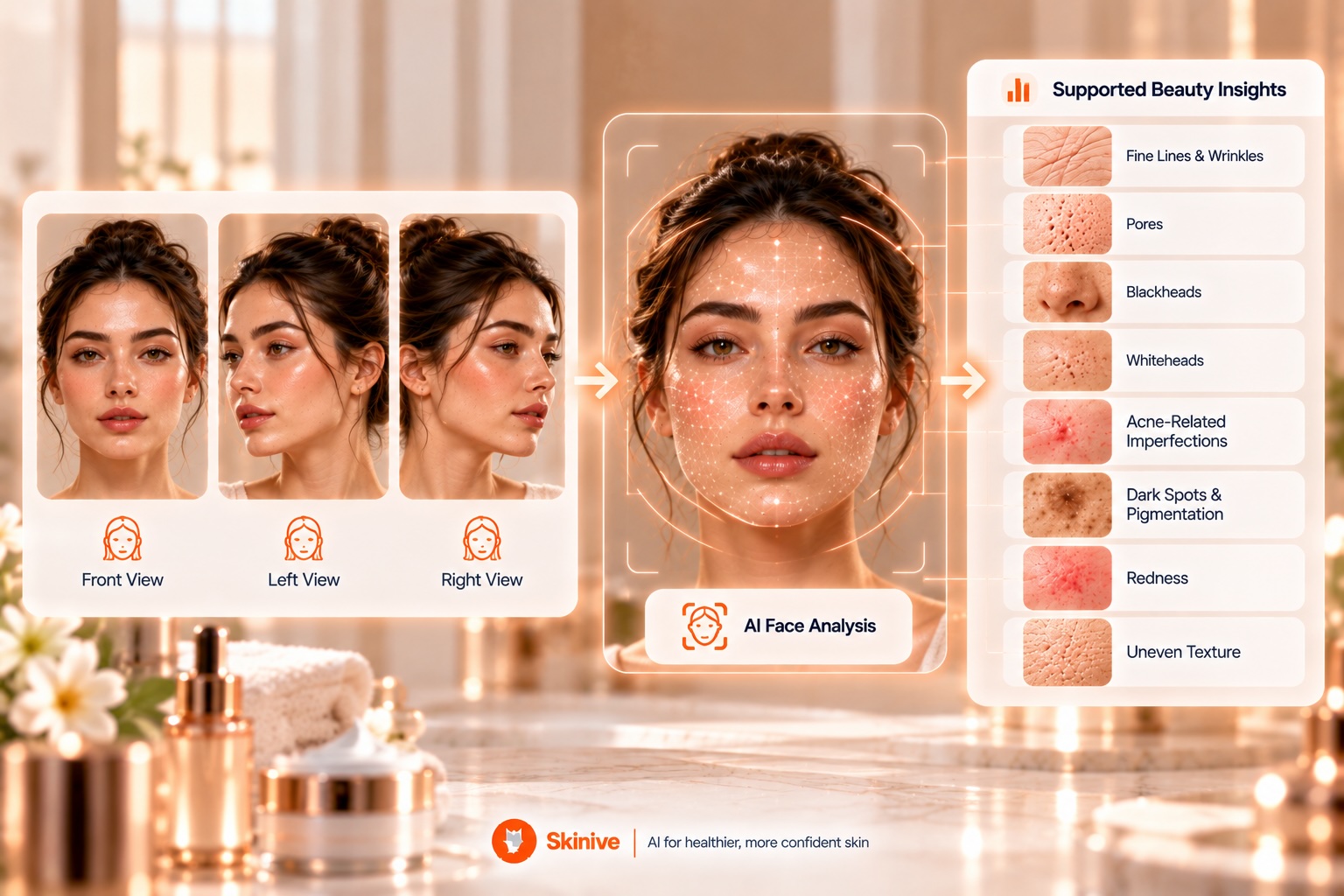
- Skinive uses front, left and right facial images for the analysis experience.
- Image quality, lighting, focus, framing and facial visibility can affect image-based analysis.
- Face Scanner results can become inputs for personalized product discovery using a beauty brand or retailer’s own catalog.
- Facial images cannot reliably reveal preferences, budget, routine, skincare history or the cause of a visible concern.
- Skinive Face Scanner is intended for beauty, cosmetics and personalized skincare rather than medical diagnosis.
What Does an AI Face Scanner Actually Analyze?
An AI Face Scanner uses facial images as input and applies computer vision to the visible characteristics supported by the system.
In a beauty context, the output describes cosmetic characteristics that can contribute to personalized skincare discovery.
Skinive Face Scanner uses three facial views:
- Front
- Left
- Right
These images provide the visual input for the analysis experience.
The important limitation is equally straightforward:
The Face Scanner can analyze supported characteristics visible in the submitted images. It cannot determine everything about the customer’s skin, preferences, lifestyle or health from a photograph.
What Beauty Concerns Can Skinive Face Scanner Analyze?
Skinive Face Scanner supports multiple visible cosmetic characteristics.
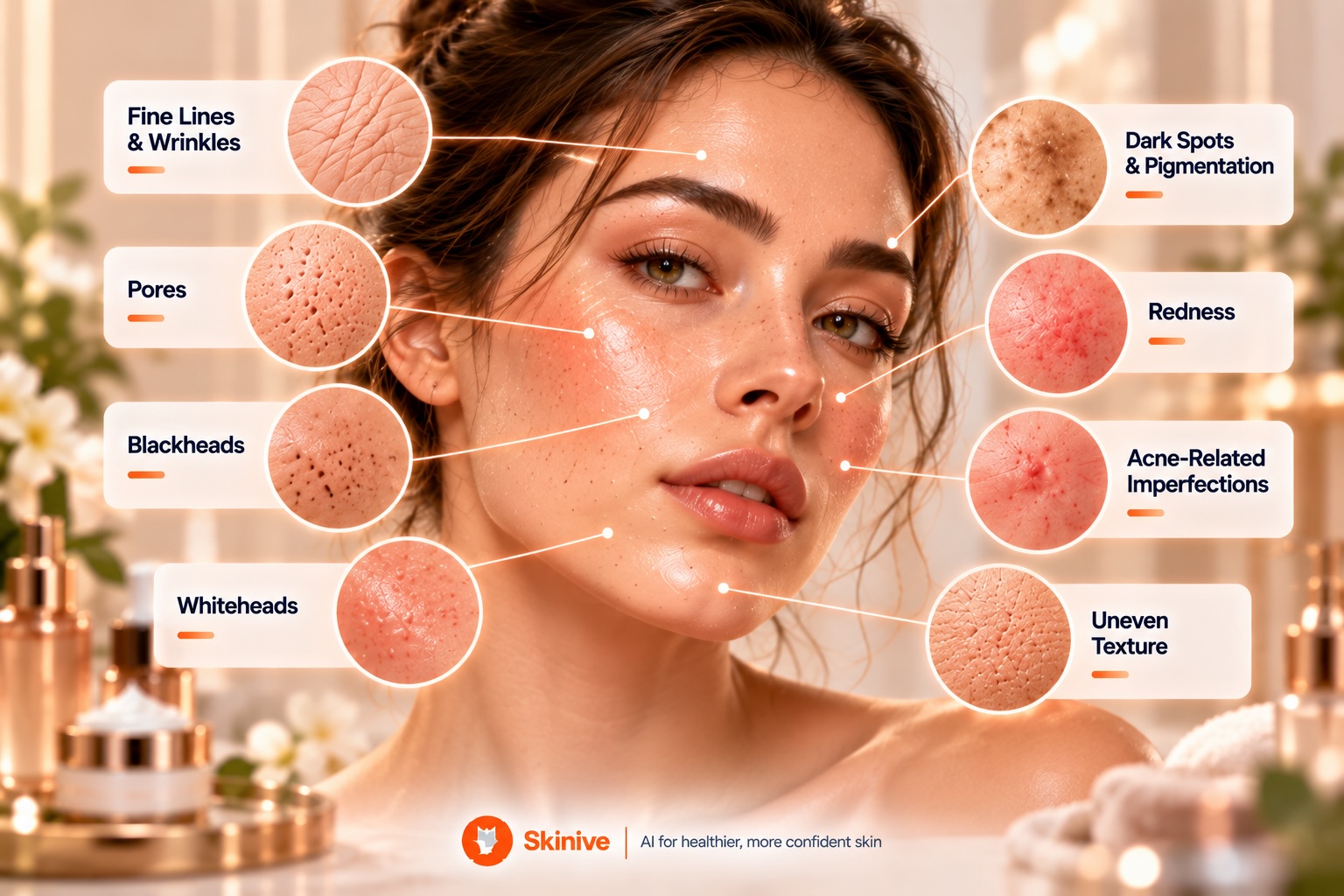
| Supported Beauty Concern | Beauty Context | Potential Product-Discovery Role |
|---|---|---|
| Fine lines & wrinkles | Visible fine lines and wrinkles | Explore products positioned around hydration, smoothing or the appearance of fine lines |
| Pores | Visible pore appearance | Explore products positioned around pores and skin texture |
| Blackheads | Visible blackhead-related cosmetic concern | Explore relevant cleansing, exfoliating or clarifying categories |
| Whiteheads | Visible whitehead-related cosmetic concern | Support relevant cosmetic product discovery |
| Acne-related imperfections | Visible blemish-related appearance | Explore products positioned for blemish-prone appearance |
| Dark spots & pigmentation | Visible darker areas and uneven-looking pigmentation | Explore products positioned around dark spots or more even-looking tone |
| Redness | Visible facial redness | Explore products positioned around soothing or redness-prone appearance |
| Uneven-looking texture | Visible variation in surface appearance | Explore products positioned around smoother-looking texture |
These results should be interpreted as beauty insights, not medical findings.
Fine Lines and Wrinkles
Fine lines and wrinkles are common visible beauty concerns.
Skinive Face Scanner can analyze them as supported cosmetic characteristics and use the resulting beauty insight as an input for personalized product discovery.
For example, a beauty retailer may connect this concern with products positioned around:
- Hydration
- Smoother-looking skin
- Firmness
- Appearance of fine lines and wrinkles
The Face Scanner should not be presented as determining biological age or predicting how someone’s skin will age.
It analyzes what is visible in the submitted images within its supported beauty scope.
Visible Pores
Pores are normal features of skin, but their appearance is a common cosmetic concern.
Skinive Face Scanner can analyze visible pore appearance as part of its beauty analysis.
A retailer can then use that result to help customers navigate relevant skincare categories based on its own product assortment and positioning.
Because pores involve relatively small visible details, clear image capture remains important.
Blackheads
Skinive Face Scanner supports blackheads as a visible cosmetic concern.
This can be particularly useful in a personalization journey because customers would otherwise need to identify the concern themselves through browsing or a questionnaire.
The result can become a starting point for exploring relevant cosmetic products without turning the beauty analysis into a medical assessment.
Whiteheads
Whiteheads are also among the supported visible cosmetic characteristics.
As with other small facial details, what is available to image-based analysis depends on the visual information captured in the submitted images.
The result should therefore be presented as a beauty-focused visual insight rather than a clinical classification.
Acne-Related Imperfections
Skinive Face Scanner can analyze visible acne-related imperfections for cosmetic personalization.
The distinction between beauty and medicine is especially important here.
In a Face Scanner beauty experience, appropriate language includes:
- Visible imperfections
- Blemish-related appearance
- Acne-related imperfections
- Blemish-prone appearance
The scanner should not be presented as diagnosing acne as a medical condition, determining its cause or assessing clinical severity.
If a customer needs medical diagnosis or treatment, that is outside the scope of a cosmetic Face Scanner.
Dark Spots and Pigmentation
Skinive Face Scanner supports visible dark spots and pigmentation as cosmetic characteristics.
These results can help organize product discovery around beauty goals such as:
- Appearance of dark spots
- More even-looking tone
- Pigmentation-focused cosmetic care
The analysis remains based on visible image information.
It should not imply that the system determines the medical cause of pigmentation changes.
Redness
Visible facial redness can also be analyzed within the supported beauty scope.
In a cosmetic experience, this can help customers explore products positioned around soothing care or the appearance of redness-prone skin.
Redness can occur for many different reasons.
A beauty Face Scanner should therefore describe what is visibly analyzed without claiming to identify an underlying medical cause.
Uneven-Looking Skin Texture
Texture describes the visible appearance of the facial surface.
Skinive Face Scanner can analyze uneven-looking texture as a supported cosmetic characteristic.
This can be useful when customers recognize that their skin does not look as smooth or even as they would like but do not know how to translate that observation into product discovery.
The beauty journey can then connect the result with products positioned around smoother-looking or more refined-looking texture.
How Does AI Identify Visible Beauty Concerns?
At a high level, AI face analysis turns facial images into structured visual inputs that can be evaluated for the characteristics supported by the system.
For Skinive Face Scanner, the customer-facing journey can be understood as:
Capture Front, Left and Right Views → Analyze Supported Visible Characteristics → Present Beauty Insights → Use Insights for Personalization
The underlying computer-vision implementation is more complex, but customer-facing content does not need to imply technical processes that have not been specifically documented.
The essential boundary is:
AI analyzes supported visual information in images. It does not infer every aspect of a customer’s skin, lifestyle or health.
For a deeper explanation, see AI Face Analysis: How It Works and What It Can Identify for Beauty & Skincare.
Why Does Skinive Use Front, Left and Right Photos?
Different facial views provide visual information from different sides of the face.
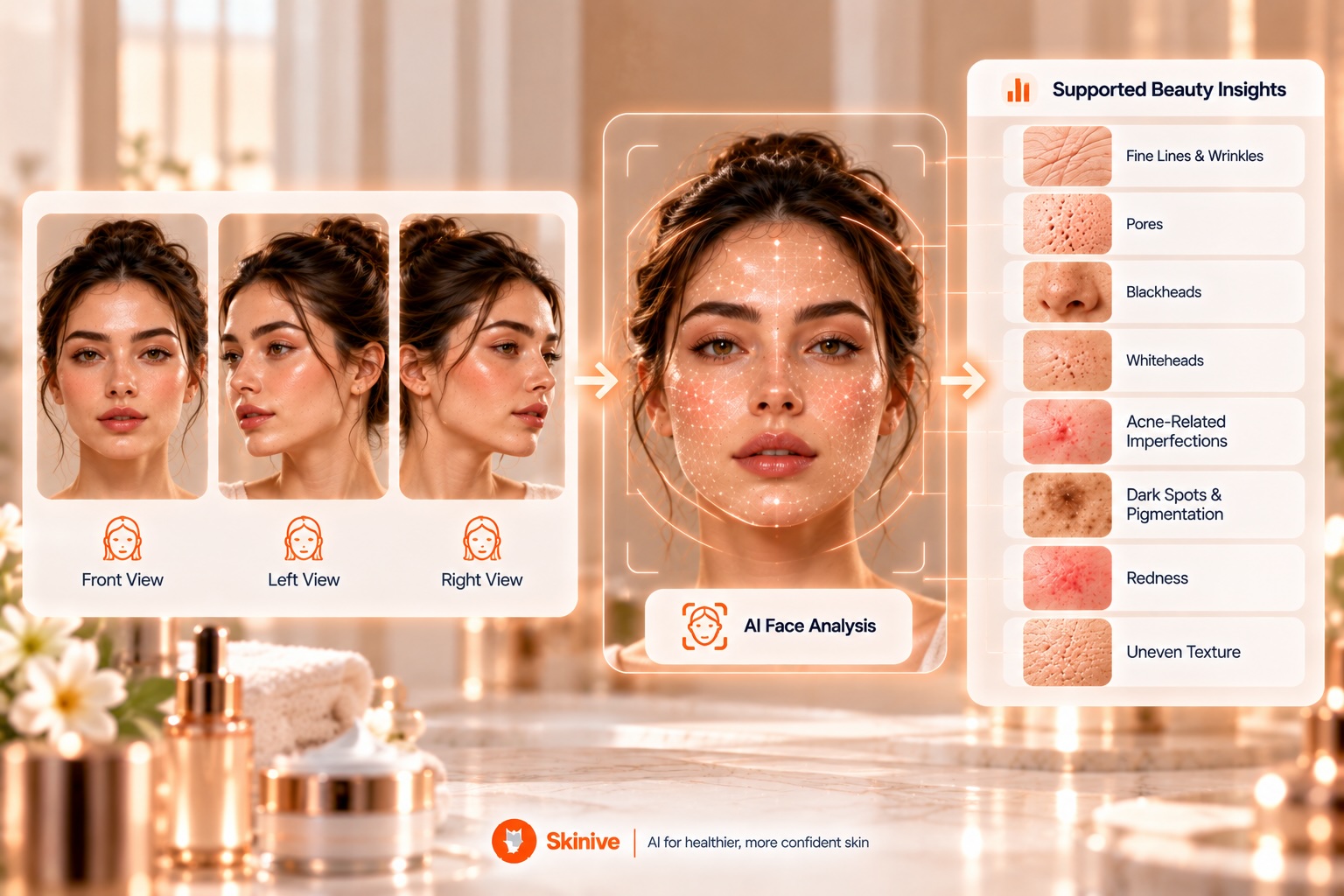
Skinive Face Scanner therefore uses:
Front → Left → Right
This creates a structured three-view capture experience rather than relying only on one front-facing image.
Customers should follow the capture guidance provided by the experience so the requested facial areas are clearly visible.
Why Does Image Quality Matter for AI Face Analysis?
An image-based system can only analyze visual information available in the images it receives.
Poor capture conditions can obscure or alter visible facial details.
| Image Factor | Why It Matters | Practical Guidance |
|---|---|---|
| Lighting | Shadows or color casts can change visible appearance | Use clear, even lighting |
| Focus | Blur can obscure smaller details | Keep the face in focus |
| Angle | Incorrect positioning changes what is visible | Follow the requested front, left and right views |
| Framing | Missing facial areas reduce visible information | Keep the requested face area in frame |
| Filters | Filters can alter visible texture or tone | Avoid beauty filters and retouching |
| Facial coverage | Makeup or other coverage may change what is visible | Follow the capture guidance |
| Camera processing | Devices can process images differently | Use the guided capture experience consistently |
The goal is not photographic perfection.
It is to provide clear images that represent the visible face as consistently as practical.
Can an AI Face Scanner See Everything About Your Skin?
No.
A Face Scanner only has access to the visual information contained in the images and the characteristics its system supports.
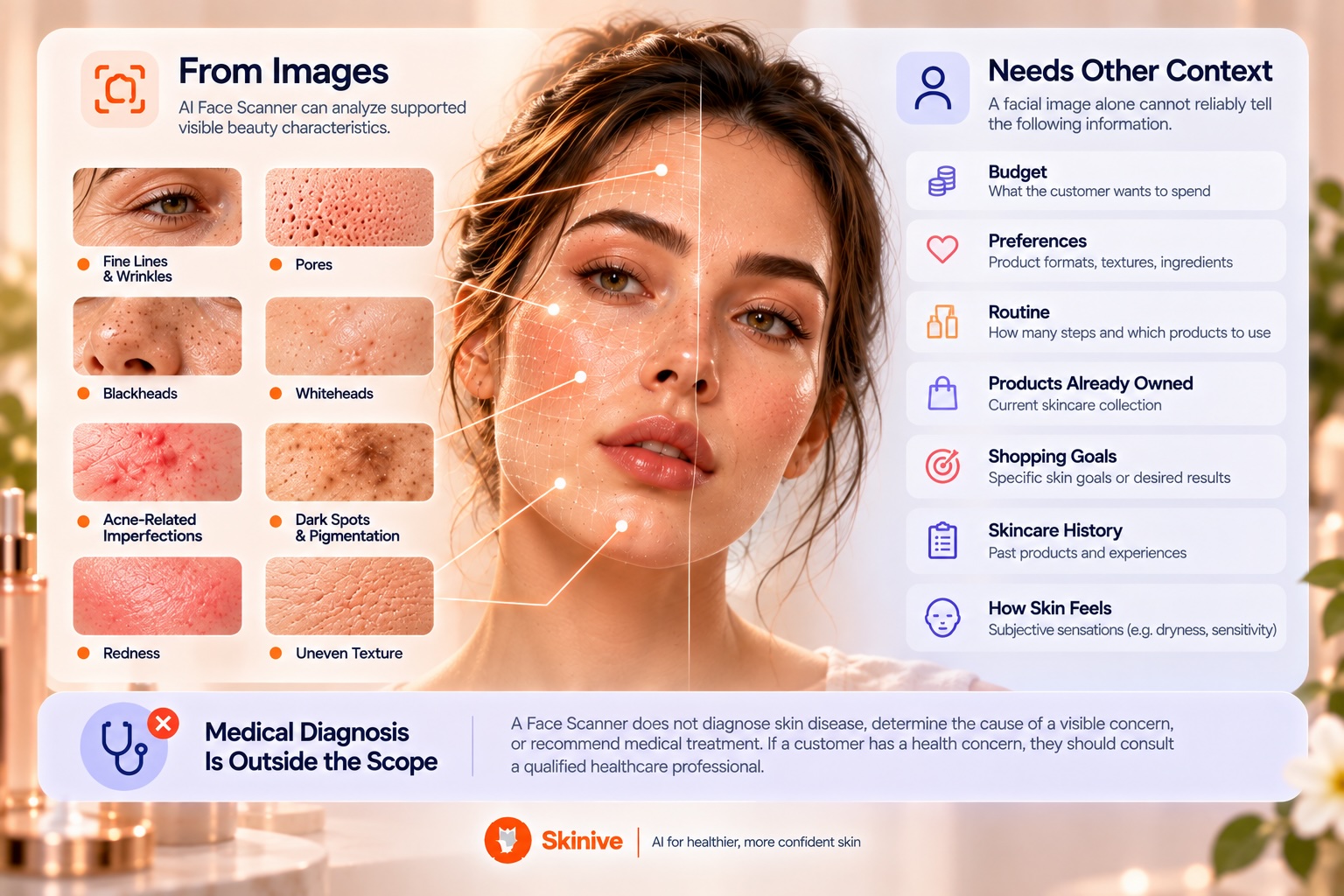
From facial images alone, it cannot reliably determine information such as:
| Not Reliably Determined From Facial Images | Better Source |
|---|---|
| Customer budget | Customer question |
| Desired routine complexity | Customer question |
| Product-format preferences | Customer question |
| Products already owned | Customer input or surrounding business systems |
| Purchase history | Retailer’s commerce or CRM systems |
| Shopping goals | Customer question or behavior |
| Subjective skin sensations | Customer input |
| Complete skincare history | Customer input |
| Cause of a visible characteristic | Outside cosmetic image analysis |
| Presence of a medical condition | Medical assessment |
| Appropriate medical treatment | Qualified healthcare professional |
This is why face analysis can be combined with other customer inputs when the product-discovery journey requires additional context.
AI Face Scanner vs. Customer Self-Assessment
Traditional skincare quizzes often ask customers to identify visible concerns themselves.
Face analysis introduces another source of information.
| AI Face Analysis | Customer Self-Assessment | |
|---|---|---|
| Input | Facial images | Customer interpretation |
| Supported visible characteristics | Computer-vision analysis | Customer selection |
| Process | Standardized analysis workflow | Depends on customer understanding |
| Preferences | Cannot be reliably inferred | Can be stated directly |
| Goals | Limited from image alone | Can be stated directly |
| Best role | Visual beauty input | Declared customer context |
Neither method provides every type of information.
For the detailed comparison, see AI Face Scanner vs. Skin Quiz: Which Creates Better Skincare Personalization?
What Does “Detect” Mean in a Beauty Face Scanner?
Words such as detect, identify, scan and analyze are commonly used when people search for AI beauty technology.
In this article, “detect” means:
the AI analyzes visible image information associated with a supported cosmetic characteristic.
It does not mean medical disease detection.
For example:
Beauty meaning: analyzing visible redness as a cosmetic characteristic.
Medical meaning: determining whether redness represents a particular health condition.
Skinive Face Scanner performs the first type of task within its beauty and cosmetics scope.
The distinction is particularly important for terms such as acne, pigmentation and redness because those words can appear in both beauty and medical contexts.
Beauty Face Analysis vs. Medical Diagnosis
The two should not be treated as equivalent.
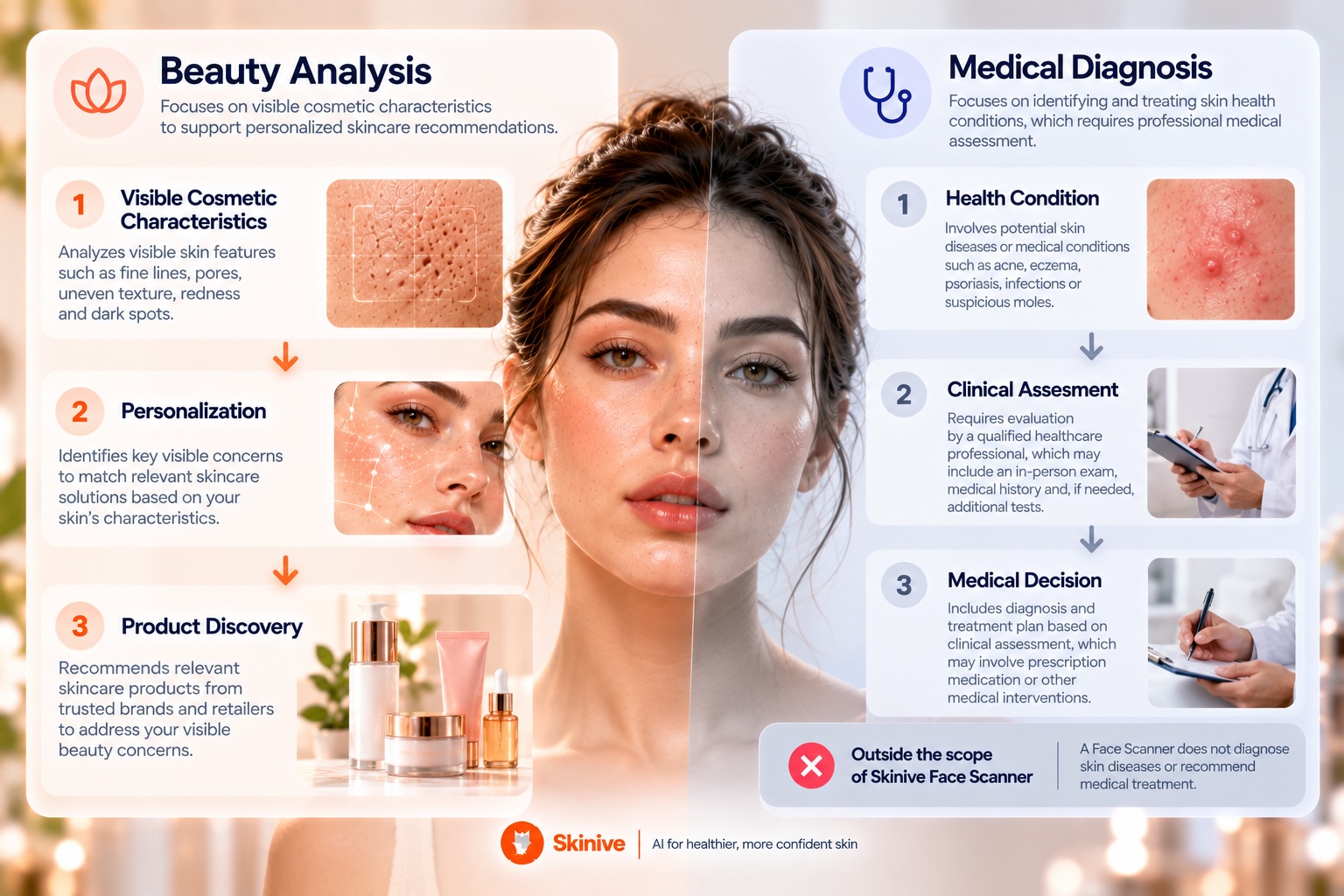
| Beauty Face Analysis | Medical Diagnosis |
|---|---|
| Analyzes supported visible cosmetic characteristics | Investigates or determines health conditions |
| Supports beauty personalization and product discovery | Supports clinical decision-making |
| Uses cosmetic and skincare context | Uses medical context |
| Can connect beauty insights with cosmetics products | May involve medical history, examination or tests |
| Does not prescribe medical treatment | May lead to treatment decisions by qualified professionals |
| Skinive Face Scanner belongs in this category | Outside Skinive Face Scanner’s beauty scope |
Keeping this distinction explicit helps prevent cosmetic personalization from being mistaken for healthcare.
From Visible Beauty Concerns to Product Discovery
Analysis becomes more useful in a beauty-commerce experience when customers can understand what to do next.
A simple journey is:
Face Analysis → Supported Beauty Insight → Relevant Product Discovery
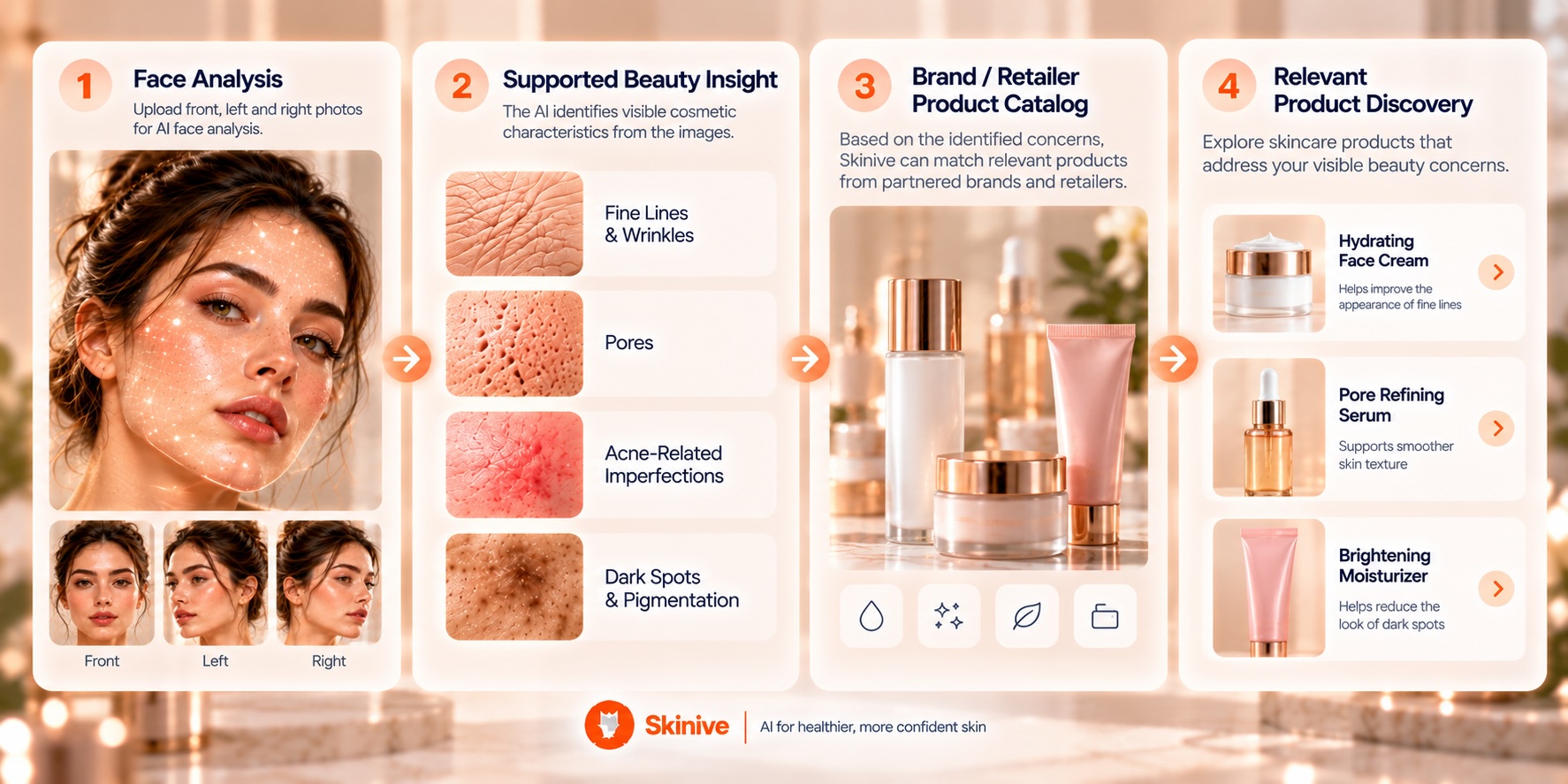
Skinive Face Scanner can work with a beauty brand or retailer’s own skincare catalog.
Product data can be provided through CSV or XML.
Minimum product information includes:
- Product name
- Description
- Ingredients
- Price
- Product-page URL
Catalog synchronization is unlimited.
Starter supports up to 1,000 products, Growth up to 5,000 products, while Enterprise can address custom requirements.
For the detailed recommendation journey, see AI Skincare Recommendations: From Face Analysis to the Right Products.
How Should Product Discovery Use Face Scanner Results?
Face Scanner results should be treated as personalization inputs rather than automatic instructions to purchase a particular product.
A useful product-discovery experience can:
- Connect supported beauty characteristics with relevant products or categories
- Use current catalog information
- Explain why products are being shown
- Keep the selection manageable
- Add customer preferences when they materially improve relevance
- Preserve normal product browsing
- Avoid medical treatment claims
The objective is to reduce uncertainty around product discovery without overstating what facial analysis knows about the customer.
Where Can AI Face Analysis Be Used?
The same beauty-analysis capability can support several customer environments.
| Channel | Potential Role |
|---|---|
| Beauty e-commerce | Visual starting point for personalized product discovery |
| Mobile beauty experience | Interactive face-analysis experience |
| Physical cosmetics retail | Self-service or beauty-advisor-assisted starting point |
| Virtual beauty consultation | Structured visual input for the consultation |
| Omnichannel beauty | Consistent supported beauty-analysis concept across touchpoints |
The surrounding UX can change while the supported analysis remains within the same cosmetic scope.
How Skinive Face Scanner Supports Beauty Analysis
| Capability | Skinive Face Scanner |
|---|---|
| Image capture | Front, left and right facial views |
| Beauty analysis | Multiple supported visible cosmetic characteristics |
| Product catalog | CSV or XML |
| Minimum catalog data | Name, description, ingredients, price, product-page URL |
| Catalog synchronization | Unlimited |
| Web Widget | Available; launch can take around five minutes |
| Web SDK | Available |
| API | Available |
| Native iOS SDK | Planned |
| Native Android SDK | Planned |
| Analytics | Scans, users, product clicks, sales conversions |
| Starter | €99/month + €0.20/scan; up to 1,000 products |
| Growth | €199/month + €0.15/scan; up to 5,000 products |
| Enterprise | Custom |
How Should Beauty Brands Explain Face Scanner Results?
Customer-facing language should accurately reflect what the system is doing.
Use Cosmetic Language
Describe visible characteristics within a beauty and skincare context.
Explain That Results Come From Images
Customers should understand that the experience is based on visual analysis.
Keep Results Actionable
Prioritize insights that help customers understand the next step.
Avoid Unsupported Precision
Do not imply that the Face Scanner knows more than its supported capabilities provide.
Avoid Medical Conclusions
Visible characteristics should not be translated into disease diagnoses or medical treatment recommendations.
Connect Analysis With Useful Next Steps
Beauty insights become more useful when customers can continue toward relevant product discovery or another appropriate beauty experience.
Related Resources
- AI Face Scanner for E-Commerce: How to Personalize Skincare Shopping
- AI Face Scanner for Beauty & Skincare Apps: Integration and Use Cases
- AI Face Scanner for In-Store Beauty Retail: Personalized Beauty Consultations at the Point of Sale
- AI Face Analysis: How It Works for Beauty & Skincare
- AI Skincare Recommendations: From Face Analysis to Relevant Products
- Personalized Skincare with AI: How Beauty Brands Can Move Beyond Generic Routines
- AI Product Recommendation Engine for Beauty and Skincare Brands
- How AI Face Scanners Can Increase Conversion in Beauty E-Commerce
- Omnichannel Beauty: One AI Face Scanner Across Web, App and In-Store
- Virtual Beauty Consultation: How AI Is Changing the Beauty Advisor Experience
- AI Face Scanner vs. Skin Quiz: Which Creates Better Skincare Personalization?
- How to Integrate an AI Face Scanner Into a Website in Minutes
- How to Connect a Cosmetics Product Catalog to AI Skincare Recommendations
- The Business Case for AI Beauty Technology: Conversion, Engagement and Customer Retention
Turn Visible Beauty Concerns Into Personalized Product Discovery
Use AI-powered face analysis to identify supported cosmetic characteristics and connect customers with relevant products from your own skincare assortment.