
The business case for AI beauty technology is not that an AI Face Scanner automatically increases revenue. It is that personalized face analysis can reduce product-discovery friction, create a more interactive beauty-shopping journey, and connect customers with relevant products from a retailer’s own catalog.
For beauty brands and retailers, the commercial impact should be evaluated through measurable customer behavior: adoption, engagement with recommendations, product discovery, conversion, and repeat interaction. ROI depends on the retailer’s traffic, margins, implementation costs, catalog quality, and customer behavior, so it should be validated with first-party data rather than generic uplift claims.
Key Takeaways
- AI beauty technology should be evaluated as a measurable commerce and customer-experience capability, not simply as an interactive feature.
- The core commercial hypothesis is that better personalization can reduce product-discovery friction and help customers reach relevant products more efficiently.
- Conversion, engagement, and customer retention represent different value opportunities and should be measured with different KPIs.
- A Face Scanner does not guarantee higher conversion or revenue. Incremental impact should be tested against an appropriate baseline or control.
- ROI should account for gross profit as well as software, scan, implementation, catalog-management, analytics, and operational costs.
- A focused pilot can test customer adoption and commercial impact before a retailer invests in deeper customization or wider deployment.
- Skinive Face Scanner supports a ready-to-use Web Widget, Web SDK, API, product catalogs through CSV or XML, and dashboard measurement of scans, users, product clicks, and sales conversions.
What Is the Business Case for AI Beauty Technology?
The business case for AI beauty technology is the economic and customer-experience rationale for adding AI-powered personalization to a beauty-shopping journey.
For an AI Face Scanner, the important question is not simply whether the technology can analyze visible facial characteristics. The commercial question is whether the resulting experience helps customers discover relevant skincare products more effectively.
Beauty retailers often operate large assortments containing cleansers, serums, creams, masks, exfoliants, and other products positioned around different cosmetic needs. Customers may know that they want to improve their skincare routine while remaining uncertain about where to begin.
AI face analysis can provide a visual starting point.
Skinive Face Scanner analyzes supported visible facial beauty concerns and can connect that context with products from a retailer’s own catalog. Instead of asking customers to navigate the entire assortment manually, the retailer can create a more focused path:
Face Analysis → Relevant Beauty Context → Product Recommendations → Product Discovery
This creates a testable commercial hypothesis:
If customers receive more relevant product guidance with less effort, does their behavior improve enough to justify the cost of providing the experience?
That is the foundation of the business case.
Where Can AI Beauty Technology Create Business Value?
AI beauty technology can potentially influence several parts of the customer journey. These value areas should be treated as hypotheses to test rather than guaranteed outcomes.
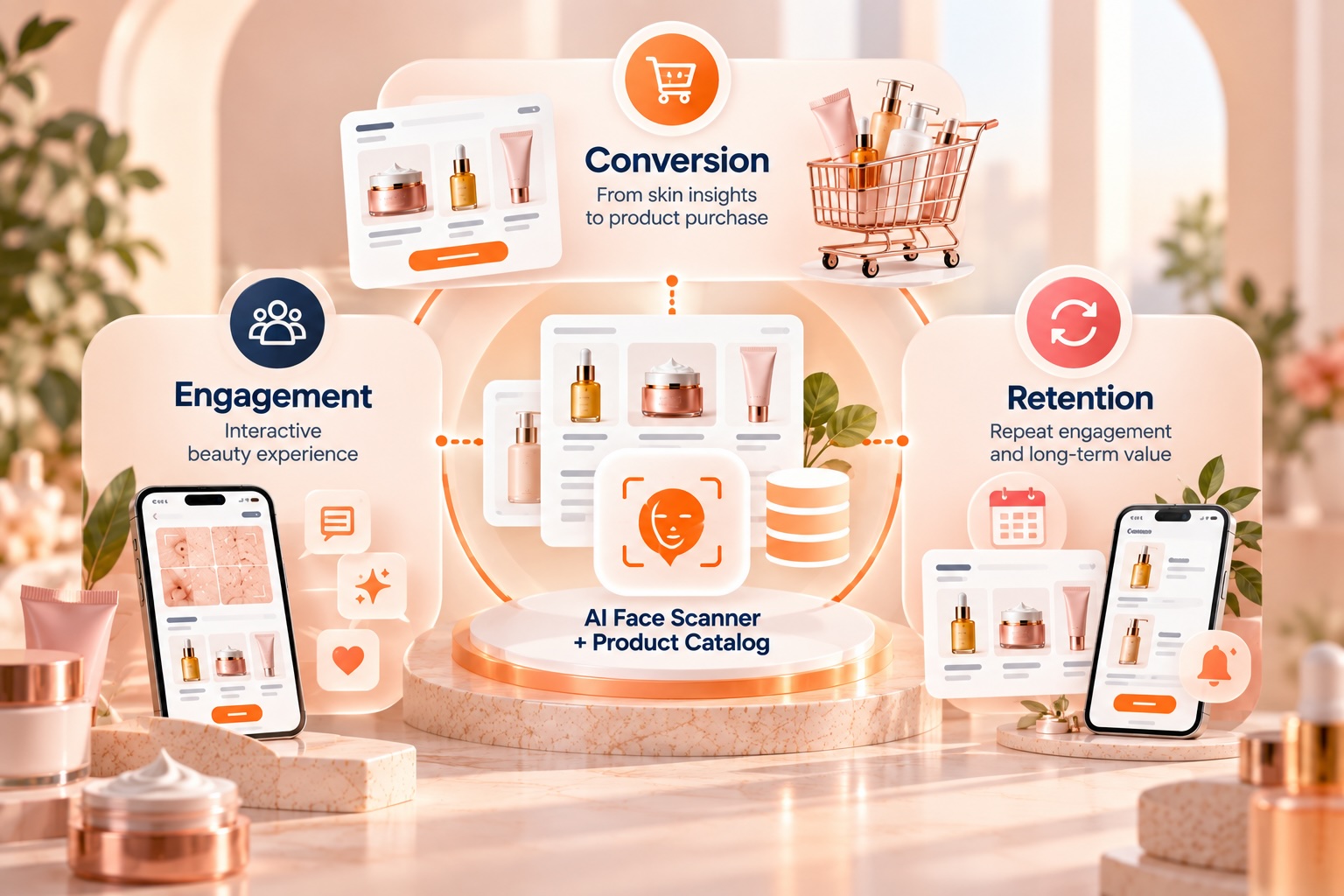
| Value Area | Potential Mechanism | What to Measure |
|---|---|---|
| Conversion | Reduce product-discovery friction and guide customers toward relevant products | Product clicks, add-to-cart behavior, purchase conversion |
| Engagement | Turn passive browsing into an interactive personalized experience | Scanner starts, completion, recommendation engagement |
| Product discovery | Narrow a large assortment to more relevant products | Products explored, recommendation clicks, category interaction |
| Basket development | Surface complementary products or routines where appropriate | Units per order, basket value, product combinations |
| Retention | Give customers a useful reason to return to the personalized experience | Returning users, repeat use, repeat purchase |
| Assisted selling | Provide structured beauty context for advisors | Advisor adoption, recommendation interaction, assisted sales |
| Omnichannel experience | Apply a consistent personalization concept across channels | Channel-specific and cross-channel engagement |
A retailer does not need to optimize every value area simultaneously.
A better pilot usually begins with one primary commercial objective and a small number of supporting metrics.
For an e-commerce retailer, that objective may be product discovery or conversion. For a beauty app, repeat engagement may matter more. For physical retail, the value may lie in assisted selling and consultation quality.
Conversion: Can AI Face Scanning Help Customers Reach Products More Efficiently?
AI face scanning can support conversion when it helps customers move from uncertainty toward relevant products with less unnecessary browsing.
The mechanism is particularly relevant when:
- the skincare assortment is large;
- customers struggle to understand product differences;
- beauty concerns span several categories;
- product terminology is complex;
- customers do not know which category to explore first.
However, adding a Face Scanner does not automatically improve conversion.
The experience can create additional friction if customers do not understand why they should start, image capture is difficult, results are unclear, or recommendations do not create an obvious next step.
This is why conversion should be analyzed through the complete customer journey rather than inferred from the number of scans.
A practical funnel is:
Scanner Exposure → Start → Complete Scan → Results → Recommendations → Product Click → Cart → Purchase
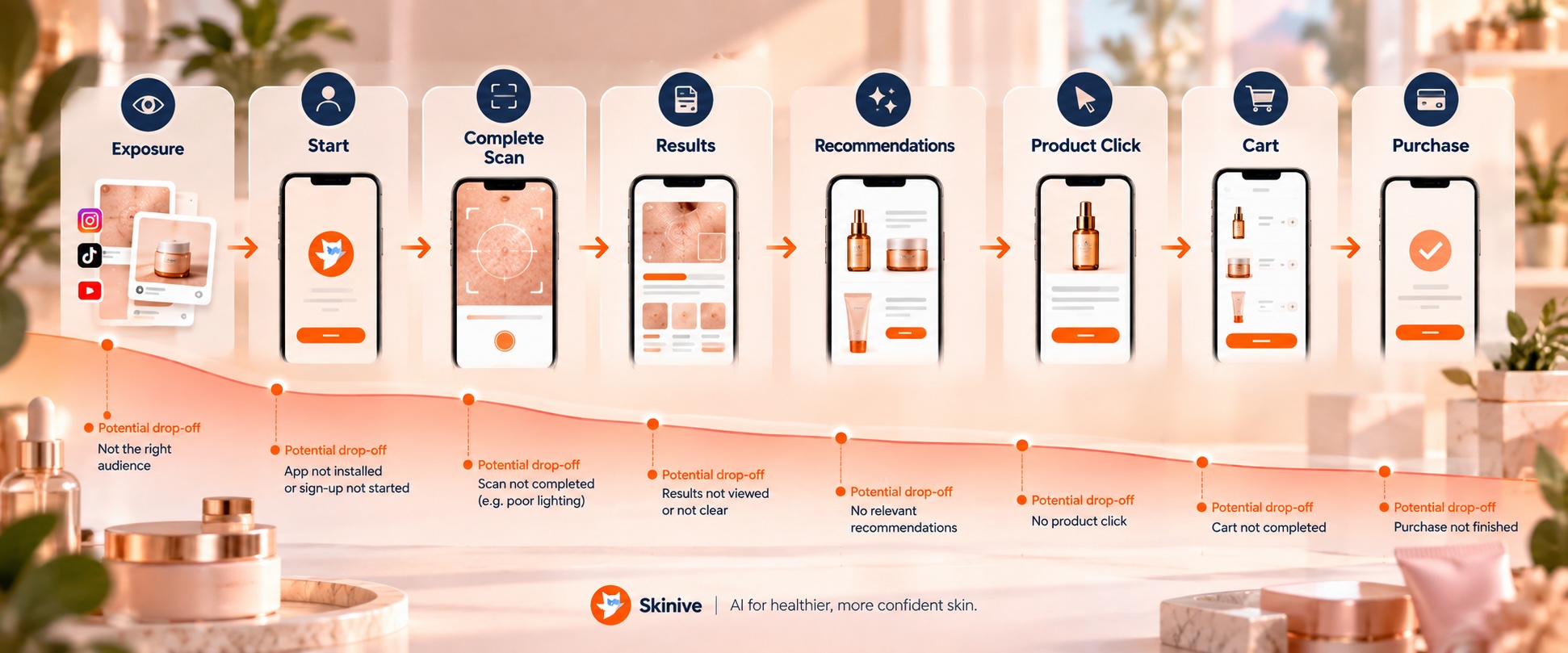
Each stage answers a different commercial question.
| Funnel Stage | Example KPI | Diagnostic Question |
|---|---|---|
| Exposure | Scanner entry-point impressions | Are relevant customers seeing the experience? |
| Start | Start rate | Is the value proposition strong enough? |
| Capture | Completion rate | Can customers complete the analysis without excessive friction? |
| Results | Results reach rate | Are customers successfully reaching the personalized value? |
| Recommendations | Recommendation engagement | Do the recommendations create interest? |
| Product discovery | Product clicks | Are customers moving toward products? |
| Cart | Add-to-cart behavior | Does discovery create purchase intent? |
| Purchase | Conversion | Does the journey contribute to completed transactions? |
The important commercial insight is not simply whether conversion changed.
The funnel helps identify where the personalized journey succeeds or fails.
For a deeper conversion-focused framework, see How AI Face Scanners Can Increase Conversion in Beauty E-Commerce.
Engagement: Does Interactive Personalization Create Meaningful Customer Behavior?
AI face analysis changes the interaction model from passive browsing to active participation.
Traditional beauty e-commerce commonly relies on category pages, search, filters, editorial content, product pages, and customer reviews. These remain important, but the customer must largely determine the path through the assortment.
A Face Scanner creates a different sequence:
Participate → Receive Personalized Beauty Context → Explore Relevant Products
That interaction can increase engagement, but engagement is commercially useful only when it progresses toward meaningful behavior.
A high number of scanner starts is not enough if customers abandon image capture.
A high completion rate is not enough if customers ignore the recommendations.
A high recommendation click rate is more useful, but it still needs to be understood in relation to downstream product behavior.
Useful engagement measures can therefore include:
- Face Scanner entry-point interaction;
- scan starts;
- scan completion;
- interaction with results;
- recommendation clicks;
- product exploration after recommendations;
- return visits to the personalized experience;
- repeat Face Scanner use where appropriate.
The objective is not to maximize interaction time for its own sake.
The better question is:
Does the interactive experience help customers make progress in their beauty-shopping journey?
Product Discovery: Reducing Choice Overload
One of the strongest commercial hypotheses for AI beauty personalization is reduced choice overload.
Large beauty assortments provide variety, but variety can also make decision-making difficult.
A customer may encounter dozens of serums positioned around hydration, texture, brightness, fine lines, pores, or blemish-prone appearance. Filters can reduce the assortment, but they still require customers to know which criteria to choose.
Face analysis can provide another starting point.
Skinive Face Scanner can analyze supported visible cosmetic characteristics and connect the resulting beauty context with a retailer’s own skincare catalog.
Instead of showing the entire assortment, the personalized experience can direct attention toward a smaller set of relevant products or categories.
The commercial value comes from reducing unnecessary search effort while preserving customer choice.
This is why recommendation design matters.
A personalized experience that returns twenty loosely related products may simply recreate the original problem in another interface.
A focused and understandable recommendation set has a clearer role:
Large Assortment → Relevant Context → Focused Product Discovery
For the recommendation layer itself, see AI Product Recommendation Engine for Beauty and Skincare Brands.
Product Catalog Quality Is Part of the Business Case
AI analysis alone cannot create a strong commerce experience if the connected product information is incomplete or outdated.
Skinive Face Scanner can work with cosmetics and skincare catalogs supplied through CSV or XML.
At minimum, product information should include:
- product name;
- description;
- ingredients;
- price;
- product-page URL.
These fields provide the context needed to connect supported facial beauty insights with products the business actually sells.
Catalog quality therefore becomes part of the commercial model.
If product descriptions are vague, URLs are broken, prices are outdated, or discontinued products remain active, recommendation quality and customer trust can suffer even when the Face Scanner itself works correctly.
Skinive supports unlimited catalog synchronization, allowing businesses to maintain current product information as their assortment changes.
Starter supports catalogs of up to 1,000 products, Growth up to 5,000 products, and Enterprise supports custom requirements.
For the catalog implementation workflow, see How to Connect a Cosmetics Product Catalog to AI Skincare Recommendations.
Customer Retention: Can Personalization Create a Reason to Return?
Retention represents a longer-term business hypothesis than immediate conversion.
A personalized beauty experience can contribute to retention when customers find it useful enough to revisit the brand, application, or product-discovery journey.
However, repeat value should not be assumed from first-session engagement.
Retention needs to be measured over customer cohorts and appropriate time periods.
Possible measures include:
| Retention Metric | What It Can Help Evaluate |
|---|---|
| Returning user rate | Whether customers return after using personalization |
| Repeat purchase rate | Whether customers who used the experience purchase again |
| Time to next purchase | Whether repeat purchasing behavior changes |
| Repeat Face Scanner use | Whether customers find continuing utility in the experience |
| App retention | Whether personalized users remain active in a beauty application |
| Customer lifetime value | Longer-term economic contribution when attribution is credible |
Some businesses may build additional experiences around personalization, such as customer profiles, loyalty programs, saved preferences, or other account functionality.
Those capabilities depend on the retailer’s own implementation and should not be assumed to be provided automatically by the Face Scanner.
The relevant business question is whether AI-powered personalization becomes a useful part of the ongoing customer relationship rather than a one-time novelty.
How Should a Beauty Retailer Calculate AI Beauty ROI?
A practical ROI model compares the incremental economic value attributable to the personalized experience with the incremental cost of providing it.
A simplified formula is:
ROI = (Incremental Gross Profit − Incremental AI Beauty Costs) / Incremental AI Beauty Costs
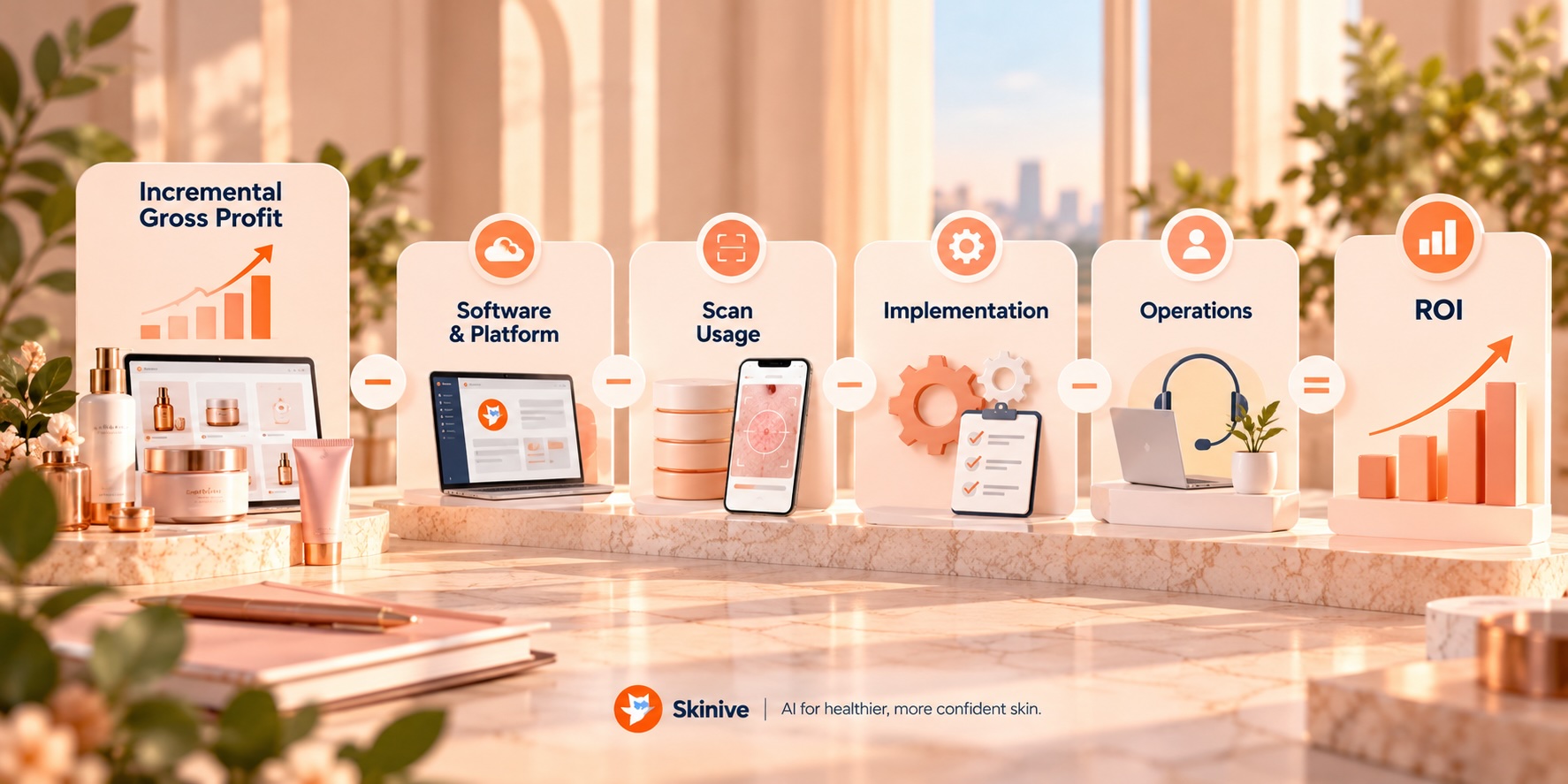
Gross profit is generally more useful than revenue alone.
Two retailers can generate the same incremental revenue while having substantially different product margins. Revenue therefore does not show whether the additional sales created enough economic value to justify the investment.
The difficult part is determining incremental impact.
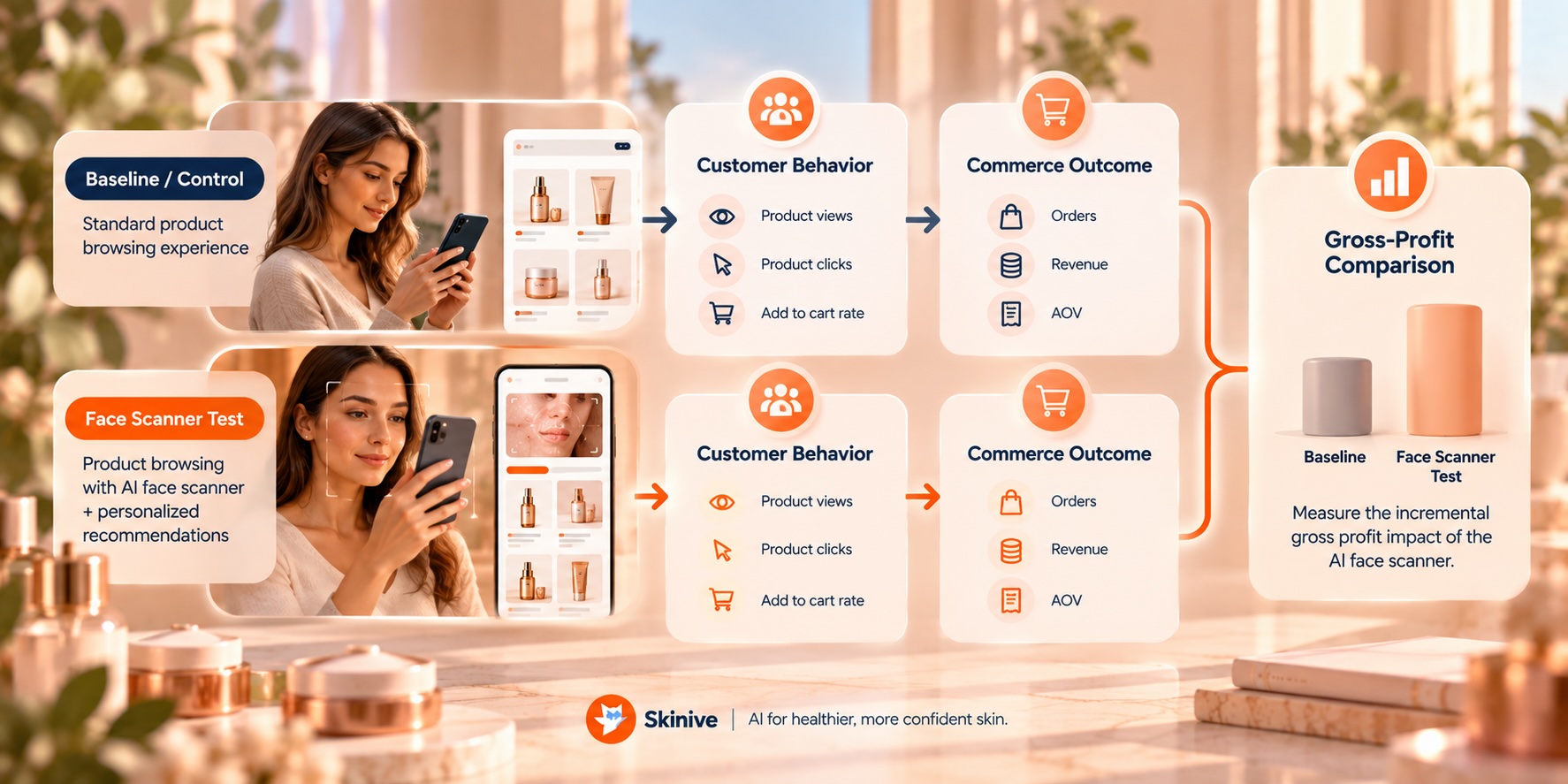
If customers who use a Face Scanner purchase more frequently than customers who do not, that does not automatically mean the Face Scanner caused the difference.
Scanner users may already be more engaged or have stronger purchase intent.
A credible business case therefore needs an appropriate baseline.
Depending on the implementation, this may involve:
- an A/B test;
- a control group;
- a holdout;
- a phased rollout;
- comparable periods;
- another defensible measurement design.
The purpose is to estimate what customer behavior would probably have looked like without the personalized experience.
What Costs Should Be Included in the Business Case?
The cost of AI beauty technology is broader than the software subscription.
A realistic model should include the incremental resources needed to launch and operate the experience.
| Cost Area | Examples |
|---|---|
| Software | Monthly plan and per-scan fees |
| Implementation | Development, e-commerce, UX, design, and QA work |
| Product catalog | Preparing and maintaining product information |
| Analytics | Event mapping, reporting, and attribution work |
| Operations | Monitoring the experience and maintaining workflows |
| Localization | Market, language, pricing, and catalog adaptations |
| Privacy and compliance | Implementation-specific review |
| Training | Advisor or retail-team onboarding where applicable |
Not every implementation will incur all of these costs at the same level.
A ready-to-use web implementation may require considerably less custom development than a deeply integrated experience.
The important principle is to avoid calculating ROI by comparing incremental revenue only with the monthly software fee.
That would understate the real investment required to operate the experience.
Skinive Face Scanner Pricing in the Business Case
Skinive’s direct platform pricing makes one part of the economic model straightforward.
| Plan | Monthly Fee | Per Scan | Catalog Capacity |
|---|---|---|---|
| Starter | €99/month | €0.20 | Up to 1,000 products |
| Growth | €199/month | €0.15 | Up to 5,000 products |
| Enterprise | Custom | Custom | Custom requirements |
A business should evaluate the plan against expected scan volume, catalog size, and implementation requirements.
The direct platform cost can then be combined with the business’s own implementation and operating costs to calculate the total incremental investment.
How Can You Build a Unit-Economics Model Without Inventing Uplift?
A useful business case does not need to begin with assumptions such as “AI will increase conversion by 20%.”
Instead, the retailer can model the journey using its own traffic and economics.
| Input | Retailer Data to Use |
|---|---|
| Eligible visitors | Customers who could reasonably encounter the Face Scanner |
| Scanner exposure | Share of eligible traffic shown the entry point |
| Start rate | Share of exposed visitors who begin |
| Completion rate | Share of starters who complete the experience |
| Recommendation engagement | Share interacting with recommended products |
| Purchase conversion | Measured commerce outcome |
| Average order value | Retailer’s actual transaction value |
| Gross margin | Retailer’s actual product economics |
| Platform cost | Skinive plan plus scan usage |
| Implementation cost | Incremental internal or external launch cost |
| Operating cost | Ongoing incremental cost of maintaining the experience |
These inputs allow the business to create scenarios without presenting them as forecasts or guarantees.
For example, a retailer can model what happens at different scanner adoption rates or recommendation-engagement levels.
Once the experience is live, modeled assumptions should gradually be replaced with observed first-party data.
Why First-Party Testing Is More Useful Than Generic Conversion Benchmarks
Industry case studies can help businesses form hypotheses, but they are weak substitutes for first-party testing.
Another retailer may have different:
- traffic quality;
- customer demographics;
- assortment size;
- brand awareness;
- product prices;
- device mix;
- existing conversion rate;
- promotional strategy;
- recommendation design.
Even apparently similar beauty retailers can therefore produce very different results.
| Generic Benchmark | First-Party Test |
|---|---|
| Another company’s audience | Your actual customers |
| Another assortment | Your product catalog |
| Different product economics | Your margins and pricing |
| Different baseline conversion | Your existing funnel |
| Unknown implementation details | Your Face Scanner placement and UX |
| Useful for forming hypotheses | Useful for investment decisions |
The business case should therefore use external benchmarks cautiously.
The strongest evidence comes from observing how the retailer’s own customers behave before and after, or with and without, the personalized experience.
Where Should AI Beauty Technology Be Deployed?
Different channels create different commercial opportunities.
| Channel | Primary Business Opportunity | Useful Measurement Focus |
|---|---|---|
| E-commerce | Reduce product-discovery friction | Scanner funnel, product clicks, cart, purchase |
| Beauty app | Support repeat personalized interaction | Engagement, repeat use, retention |
| Physical retail | Support advisor-assisted product discovery | Advisor adoption, recommendation engagement, assisted sales |
| Virtual beauty consultation | Structure remote product discovery | Completion, product interaction, downstream commerce |
| Omnichannel | Extend a consistent personalization concept across touchpoints | Channel-specific and cross-channel behavior |
The same ROI model should not be applied mechanically to every channel.
A website may be evaluated primarily through digital funnel behavior. A physical store may require assisted-sales or consultation metrics. A beauty app may justify investment partly through retention.
The commercial objective should therefore be defined before choosing the measurement model.
Why E-Commerce Is a Practical Starting Point
E-commerce can be a practical environment for an initial AI beauty pilot because many of the relevant customer actions are already measurable.
Retailers commonly have analytics for:
- website traffic;
- product-page interaction;
- cart activity;
- transactions;
- device type;
- customer acquisition sources.
A Face Scanner can then be evaluated as another layer within that existing commerce funnel.
Skinive Face Scanner provides a ready-to-use Web Widget that can be launched in around five minutes for a basic implementation.
Businesses that require more customized web experiences can use the Web SDK or API.
This creates a useful progression:
Launch → Observe Customer Behavior → Optimize → Decide Whether Deeper Integration Is Justified
The objective of the initial implementation is not necessarily to build the final personalization architecture.
It is to obtain evidence.
For the website implementation process, see How to Integrate an AI Face Scanner Into a Website in Minutes.
How Does the Business Case Change for Beauty Apps?
A beauty app can place more emphasis on ongoing engagement than a single-session e-commerce journey.
The Face Scanner may become one component within a broader app experience where customers repeatedly interact with skincare content, product discovery, or other brand functionality.
Useful business questions can include:
- Do users start and complete the Face Scanner?
- Do they explore recommended products?
- Do Face Scanner users return to the app?
- Does personalized product discovery contribute to repeat commerce behavior?
Skinive provides Web SDK and API integration options. Native iOS and Android SDKs are planned.
Any additional account, loyalty, profile, notification, or retention functionality depends on the surrounding app and should not be attributed automatically to Skinive Face Scanner.
How Does the Business Case Change in Physical Retail?
Physical beauty retail has different economics and customer behavior.
The Face Scanner can support a structured beauty consultation by giving the customer and advisor a shared visual starting point for product discovery.
Commercial value may therefore be evaluated through:
- consultation participation;
- advisor adoption;
- interaction with recommended products;
- assisted conversion;
- basket behavior;
- post-consultation engagement where the retailer can measure it.
A retailer should not force an e-commerce conversion model onto physical retail.
The business case should reflect how customers actually move through the store and how beauty advisors participate in the selling process.
When Might AI Beauty Technology Fail to Create Enough Value?
AI beauty technology is not automatically a strong investment for every customer journey.
The commercial case may be weak when:
- the assortment is too small for product discovery to be difficult;
- traffic is insufficient to produce meaningful usage or testing;
- the Face Scanner is placed where customers rarely discover it;
- customers do not understand the value before image capture;
- the catalog contains incomplete or outdated product information;
- the experience ends after analysis without a clear product-discovery path;
- image capture creates more friction than customers perceive in return;
- downstream commerce behavior cannot be measured;
- the business is unwilling to maintain and optimize the experience after launch.
These conditions do not necessarily mean AI beauty technology cannot work.
They may indicate that the use case, placement, catalog, or customer journey needs to change.
A business case should be capable of producing a no-scale decision as well as a scale decision. Otherwise, it is not really an investment evaluation.
How Should a Beauty Retailer Design an AI Face Scanner Pilot?
A pilot should test the smallest implementation capable of answering the commercial question.
A practical process is:
- Define one primary business objective.
- Select one channel and customer journey.
- Establish the current baseline.
- Choose a relevant Face Scanner entry point.
- Connect a representative, high-quality product catalog.
- Launch the simplest implementation that can test the hypothesis.
- Measure adoption through the Face Scanner funnel.
- Measure recommendation and product interaction.
- Compare downstream behavior with an appropriate baseline or control.
- Calculate incremental gross profit where attribution allows.
- Include platform, implementation, and operating costs.
- Decide whether to optimize, expand, redesign, or stop.
This keeps the pilot focused on evidence rather than feature completeness.
A first implementation does not need to solve every future omnichannel or personalization requirement.
It needs to answer:
Is there enough customer and economic value to justify the next investment?
What Should a Good Pilot Decision Tell You?
At the end of a pilot, the business should be able to answer a small number of practical questions.
| Question | Evidence |
|---|---|
| Do customers use the experience? | Exposure, start, and completion rates |
| Do customers reach relevant products? | Recommendation engagement and product clicks |
| Does behavior improve? | Comparison with baseline or control |
| Is the catalog good enough? | Recommendation review and product-data QA |
| Where is friction occurring? | Funnel drop-off |
| Is the economics attractive? | Incremental gross profit versus incremental cost |
| Should the experience expand? | Evidence across sufficient customers and traffic |
The decision does not need to be binary.
A pilot may show strong customer adoption but weak product engagement, suggesting that recommendations need improvement.
It may show good recommendation engagement but poor scanner starts, suggesting that placement or messaging is the main problem.
It may show positive commerce behavior but insufficient economics at the current operating cost.
This diagnostic value is one of the reasons funnel measurement is important.
How Should You Avoid Misleading AI Beauty ROI Claims?
AI beauty business cases become less useful when attribution is weak or metrics are selected only to support a positive narrative.
Several practices should be avoided:
- Do not present correlation as incremental impact.
- Do not assume Face Scanner users and non-users are naturally comparable.
- Do not report revenue without the relevant baseline.
- Do not ignore gross margin.
- Do not exclude implementation and operating costs.
- Do not treat scanner starts as evidence of commercial success.
- Do not generalize short-term engagement into long-term retention.
- Do not assume results from one market, placement, or channel will transfer unchanged to another.
- Do not use generic industry uplift claims as though they were guaranteed Skinive results.
- Do not attribute medical value to a beauty and cosmetics personalization experience.
A credible business case should make uncertainty visible rather than hiding it.
That makes the resulting investment decision more useful.
How Skinive Face Scanner Supports a Measurable AI Beauty Pilot
Skinive Face Scanner provides several capabilities relevant to testing an AI beauty business case.
| Capability | Business Relevance |
|---|---|
| Ready-to-use Web Widget | Provides a low-complexity starting point for web pilots |
| Web Widget launch | Basic implementation can be launched in around five minutes |
| Web SDK | Supports more customized web experiences |
| API | Supports custom integration architectures |
| Product catalogs | CSV and XML |
| Minimum catalog data | Name, description, ingredients, price, product-page URL |
| Catalog synchronization | Unlimited |
| Starter catalog | Up to 1,000 products |
| Growth catalog | Up to 5,000 products |
| Dashboard analytics | Scans, users, product clicks, sales conversions |
| Native mobile SDKs | iOS and Android planned |
| Technical support | Email and scheduled calls during working hours |
The most practical implementation path is often progressive.
A retailer can begin with a limited customer journey, observe actual behavior, and then decide whether additional customization or wider deployment has a clear business justification.
A Practical Decision Framework for AI Beauty Investment
The business case can ultimately be reduced to seven decisions.
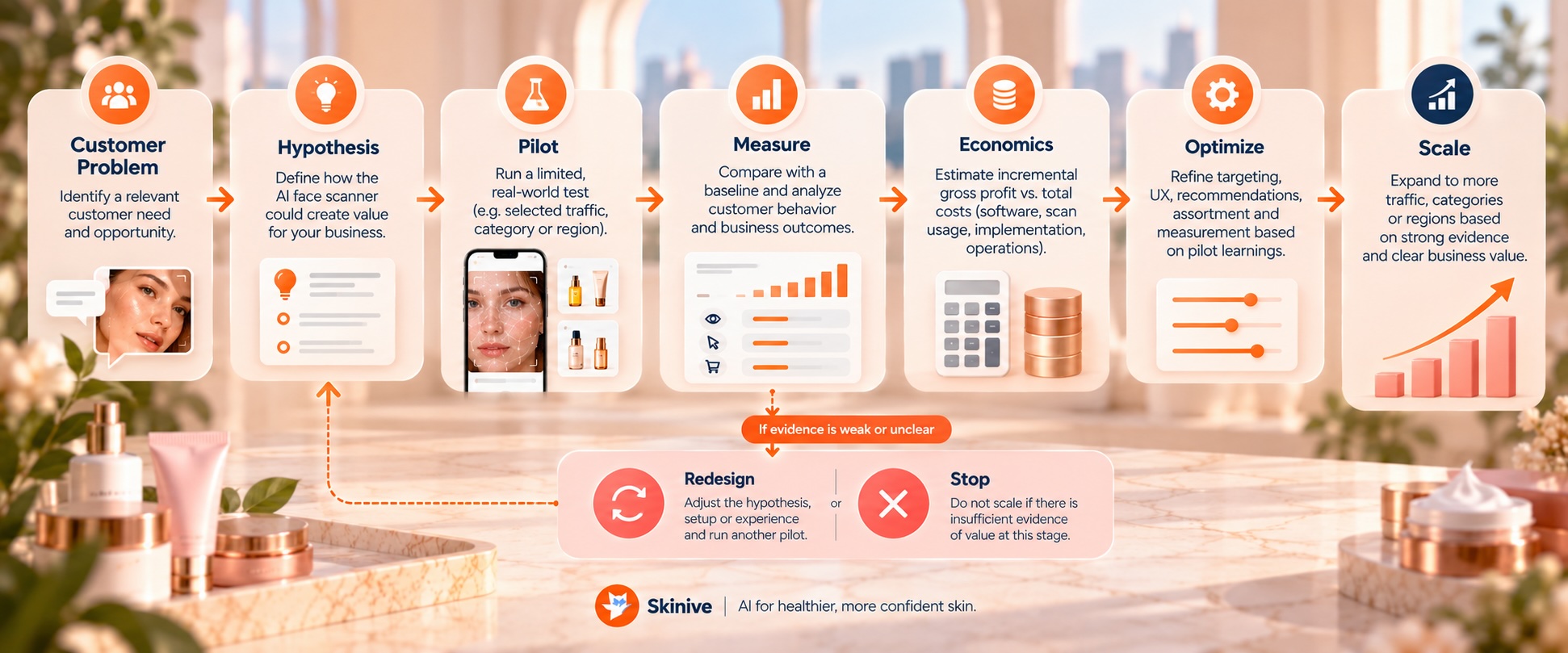
| Stage | Decision |
|---|---|
| Problem | Is product discovery or personalization a meaningful customer problem? |
| Hypothesis | How should AI face analysis change customer behavior? |
| Pilot | Can that hypothesis be tested with limited cost and complexity? |
| Measurement | Can the business observe the relevant funnel and baseline? |
| Economics | Does incremental value justify incremental cost? |
| Optimization | Can identified friction be improved? |
| Scale | Is the evidence strong and repeatable enough for wider deployment? |
This prevents the investment decision from beginning with technology.
The starting point is the customer problem.
The technology is justified when it provides a practical way to address that problem and the resulting behavior creates enough measurable value.
The overall business-case sequence is:
Customer Problem → Personalization Hypothesis → Pilot → Measure → Economics → Optimize → Scale
If the evidence is weak, the appropriate outcome may instead be:
Pilot → Diagnose → Redesign or Stop
Both are valid outcomes of a properly designed business case.
Related Resources
- AI Face Scanner for E-Commerce: How to Personalize Skincare Shopping
- AI Face Scanner for Beauty & Skincare Apps: Integration and Use Cases
- AI Face Scanner for In-Store Beauty Retail: Personalized Beauty Consultations at the Point of Sale
- AI Face Analysis: How It Works for Beauty & Skincare
- AI Skincare Recommendations: From Face Analysis to Relevant Products
- Personalized Skincare with AI: How Beauty Brands Can Move Beyond Generic Routines
- AI Product Recommendation Engine for Beauty and Skincare Brands
- How AI Face Scanners Can Increase Conversion in Beauty E-Commerce
- Omnichannel Beauty: One AI Face Scanner Across Web, App and In-Store
- Virtual Beauty Consultation: How AI Is Changing the Beauty Advisor Experience
- AI Face Scanner vs. Skin Quiz: Which Creates Better Skincare Personalization?
- What Can an AI Face Scanner Detect? Wrinkles, Pores, Blackheads, Dark Spots and More
- How to Integrate an AI Face Scanner Into a Website in Minutes
- How to Connect a Cosmetics Product Catalog to AI Skincare Recommendations
Test AI Beauty Personalization Against Your Own Commerce Data
The strongest business case for AI beauty technology comes from your own customers, product catalog, margins, and commerce funnel.
Use Skinive Face Scanner to build a measurable personalized product-discovery journey, track scans, users, product clicks, and sales conversions, and evaluate whether the experience creates enough customer and commercial value to scale.