
Introduction
Finding a dermatologist in Halifax for a medically necessary skin concern usually begins with primary care. A family doctor, nurse practitioner or another appropriate provider can assess the problem and arrange specialist referral when needed, with eligible medically necessary services covered through Nova Scotia’s Medical Services Insurance (MSI) program.
Halifax is Nova Scotia’s main specialist and academic healthcare centre, with services connected to Nova Scotia Health, the QEII Health Sciences Centre and Dalhousie University. This gives residents more options than many smaller Atlantic Canadian communities, although routine dermatology referrals can still involve significant waiting times.
For a mole check, persistent rash or changing skin lesion, options may include MSI-funded medical care, private/self-pay services for uninsured concerns and virtual assessment where appropriate.
👉 How to see a dermatologist in Canada — practical guide
When should you see a dermatologist?
Many common skin problems can initially be assessed in primary care. Seeing a dermatologist in Halifax becomes more important when symptoms persist, repeatedly return, worsen despite treatment or require specialist diagnosis or procedures.
Common skin conditions
You should consider seeing a skin specialist in Halifax if you experience ongoing or worsening skin problems. Dermatologists diagnose and treat a wide range of conditions, including:
- Acne, including persistent or adult acne
- Eczema with dry, inflamed or itchy skin
- Psoriasis and other chronic inflammatory skin conditions
- Rosacea, facial redness and visible blood vessels
- Bacterial, viral or fungal skin infections
- Pigmentation disorders such as dark spots and melasma
Specialist assessment can also be appropriate for unexplained hair loss, nail disorders, recurring rashes and skin conditions that have not responded adequately to initial treatment.
Warning signs
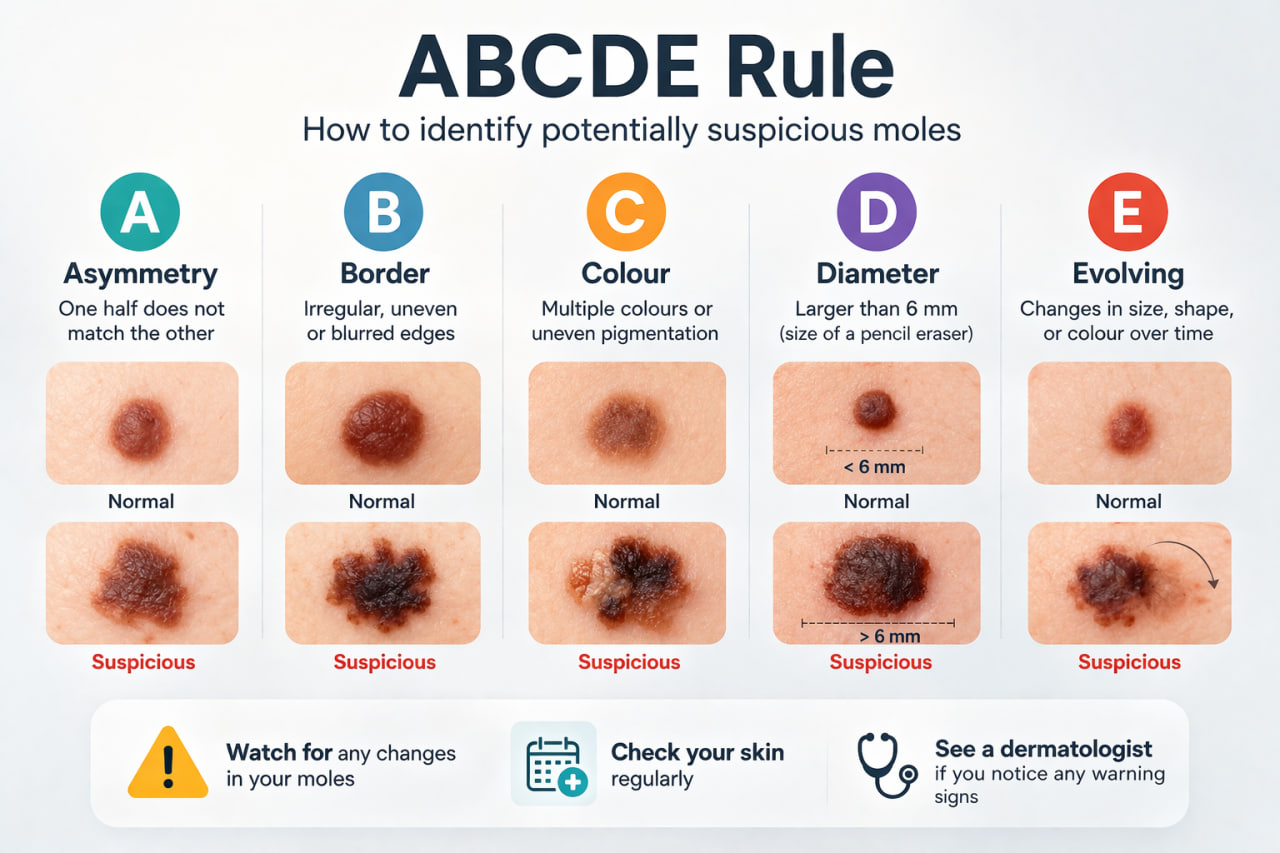
Arrange medical assessment if a mole changes noticeably in size, shape or colour, starts bleeding without an obvious injury or looks distinctly different from your other moles.
A sore or lesion that repeatedly crusts or does not heal should also be checked. These signs do not automatically mean melanoma, but they are appropriate reasons to arrange a professional mole check.
Check your skin before visiting a doctor
Skin analysis with Skinive
Skinive can be used as a first step when you notice a new skin concern and are unsure what to do next. The app uses AI-based image analysis to assess visible skin lesions and provides information that can help users decide whether further medical evaluation should be considered.
Skinive is CE-marked medical software and is available 24/7. It can also support regular mole monitoring, which can make it easier to notice visible changes over time.
Key benefits include:
- Instant mole and skin analysis
- Ability to track changes over time
- Support for early detection of suspicious lesions
- Convenient access from home
The app is not a replacement for a dermatologist, biopsy, laboratory test or professional diagnosis. If a lesion appears suspicious, changes rapidly or causes concerning symptoms, arrange an in-person medical assessment.
How dermatology works in Canada
Healthcare is administered provincially and territorially in Canada. Halifax is in Nova Scotia, where eligible residents receive provincial health coverage through Medical Services Insurance, commonly known as MSI.
Publicly funded dermatology in Nova Scotia
For medically necessary specialist dermatology, the typical pathway is:
Family doctor or primary-care provider → referral → dermatologist.
A physician or nurse practitioner can assess the problem and determine whether specialist care is necessary. The referral can include photographs, previous treatments and details about symptoms or suspicious changes to support appropriate triage.
Eligible medically necessary physician services are generally insured through MSI. Cosmetic procedures and services that are not medically necessary are usually outside provincial coverage.
Halifax is home to the province’s major tertiary healthcare facilities and Dalhousie University’s Faculty of Medicine. Dermatology services are therefore concentrated more heavily in Halifax than in many other parts of Nova Scotia.
This also means that specialists in the city may receive referrals from across the province. Routine waiting time can consequently be substantial even though Halifax has relatively strong specialist resources.
Residents without a regular family doctor may use other primary-care pathways available in Nova Scotia, including participating clinics and virtual-care services, to obtain an initial assessment.
Private dermatologists and self-pay services
Private dermatology in Nova Scotia is more limited than in large markets such as Toronto or Vancouver. Most medically necessary specialist care remains closely connected to the publicly funded referral system.
Self-pay options are more common for cosmetic, aesthetic and other uninsured services. Depending on the provider, these can include cosmetic lesion treatment, injectables, laser procedures, pigmentation treatments and other elective skin care.
Direct booking may be available for these services, potentially providing greater scheduling flexibility.
However, paying for a cosmetic skin consultation does not necessarily provide direct access to insured medical dermatology. Before booking a private dermatologist in Halifax, confirm whether the clinic treats your specific concern, whether a referral is required and whether the service is MSI-insured or self-pay.
Dermatology clinics in Halifax
Halifax has academic hospital services, community dermatology practices and private clinics providing medical or cosmetic skin care.
| Clinic | Location | Services | Price |
|---|---|---|---|
| QEII Health Sciences Centre | Halifax | Tertiary specialist care, complex medical conditions and hospital-based services | Insurance coverage |
| Halifax Infirmary | Halifax | Acute and specialist hospital services within the QEII network | Insurance coverage |
| Dickson Building, Victoria General Site | Halifax | Specialist outpatient and cancer-related services within the QEII network | Insurance coverage |
| Luma Clinic | Halifax | Skin care clinic | 250–350 CAD |
| Maritime Dermatology | Halifax | Dermatologist | 250–350 CAD |
Hospital-based dermatology is generally not a walk-in service. For a medically necessary skin problem, primary-care assessment and referral are usually the appropriate starting point.
Private dermatologists in Halifax
Halifax has fewer private dermatology options than Canada’s largest metropolitan areas, but residents can access cosmetic medicine, aesthetic skin treatments and selected privately paid services.
| Clinic | Services | Location | Price |
|---|---|---|---|
| Dr. Ariel Burns Dermatology | Medical office | Halifax | 250–350 CAD |
| Dermatology Rejuvenation Centre | Skin care clinic | Halifax | 250–350 CAD |
| Precision Dermatology | Skin care clinic | Halifax | 250–350 CAD |
| Michele MacLean M.D. | Skin care clinic | Halifax | 250–350 CAD |
| Dr Caroline Heughan | Dermatologist | Halifax | 250–350 CAD |
Not every private skin clinic employs a dermatologist, and cosmetic providers should not be treated as substitutes for specialist medical assessment.
If you specifically need a private dermatologist in Halifax for a medical concern, verify the clinician’s credentials and referral requirements before paying for an appointment.
Dermatologists near Halifax
Halifax is the principal specialist centre for Nova Scotia, so patients from neighbouring communities frequently travel into the city for dermatology. Residents of Halifax can also consider nearby communities for primary care, private skin services and selected specialist options.
Dermatologist in Dartmouth
Dartmouth is directly across Halifax Harbour and forms part of the Halifax Regional Municipality, making it the closest practical alternative.
Dartmouth General Hospital provides major local hospital services, while the nearby Nova Scotia Hospital provides specialized mental health services. For complex medical and specialist care, patients can also access the QEII Health Sciences Centre in Halifax.
Someone searching for a dermatologist in Dartmouth may find community medical clinics and private skin services locally, but specialist dermatology can still involve referral to Halifax.
Publicly funded medical dermatology follows Nova Scotia’s MSI pathway, while cosmetic and uninsured services may allow direct booking.
Because Halifax and Dartmouth are connected by bridges and ferry services, expanding your search across both sides of the harbour usually creates little additional travel burden. This can be particularly useful for private or cosmetic appointments where clinic availability differs.
Dermatologist in Bedford
Bedford is northwest of central Halifax and is part of the Halifax Regional Municipality.
The community has primary-care practices, medical clinics and private health services, while major hospital care is available through the QEII Health Sciences Centre in Halifax and Cobequid Community Health Centre in Lower Sackville. Dartmouth General Hospital provides another regional option.
Patients looking for a dermatologist in Bedford generally follow the same provincial pathway as Halifax residents: primary-care assessment followed by specialist referral when medically necessary.
Private aesthetic and skin clinics can provide additional options for cosmetic or uninsured concerns.
Bedford is close enough to central Halifax that patients can realistically compare providers across the metropolitan area. For specialist medical dermatology, however, the actual referral destination may still be a Halifax-based service because specialist resources are concentrated there.
Dermatologist in Truro
Truro is approximately an hour’s drive north of Halifax and serves as an important healthcare centre for central Nova Scotia.
Colchester East Hants Health Centre is the principal regional hospital. Patients requiring more specialized services may be referred to the QEII Health Sciences Centre or other Halifax facilities.
A patient searching for a dermatologist in Truro can begin with local primary care. Specialist availability outside Halifax is more limited, so some dermatology referrals may require travel to the provincial capital.
Private cosmetic skin services may be available locally, but these should not be confused with specialist medical dermatology.
For Halifax residents, travelling to Truro simply to shorten a routine wait is only worthwhile if an appropriate provider confirms earlier availability. For residents of central Nova Scotia, however, local assessment can reduce unnecessary trips to Halifax.
Dermatologist in Windsor
Windsor lies northwest of Halifax in West Hants and provides local healthcare access for surrounding communities.
Hants Community Hospital provides emergency and community hospital services. Valley Regional Hospital in Kentville is another major regional facility, while the QEII Health Sciences Centre in Halifax provides tertiary specialist care.
Patients looking for a dermatologist in Windsor generally begin with primary care and may be referred toward Halifax or another regional specialist depending on availability.
Private cosmetic skin services are more limited than in Halifax, so residents seeking elective treatments may also travel toward the city.
For someone based in western Halifax Regional Municipality, Windsor may be geographically convenient for selected healthcare services. Specialist dermatology remains more concentrated in Halifax, however, so confirm the actual location of follow-up care before choosing a referral pathway.
Dermatologist in Kentville
Kentville is a major healthcare centre in the Annapolis Valley and is roughly an hour from Halifax by road.
Valley Regional Hospital provides acute and regional healthcare services, while Soldiers Memorial Hospital in Middleton supports communities farther west. Complex specialist cases may be referred to the QEII Health Sciences Centre in Halifax.
Someone seeking a dermatologist in Kentville can access local primary care and regional healthcare, but specialist availability is more limited than in Halifax. Referral to the city may therefore be necessary for some medical skin conditions.
Private and cosmetic skin services provide additional choices for uninsured concerns in the Annapolis Valley.
If you live between Halifax and the Valley, ask whether a dermatologist in Halifax or a regional provider offers the most appropriate combination of availability and follow-up convenience.
Dermatologist in Bridgewater
Bridgewater is the main commercial and healthcare centre for much of Nova Scotia’s South Shore.
South Shore Regional Hospital provides major hospital services in Bridgewater, while Fishermen’s Memorial Hospital in Lunenburg provides additional regional healthcare. Patients needing tertiary specialist treatment may travel to Halifax.
A patient searching for a dermatologist in Bridgewater can start with local primary care and obtain referral when specialist assessment is appropriate. Limited specialist availability may mean travelling to a dermatologist in Halifax for certain conditions.
Private cosmetic services may be available locally, but specialist medical dermatology and cosmetic skin care should be considered separately.
For Halifax residents, Bridgewater is unlikely to be more convenient for routine specialist care unless a particular service has better availability. For South Shore residents, virtual follow-up can sometimes reduce repeated travel when clinically appropriate.
Online dermatologists in Canada
Online dermatology can be useful when travel is difficult, you need initial guidance or you want to document a skin problem before an in-person appointment.
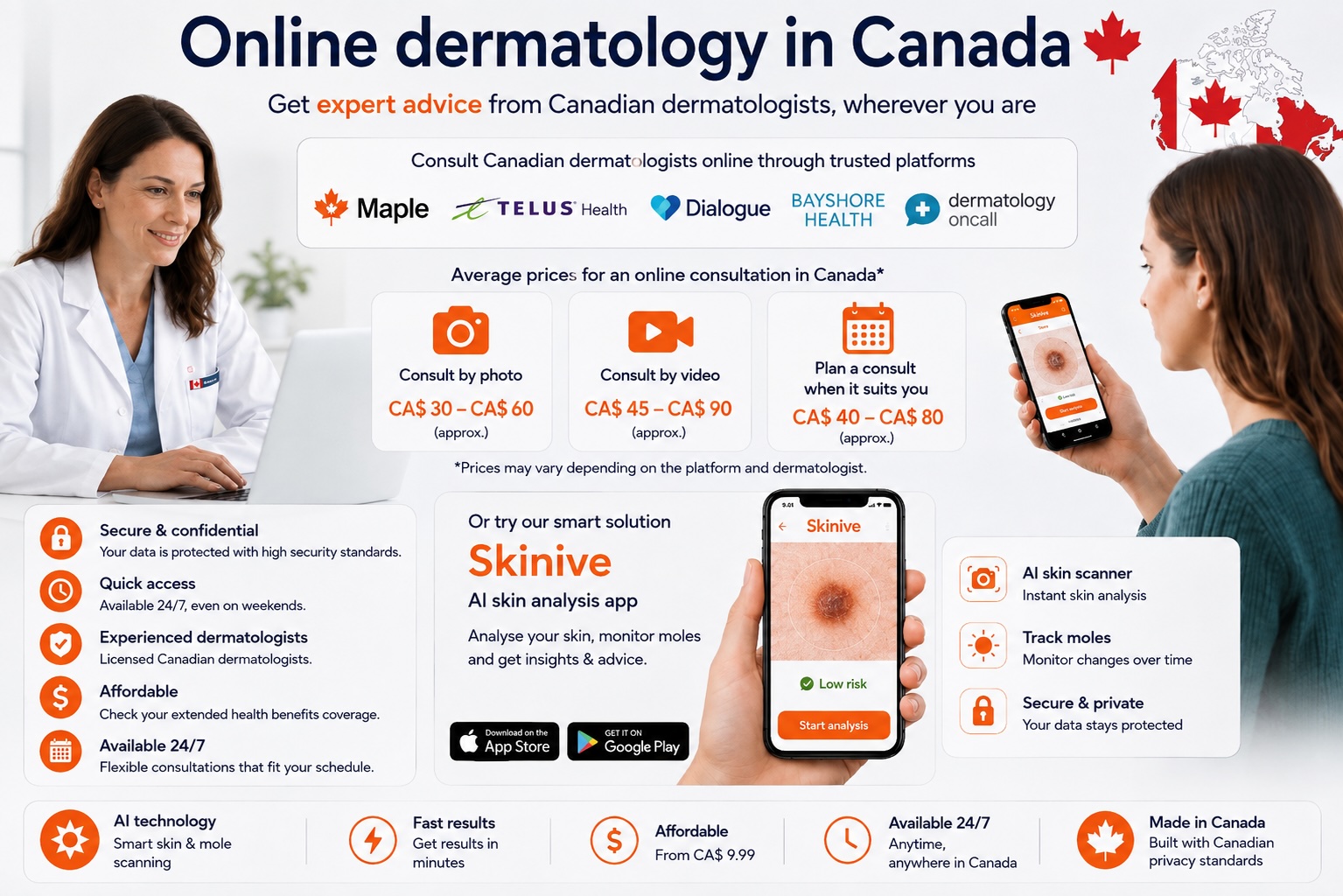
Virtual care does not eliminate the need for physical examination, dermoscopy or biopsy when these are clinically necessary.
| Platform | Services | Availability | Price |
|---|---|---|---|
| Skinive | AI skin analysis and mole monitoring | 24/7 | App-based; plan-dependent |
| Ontario virtual primary care options | Initial medical assessment and possible referral | Depends on provider and eligibility | May be OHIP-covered when eligibility and billing requirements are met |
| Maple | Virtual medical consultations and selected specialist services | Online | Self-pay or eligible benefit coverage depending on service |
| TELUS Health virtual services | Virtual healthcare through participating programs | Depends on plan/provider | Coverage varies |
| Private teledermatology providers | Image-based or video skin consultations | Varies across Canada | Self-pay fees vary |
Online assessment is particularly useful for triage, follow-up of visible changes and deciding what level of care to seek. A dermatologist may still request an in-person visit if the diagnosis depends on palpation, dermoscopy, laboratory testing or biopsy.
👉 Online dermatologists in Canada — full guide
How to get a dermatology consultation online for free or affordably
Nova Scotia has expanded virtual primary care, which can provide an important first step for residents who do not have timely access to an in-person primary-care provider.
Free or publicly covered options
VirtualCareNS provides virtual primary-care access for eligible Nova Scotia residents. Availability and eligibility depend on the provincial program and a patient’s circumstances.
A virtual clinician can assess many visible skin problems, recommend initial treatment and determine whether referral to a dermatologist in Halifax is appropriate.
Skinive can be used before the consultation for AI-based initial analysis and mole monitoring. It can provide useful information about a visible concern but does not provide a definitive medical diagnosis.
Affordable options
Private telemedicine can provide another route when a publicly funded virtual appointment is unavailable or does not fit your needs.
Before paying, check whether you will see a family physician, nurse practitioner or dermatologist. These services can have different capabilities, especially when specialist diagnosis, prescriptions or referral are required.
For Nova Scotians living outside Halifax, virtual care may also reduce the cost and time associated with travelling to the city for an initial assessment.
International options
International online dermatology services can provide second opinions based on photographs, previous diagnoses or pathology information.
However, overseas physicians may not be able to prescribe locally, order Nova Scotia investigations or provide a referral that integrates with the MSI-funded specialist system.
They are therefore better suited to additional expert opinions than replacing local healthcare.
Best approach
For many non-emergency visible concerns, a practical pathway is:
Skinive → virtual or primary-care assessment → in-person dermatologist when necessary.
If a lesion changes rapidly, repeatedly bleeds or fails to heal, do not allow repeated digital monitoring to postpone appropriate medical assessment.
Dermatologist waiting times in Halifax
There is no single waiting time for every dermatologist in Halifax. The actual delay depends on clinical urgency, diagnosis, referral destination and current specialist capacity.
| Type | Typical access pattern |
|---|---|
| Routine MSI-funded dermatologist referral | Often several months; individual waits vary substantially |
| Urgent dermatology referral | Prioritized according to clinical urgency |
| Specialized hospital or cancer-related pathway | Depends on referral criteria and triage |
| Private/uninsured service where available | Potentially days to several weeks |
| Online or virtual assessment | Same day to several days depending on service |
Nova Scotia publishes specialist wait-time information, but historical or provincial averages should not be interpreted as a guaranteed appointment time for an individual patient.
If you have been referred but have not received appointment information, contact your referring provider and confirm that the referral was received.
Ask whether another dermatologist in Halifax or an appropriate regional service could offer earlier access. If symptoms change significantly while you are waiting, contact the referring provider so the clinical urgency can be reconsidered.
Cost of dermatologist in Halifax
For Nova Scotia residents, the most important distinction is whether the service is medically necessary and insured through MSI or elective and uninsured.
| Service | Approximate patient cost |
|---|---|
| Eligible medically necessary dermatologist consultation | Usually no direct charge for the insured physician service |
| Uninsured/private consultation where available | Often approximately CA$150–CA$350+ |
| Cosmetic skin consultation | Often approximately CA$100–CA$250+ |
| Elective mole mapping or skin screening | Approximately CA$150–CA$400+ depending on provider |
| Cosmetic, injectable or laser procedure | Highly variable; commonly several hundred dollars or more |
These are broad Canadian price ranges rather than guaranteed Halifax fees. Private providers determine their own charges, and consultation fees may not include procedures or follow-up.
A dermatologist in Halifax providing medically necessary care through the provincial system operates differently from a cosmetic skin clinic offering self-pay services.
Before paying privately, ask whether the fee includes photography, procedures, pathology or follow-up and whether the person conducting the consultation is a dermatologist.
Melanoma symptoms and suspicious moles
When is it urgent?
Most skin conditions do not require emergency treatment. Stable acne, chronic eczema and cosmetic pigmentation concerns can normally be managed through routine primary-care or dermatology appointments.
Seek prompt medical assessment for a rapidly spreading or blistering rash, serious skin infection, severe skin pain accompanied by systemic illness or another quickly deteriorating condition.
A lesion that changes rapidly, repeatedly bleeds or becomes ulcerated also deserves timely assessment. Explain the specific changes when contacting your healthcare provider rather than simply requesting a routine mole check.
Breathing difficulty, facial or throat swelling, collapse or other signs of a severe allergic reaction require emergency treatment. Call 911.
For an acute emergency, waiting specifically for a dermatologist in Halifax is not appropriate. Emergency services can assess the immediate problem and involve specialist teams when necessary.
FAQ — Dermatologist in Halifax
Do I need a referral to see a dermatologist in Halifax?
For the usual MSI-funded specialist dermatology pathway, referral from an appropriate healthcare provider is generally required. Your family doctor, nurse practitioner or another eligible provider can assess the problem and determine whether specialist care is necessary.
Cosmetic and selected uninsured services may allow direct booking. Always confirm the clinic’s requirements before scheduling.
How long is the wait for a dermatologist in Halifax?
Routine specialist referrals can involve waits of several months, although actual access varies significantly according to the dermatologist, diagnosis and clinical urgency.
Urgent conditions may be prioritized more quickly. If your symptoms change while waiting, contact your healthcare provider rather than assuming the original priority still applies.
Is a dermatologist covered by MSI in Nova Scotia?
Eligible medically necessary physician services are generally covered through Nova Scotia’s MSI program for qualifying residents.
Cosmetic and other medically unnecessary services are normally not publicly insured. The reason for the appointment therefore matters when determining whether you will pay privately.
How much does a private dermatologist in Halifax cost?
Where an uninsured consultation is available, a broad estimate is approximately CA$150–CA$350 or more. Cosmetic consultations and procedures use separate private fee structures.
Halifax has fewer private specialist dermatology options than Toronto or Vancouver, so confirm both availability and pricing before assuming you can pay for immediate medical specialist access.
Can I see an online dermatologist in Halifax?
Virtual healthcare is available in Nova Scotia, including VirtualCareNS for eligible residents and private telemedicine services.
A virtual clinician may assess selected visible skin problems and determine whether specialist referral is necessary. Dermoscopy, biopsy and other procedures still require in-person care.
Where can I get a mole check in Halifax?
A primary-care provider can examine a concerning mole and arrange specialist referral when necessary. Hospital or community dermatology services can provide further assessment when clinically indicated.
If a mole has changed in size, colour or shape, started bleeding or looks noticeably different from your other moles, mention these changes when requesting assessment.
Can Skinive replace a dermatologist?
No. Skinive uses AI-based analysis to help users check and monitor visible skin concerns, but it does not replace professional medical diagnosis.
It can be useful as an initial screening and monitoring tool. Suspicious findings, persistent symptoms and changing lesions should be assessed by an appropriate healthcare professional.
What can I do if my dermatology wait is too long?
First confirm that the referral was received and ask whether another appropriate dermatologist in Halifax or regional service could see you sooner.
Virtual care can provide interim assessment for selected conditions. If your problem worsens or a lesion changes while you wait, contact your healthcare provider so the referral priority can be reassessed.
Choosing between public, private and online dermatology
For most medically necessary skin problems, primary care followed by an MSI-funded referral remains the practical route to specialist treatment.
Halifax has Nova Scotia’s strongest concentration of specialist and academic healthcare resources, but it also receives referrals from across the province. A dermatologist in Halifax can therefore still have a significant waiting list for routine conditions.
Private and self-pay services provide more flexibility for cosmetic, elective and other uninsured concerns. However, Halifax has a smaller private specialist market than Canada’s largest cities, and patients should not assume that paying privately provides immediate access to every type of medical dermatology.
Online healthcare is particularly valuable in Nova Scotia because it can provide initial assessment without requiring travel to Halifax. VirtualCareNS and other telehealth options can help determine whether primary care is sufficient or specialist referral is appropriate.
Skinive can be used before these steps for 24/7 AI-based skin analysis and mole monitoring. It supports early detection awareness but does not replace a dermatologist or other healthcare professional.
For many patients, the practical pathway is simple: document the concern, use Skinive as an initial check when appropriate, obtain primary or virtual medical assessment and see a dermatologist in Halifax when specialist care is required.