
Referrals, Costs, Waiting Times & Online Dermatology Explained
Seeing a dermatologist in Canada usually starts with primary care, but the exact pathway depends on where you live. Healthcare is administered by individual provinces and territories, so referral requirements, specialist availability, waiting times and coverage can differ across the country.
For medically necessary dermatology care, patients typically begin with a family doctor, nurse practitioner or another primary care provider. If specialist assessment is needed, they can refer the patient to a dermatologist.
Other options include walk-in clinics, private dermatology services, virtual care and teledermatology. The most appropriate route depends on the skin concern, urgency, location and whether the service is covered by provincial health insurance.
This guide explains how to see a dermatologist in Canada, including:
- how dermatologist referrals work
- public and private dermatology options
- what to do without a family doctor
- typical waiting times and costs
- online dermatology and teledermatology
- dermatology access in major Canadian cities
Introduction: How Dermatology Care Works in Canada
Canada has a publicly funded healthcare system, but healthcare services are organised at the provincial and territorial level rather than through one national insurance plan.
Eligible residents receive healthcare coverage through their province or territory — such as OHIP in Ontario, MSP in British Columbia, AHCIP in Alberta and RAMQ in Quebec. Medically necessary physician and hospital services are generally covered, while cosmetic dermatology and some other services are usually paid privately.
Primary care is normally the first point of contact. A family doctor, nurse practitioner or other primary care provider can assess common skin problems and determine whether specialist dermatology care is necessary.
People commonly seek dermatology care for:
- acne
- eczema and dermatitis
- psoriasis
- rosacea
- persistent or unexplained rashes
- suspicious or changing moles
- possible skin cancer
- hair and scalp disorders
- nail conditions
If specialist care is required, the primary care provider can send a referral to a dermatologist. The dermatologist or clinic then reviews the referral, with appointment timing influenced by clinical urgency and local availability.
Canada also has online dermatology and teledermatology services, which can provide another pathway for some skin concerns. Private virtual services may allow direct access without the traditional referral process, while publicly funded teledermatology usually operates within provincial healthcare pathways.
How the Canadian Dermatology System Works
There is no single dermatology pathway used everywhere in Canada. Each province and territory manages its own healthcare system, while dermatology care is delivered through a combination of primary care, hospital-based specialist services, community dermatologists and virtual care.
Publicly funded dermatology
For medically necessary conditions, specialist dermatology is generally covered by provincial or territorial health insurance for eligible residents.
The typical pathway is:
Primary care → dermatologist referral → specialist assessment → treatment or follow-up
Publicly insured dermatology may include assessment and treatment of conditions such as:
- suspected skin cancer
- severe or persistent acne
- eczema and psoriasis
- complex inflammatory skin disease
- unusual or persistent rashes
- hair and nail disorders
- other medically necessary skin conditions
Referrals are assessed according to clinical need. More urgent or potentially serious conditions may receive priority, while non-urgent cases can face longer waits.
Private and cosmetic dermatology
Private dermatology also exists in Canada, particularly for services that are not considered medically necessary.
These may include:
- cosmetic consultations
- removal of benign moles or skin tags for cosmetic reasons
- treatment of pigmentation or age spots
- cosmetic laser procedures
- injectables and other aesthetic treatments
These services are generally not covered by provincial health insurance and patients normally pay out of pocket.
It is important to distinguish private cosmetic dermatology from medically necessary specialist care. Paying privately does not automatically provide an alternative route to every publicly insured dermatology service, and rules differ between provinces.
When Should You See a Dermatologist in Canada?
Many common skin problems can initially be managed by a family doctor, nurse practitioner or pharmacist. A dermatologist may be appropriate when a condition is persistent, severe, difficult to diagnose or not responding to initial treatment.
Specialist assessment may be recommended for:
- a mole changing in size, shape or colour
- a new or unusual skin lesion
- a lesion that bleeds, crusts or does not heal
- suspected skin cancer
- severe or treatment-resistant acne
- eczema or psoriasis that remains poorly controlled
- recurrent or unexplained rashes
- significant hair loss or scalp disease
- complex nail disorders
Dermatologists also perform procedures that cannot be completed through an online consultation, including dermoscopy, biopsies and surgical treatment of certain skin lesions.
A rapidly changing or bleeding lesion, or another potentially serious skin problem, should not simply be placed on a routine dermatology waiting list without assessment. A primary care provider can evaluate the concern and indicate the appropriate urgency when making a referral.
For some visible, non-emergency skin concerns, online dermatology in Canada may provide another way to obtain an initial assessment or follow-up care.
Do You Need a Referral to See a Dermatologist in Canada?
For most medically necessary specialist dermatology care in Canada, the usual pathway involves a referral from a physician, nurse practitioner or another healthcare provider permitted to make specialist referrals in the province.
Step-by-step: How a dermatologist referral works
- See a primary care provider
Visit your family doctor, nurse practitioner, walk-in clinic or another appropriate primary care service. - Have your skin concern assessed
The provider examines the problem and determines whether specialist dermatology is appropriate. - A referral is submitted
Relevant medical information, photographs, test results and the clinical urgency may be included. - The dermatology clinic reviews the referral
Referrals may be prioritised according to urgency and the type of condition. - The appointment is scheduled
Depending on the province and referral system, the dermatologist’s office or another booking service may contact you.
Can you see a dermatologist without a referral?
Sometimes, but it depends on the service.
Cosmetic dermatology can often be booked directly because it falls outside publicly insured medically necessary specialist care. Some private online dermatology services also provide direct access without a traditional family-doctor referral.
However, if you want publicly funded specialist dermatology care, obtaining a referral through primary care is generally the standard route.
For direct virtual options, see our guide to Online Dermatologists in Canada.
What If You Don’t Have a Family Doctor?
Not having a regular family doctor does not necessarily prevent you from getting a dermatologist referral.
Depending on your province and local availability, you may be able to start with:
- a walk-in clinic
- a nurse practitioner
- a community health centre
- another primary care clinic
- a provincially supported virtual-care service
- a private virtual doctor service
The clinician can assess your skin concern and, when appropriate, arrange a referral to a dermatologist.
This is particularly relevant because access to regular primary care varies considerably across Canada. Patients without a family physician may therefore need to use another entry point into the healthcare system before accessing publicly funded specialist dermatology.
Another option for suitable skin concerns is teledermatology. Some services allow photographs and medical information to be reviewed remotely, while certain private platforms offer direct online access to dermatologists without a traditional referral.
For a detailed comparison of providers, prices and referral requirements, see Online Dermatologists in Canada.
Access also varies significantly by location. Toronto, Vancouver, Montreal, Calgary, Edmonton, Ottawa and other major cities generally provide more specialist options than many smaller or remote communities.
For local referral pathways, clinics and access options, explore our Dermatologists in Canada city guides.
Dermatologist Waiting Times in Canada
Waiting times to see a dermatologist in Canada vary considerably by province, city, clinical urgency and type of service.
Within the publicly funded system, referrals are generally prioritised according to medical need. A patient with a suspicious or rapidly changing lesion may be assessed more quickly than someone referred for a stable, non-urgent skin condition.
For routine dermatology, waits can range from several weeks to several months, and may be longer in areas with fewer specialists. Patients in large metropolitan areas such as Toronto, Vancouver, Montreal and Calgary generally have access to more dermatologists than those living in rural or remote communities.
Private virtual dermatology and teledermatology can sometimes provide a faster first assessment.
Typical Dermatology Waiting Times in Canada
| Pathway | Referral Required | Typical Access | Best For |
|---|---|---|---|
| Publicly insured dermatologist | Usually yes | Several weeks to several months | Medical and complex skin conditions |
| Urgent specialist referral | Usually yes | Prioritised according to clinical urgency | Suspicious lesions or serious skin disease |
| Private / cosmetic dermatologist | Often no for cosmetic care | Usually faster, depending on clinic | Cosmetic and uninsured services |
| Online dermatologist | Depends on provider | Same day to several days | Suitable visible skin concerns |
| Provincial teledermatology | Usually through a healthcare provider | Varies by province | Remote specialist assessment |
These are general ranges rather than guaranteed waiting times. Access can differ substantially between provinces and individual clinics.
If your skin concern changes while you are waiting — particularly a lesion that grows rapidly, bleeds or does not heal — contact your healthcare provider rather than simply waiting for the scheduled dermatology appointment.
How Much Does a Dermatologist Cost in Canada?
The cost of seeing a dermatologist in Canada depends largely on whether the service is considered medically necessary.
For eligible residents, medically necessary physician and specialist services are generally covered through provincial or territorial health insurance. This means a referred dermatology consultation for a medical skin condition will usually not involve a standard consultation fee at the point of care.
Cosmetic and other uninsured dermatology services work differently. Patients normally pay privately for treatments that are not medically necessary.
Typical Dermatology Costs in Canada
| Service | Provincial Coverage | Typical Patient Cost |
|---|---|---|
| Primary care assessment | Usually covered for eligible residents | $0 |
| Referred medical dermatologist | Usually covered | $0 for insured consultation |
| Hospital dermatology clinic | Usually covered | $0 for insured services |
| Private online dermatologist | Usually not provincially covered | Approximately $79–$219+ |
| Cosmetic dermatology consultation | Usually not covered | Varies by clinic |
| Cosmetic mole / skin tag removal | Usually not covered | Varies by procedure |
| Cosmetic laser treatment | Not usually covered | Private fee |
| AI skin self-check | Not provincial healthcare | Free or subscription-based |
Coverage rules vary by province and by procedure. A service performed by a dermatologist is not automatically publicly insured simply because it takes place in a medical clinic.
What should you check before booking?
Before paying for a dermatology service, ask:
- Is the consultation covered by my provincial health plan?
- Do I need a referral?
- Will I see a dermatologist or another healthcare professional?
- Are procedures, pathology or follow-up appointments charged separately?
- Is the service medically necessary or considered cosmetic?
- Does my private insurance provide any additional coverage?
Understanding these differences is particularly important when comparing conventional dermatology with direct-access online services.
Online Dermatology Services in Canada
Online dermatology in Canada, also known as teledermatology or virtual dermatology, provides another way to access skin care without always visiting a clinic in person.
Depending on the service, patients may upload photographs of a skin concern and medical history or have a video consultation with a healthcare professional.
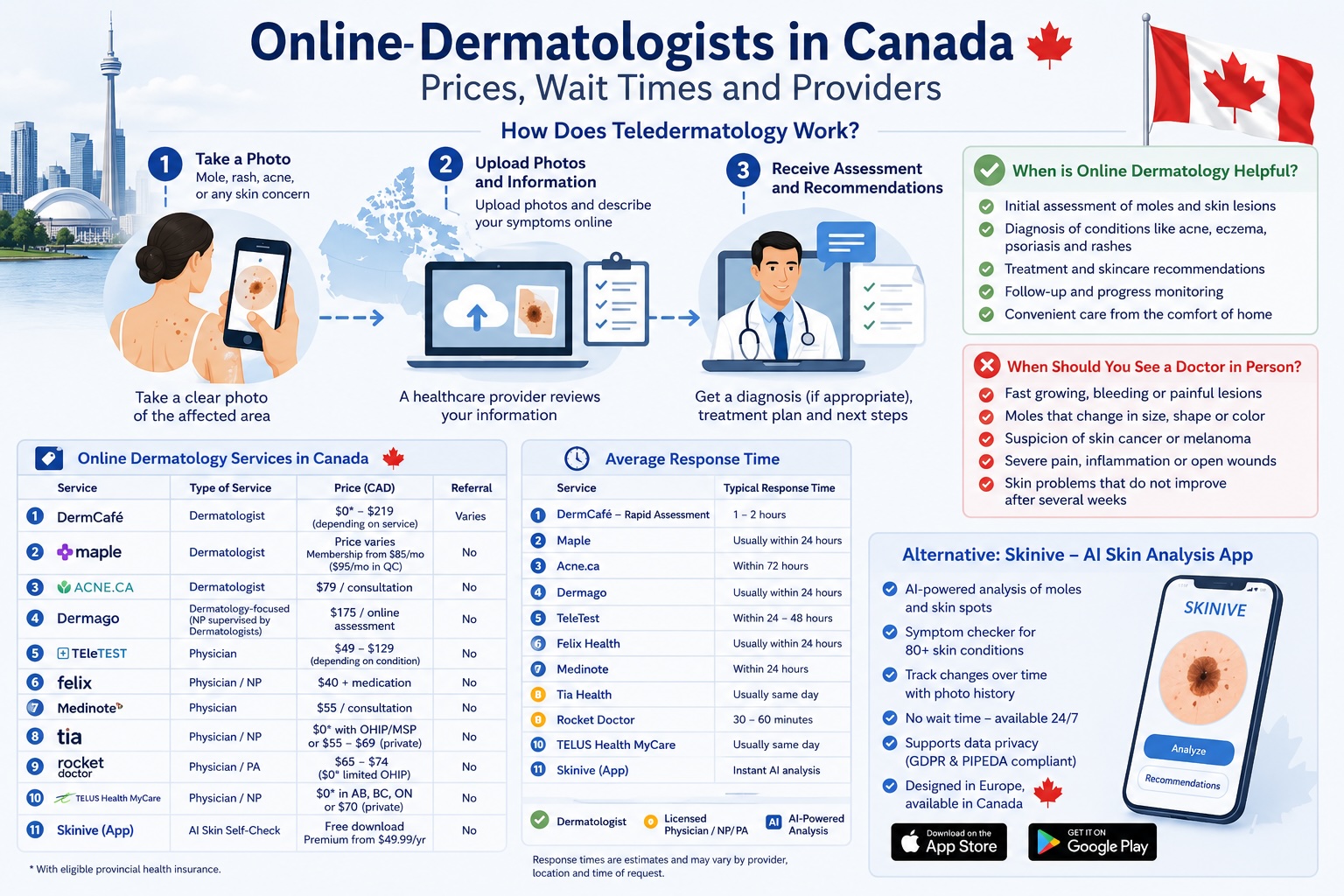
Canadian virtual-care options include several different models:
- publicly supported teledermatology through provincial healthcare pathways
- online consultations with Canadian dermatologists
- general virtual doctors or nurse practitioners who assess skin concerns
- specialised online services for conditions such as acne
- AI-powered skin self-check and monitoring tools
Some private services allow patients to consult a dermatologist online without a referral, while publicly funded specialist teledermatology usually operates through a healthcare provider.
Online dermatology can be particularly useful for acne, eczema, psoriasis, rosacea, rashes and follow-up of existing conditions. It may also provide an initial assessment of a visible skin lesion.
However, virtual care cannot replace every part of an in-person examination. Dermoscopy, biopsy, surgical procedures and some suspicious lesions require face-to-face assessment.
For providers, current prices, response times and referral requirements, see our complete guide to Online Dermatologists in Canada.
Dermatology Access in Canada’s Largest Cities
Where you live can make a significant difference to how easily you can see a dermatologist in Canada.
Major metropolitan areas have the largest concentrations of specialists, hospital dermatology departments and private clinics. Smaller cities and rural communities may have fewer local dermatologists, making referrals to regional centres or teledermatology more important.
Some of Canada’s main dermatology markets include:
- Toronto — Canada’s largest concentration of healthcare services, including major teaching hospitals and specialist dermatology clinics
- Vancouver — public and private dermatology options across Metro Vancouver
- Montreal — specialist care within Quebec’s healthcare system, including French-language services
- Calgary — hospital, community and private dermatology services within Alberta
- Ottawa — specialist services serving Ottawa and the surrounding Eastern Ontario region
- Edmonton — major hospital and community dermatology services in northern Alberta
- Winnipeg — an important specialist centre for patients across Manitoba
- Halifax — a regional centre for specialist dermatology in Atlantic Canada
Access can differ even within the same province. A patient in downtown Toronto may have a very different specialist pathway and waiting time from someone living in Northern Ontario.
For local information about referrals, dermatology services and access options, explore our guide to Dermatologists in Canada, with dedicated pages for major Canadian cities.
Can AI Help Before You See a Dermatologist?
AI-powered skin tools provide an additional option for people who notice a mole, skin spot or other visible change and want to perform an initial skin self-check at home.
Skinive allows users to photograph visible skin concerns with a smartphone and use AI-assisted image analysis to check and monitor skin spots over time.
This can be useful for:
- checking visible moles and skin spots
- keeping a photographic history of a lesion
- monitoring changes over time
- recording a skin concern before an online or in-person consultation
- becoming more aware of changes that may warrant professional attention
An AI skin check is particularly different from teledermatology: with an online dermatologist, a healthcare professional reviews the patient’s concern; with an AI self-check, software analyses the submitted image and provides information to the user.
AI analysis should not be treated as a definitive medical diagnosis or as a replacement for a dermatologist. A new, changing, bleeding, persistent or otherwise concerning lesion should be assessed by an appropriate healthcare professional.
Check your skin with the Skinive AI app
Dermatologist Access by Province
Although the basic referral pathway is similar across Canada, healthcare is administered by individual provinces and territories. This means insurance coverage, referral processes, virtual-care options and specialist availability can vary.
Ontario
Eligible Ontario residents receive medically necessary physician services through OHIP. Patients typically obtain a dermatologist referral through a family doctor, nurse practitioner or another appropriate healthcare provider.
Toronto and the Greater Toronto Area have the province’s largest concentration of dermatologists, but waiting times can still vary considerably depending on the condition and clinic.
British Columbia
In British Columbia, medically necessary physician services are generally covered for eligible residents through MSP. Primary care providers can refer patients to dermatologists, and teledermatology may also be used in appropriate cases.
Vancouver and the Lower Mainland have the largest concentration of specialist dermatology services in the province.
Alberta
Eligible Alberta residents receive insured physician services through AHCIP. Dermatologist referrals can be made through primary care, with Calgary and Edmonton serving as the province’s largest centres for specialist dermatology.
Virtual-care options may also be available for suitable skin concerns.
Quebec
Quebec’s public health insurance system is administered through RAMQ. Patients requiring medically necessary specialist dermatology generally enter the system through primary care and referral pathways.
Montreal and Quebec City have significant concentrations of dermatology services. French is the primary language of healthcare in Quebec, although availability of English-language services varies by provider and location.
Other provinces and territories
Dermatologists are also available across Manitoba, Saskatchewan, Nova Scotia, New Brunswick, Newfoundland and Labrador, Prince Edward Island and Canada’s territories, but specialist availability can be more limited outside major population centres.
For people living in rural, northern or remote communities, teledermatology and referrals to regional specialist centres can play a particularly important role.
Explore our Dermatologists in Canada hub for information about finding dermatology care in individual Canadian cities.
Frequently Asked Questions About Seeing a Dermatologist in Canada
Do I need a referral to see a dermatologist in Canada?
For publicly funded medically necessary specialist dermatology, a referral from a physician, nurse practitioner or another eligible healthcare provider is generally required. Cosmetic dermatology and some private online dermatology services may allow direct booking.
Is a dermatologist free in Canada?
For eligible residents, medically necessary dermatologist consultations are generally covered by provincial or territorial health insurance when accessed through the appropriate healthcare pathway.
Cosmetic procedures and other uninsured services normally require private payment.
Can I see a dermatologist without a family doctor?
Yes. Depending on your province, you may be able to visit a walk-in clinic, nurse practitioner, community health centre or another primary care service. If specialist assessment is appropriate, the healthcare provider may arrange a dermatologist referral.
Can I see a dermatologist without a referral in Canada?
Direct access is possible for some cosmetic dermatology and private online dermatology services. Publicly funded medical dermatology generally requires a referral.
How long does it take to see a dermatologist in Canada?
Waiting times vary widely by province, city, dermatologist and clinical urgency. Routine referrals may take several weeks or months, while potentially serious conditions can be prioritised.
How much does a dermatologist cost in Canada?
A medically necessary specialist consultation is generally covered for eligible residents through provincial health insurance. Private online consultations, cosmetic dermatology and uninsured procedures have separate fees.
Does OHIP cover dermatologists?
OHIP generally covers medically necessary physician services provided to eligible Ontario residents through the appropriate insured pathway. Cosmetic procedures and other uninsured dermatology services are not normally covered.
Does MSP cover dermatologists in British Columbia?
Medically required physician services are generally covered for eligible MSP beneficiaries. A referral is normally used to access specialist medical dermatology.
Can I see a dermatologist online in Canada?
Yes. Canada has both private online dermatology providers and teledermatology pathways connected to provincial healthcare systems. Some private services allow patients to access dermatology care without a traditional referral.
See our complete comparison of Online Dermatologists in Canada for providers, prices, referral requirements and response times.
Can an online dermatologist prescribe medication?
Depending on the condition, provider and provincial regulations, an appropriately licensed healthcare professional may prescribe medication following a virtual consultation when clinically appropriate.
Can a dermatologist check a mole online?
Photographs can be useful for an initial assessment or triage, but some lesions require an in-person examination with dermoscopy or biopsy. A changing, bleeding or otherwise concerning mole should receive appropriate medical assessment.
Where can I find a dermatologist near me?
Dermatologists are concentrated in Canada’s larger cities, including Toronto, Vancouver, Montreal, Calgary, Edmonton and Ottawa. Your primary care provider can arrange a referral, or you can explore our Dermatologists in Canada hub for city-specific information.
Final Thoughts: Getting Dermatology Care in Canada
There is no single route to seeing a dermatologist in Canada. The best option depends on your skin concern, province, urgency and whether the care you need is medically necessary or cosmetic.
For most medical skin conditions, the usual pathway is:
Primary care assessment → dermatologist referral → specialist consultation
If you do not have a family doctor, a walk-in clinic, nurse practitioner or another primary care service may provide an alternative starting point.
For suitable visible skin concerns, online dermatology in Canada can offer another option. Private services may provide faster direct access, while provincial teledermatology can connect patients with specialist expertise through the public healthcare system.
AI-powered tools such as Skinive can also be used for skin self-checks and monitoring between professional assessments, but they should not replace appropriate medical care.
If you are deciding what to do next:
- Explore Online Dermatologists in Canada to compare virtual providers, prices and referral requirements.
- Visit Dermatologists in Canada to find information about specialist access in major Canadian cities.
- Use Skinive app for AI-assisted skin self-checks and monitoring at home.
A new, changing, bleeding or persistent skin lesion should be assessed by an appropriate healthcare professional rather than relying solely on an online tool.