
Online dermatology services in Canada
Access to dermatology care in Canada can vary significantly by province. Seeing a dermatologist through the public healthcare system usually starts with a referral from a family doctor or another primary care provider, and waiting times for specialist appointments can vary depending on location and urgency.
Online dermatology — also known as teledermatology or virtual dermatology — provides another way to access skin care. Depending on the service and province, patients may upload photos of a skin concern, complete a medical questionnaire, or speak with a healthcare professional by video.
Some virtual services connect patients directly with Canadian-licensed dermatologists without a referral, while others operate through provincial healthcare systems or require a referral from a family doctor.
This guide explains how online dermatology in Canada works, when it may be useful, what it can cost, and how to compare virtual dermatology services available to Canadian patients.
When online dermatology may be appropriate
An online dermatologist in Canada may be useful for visible, non-emergency skin concerns that can be assessed using good-quality photographs and medical history.
Virtual dermatology is commonly used for:
- acne and acne treatment
- eczema and dermatitis
- psoriasis
- rosacea
- rashes and skin irritation
- hair and scalp concerns
- nail conditions
- follow-up of existing skin conditions
- assessment of moles or other visible skin lesions
Online consultations can also be useful for people who live far from a dermatology clinic, do not have easy access to a family doctor, or want an initial assessment before arranging an in-person appointment.
When in-person care may still be needed
A virtual dermatologist cannot perform every examination or procedure that is possible in a clinic. An in-person assessment may be necessary when:
- a skin lesion needs dermoscopy or closer physical examination
- a biopsy or other diagnostic procedure may be required
- a mole or lesion is changing rapidly
- there is significant bleeding, ulceration or severe pain
- symptoms are severe, widespread or rapidly worsening
- skin cancer or melanoma is suspected
Online dermatology can therefore be a useful first step, but it does not replace an in-person dermatologist when physical examination, testing or treatment procedures are required.
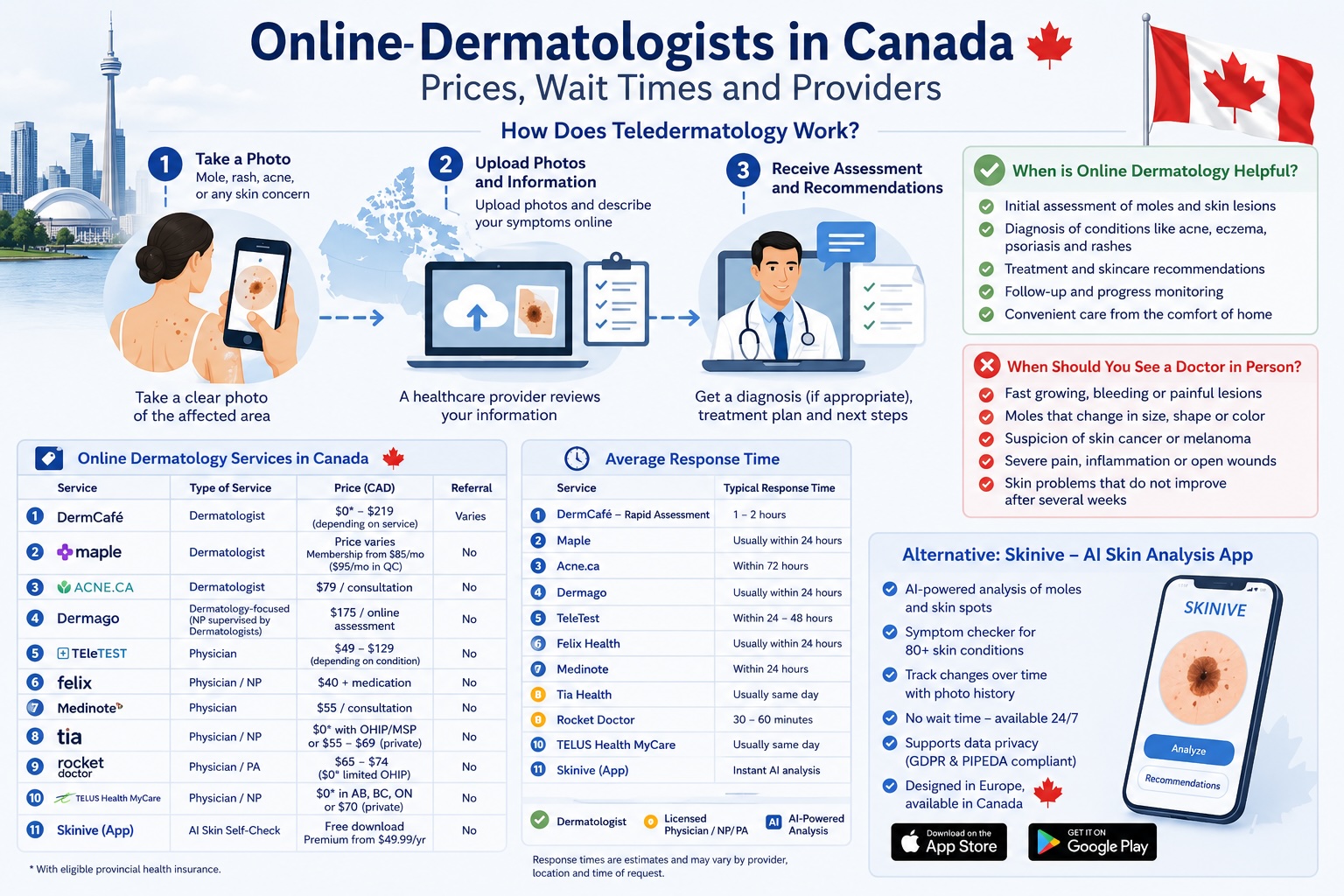
How online dermatology consultations work in Canada
The exact process varies between providers and provinces, but most online dermatology services in Canada use one of two models: asynchronous photo-based assessment or a live virtual consultation.
Step 1 — Submit photos of your skin concern
For photo-based teledermatology, patients upload clear images of the affected area. Some services request several photographs from different distances or angles.
Step 2 — Provide your medical information
You may be asked about your symptoms, how long the problem has been present, medications, allergies, previous treatments and relevant medical history.
Step 3 — Dermatology review
A dermatologist or other qualified healthcare professional reviews the information. Depending on the platform, this may happen asynchronously or during a scheduled video consultation.
Step 4 — Receive advice or a treatment plan
Where clinically appropriate, the provider may offer treatment recommendations, issue a prescription, suggest follow-up care or advise you to see a doctor or dermatologist in person.
Response times vary. Some private online dermatology services offer assessments within hours or approximately one day, while publicly funded teledermatology pathways depend on the province and referral system.
Do you need a referral for an online dermatologist in Canada?
It depends on the type of service.
For traditional specialist dermatology within Canada’s publicly funded healthcare system, patients generally access a dermatologist through a referral from a family doctor or another eligible healthcare provider. Provincial teledermatology programs may follow a similar model, with the referring clinician submitting photographs and medical information to a dermatologist.
Private virtual dermatology can work differently. Some services allow patients to consult a dermatologist online without a referral, although the consultation may not be covered by provincial health insurance.
This distinction is important when comparing services:
- Publicly funded teledermatology: often requires a healthcare provider or referral and eligibility depends on the province.
- Private online dermatologist: direct access may be available without a referral, but patients may need to pay for the consultation.
- General virtual care: may provide an initial assessment through a doctor or nurse practitioner rather than a dermatologist and arrange further care if necessary.
Coverage, referral requirements and availability vary between Ontario, British Columbia, Alberta, Quebec and other provinces, so patients should check the rules for both their province and the specific provider.
Is online dermatology covered by provincial health insurance?
Coverage for online dermatology in Canada depends on the province, provider and type of consultation.
Canada does not have a single national insurance plan for physician services. Healthcare is administered provincially, so access to publicly funded virtual dermatology can differ between Ontario, British Columbia, Alberta, Quebec and other provinces.
Some virtual-care pathways may be covered for eligible patients through provincial health insurance. For example, certain services provide insured virtual medical appointments for patients covered by plans such as OHIP in Ontario, MSP in British Columbia or AHCIP in Alberta.
Direct-access private dermatology works differently. A patient may be able to book an online dermatologist without a referral, but the consultation is usually paid privately unless it is covered by supplementary insurance.
Before booking, check:
- whether the provider accepts your provincial health plan
- whether a referral is required
- whether you will see a dermatologist or another healthcare professional
- whether the consultation is publicly insured or private-pay
- whether private health insurance may reimburse the cost
This distinction can make a significant difference to the cost of seeing a dermatologist online in Canada.
Comparison of online dermatology services in Canada
Online dermatology providers in Canada differ in specialist access, provincial availability, consultation format, referral requirements and insurance coverage.
When comparing services, it is particularly important to check whether you are consulting a dermatologist or a general healthcare provider who can assess skin concerns.
| Service | Type of service | Price (CAD) | Referral | Availability / coverage |
|---|---|---|---|---|
| DermCafé | Board-certified Canadian dermatologist | $0 for eligible insured medical video visits; $199 Rapid Assessment; private dermatologist visit from $219 | Depends on pathway; Rapid Assessment requires no referral | OHIP, MSP and AHS-covered pathways; private access also available |
| Maple | Canadian-licensed dermatologist / virtual healthcare | Dermatology price varies; Maple membership $85/month in most provinces; $95/month in Quebec | No referral required for private specialist access | Dermatology available in selected provinces |
| Acne.ca | Board-certified dermatologist, focused on acne | $79 per consultation | No referral | Available across Canada |
| Dermago / Dermsmart | Virtual dermatology-focused assessment; specialised NP supervised by dermatologists | $175 per online assessment | No referral | Canada except Saskatchewan |
| Canadian-licensed clinician; online treatment for multiple skin conditions | $49 for most medical skin consultations; $129 for some cosmetic dermatology / melasma consultations | No referral | ||
| Felix Health | Licensed healthcare practitioner; acne and prescription skin treatment | $40 per online visit in most acne categories + medication | No referral | Available in participating Canadian provinces |
| Medinote | Licensed Canadian physician; virtual skin-condition and prescription care | $55 per consultation | No referral | Canada, subject to provincial availability |
| Tia Health | Virtual primary-care physician; can assess skin concerns and arrange treatment/referral | $0 with eligible OHIP, AHCIP or MSP; private visits from approximately $55–$69 | No referral for primary-care appointment | Ontario, Alberta, British Columbia and private-pay options elsewhere |
| Rocket Doctor | Licensed physician / physician assistant; general virtual care including skin concerns | $74 doctor consultation; $65 physician-assistant video visit; limited $0 OHIP appointments may be available | No referral for initial appointment | Primarily Ontario; service availability varies |
| TELUS Health MyCare | Family doctor or nurse practitioner; skin assessment, prescriptions and referrals | $0 for eligible insured visits in AB, BC and ON; $70 per visit without provincial coverage | No referral for primary care | Provincial availability varies |
| Skinive app | AI skin self-check and monitoring | Free download + optional Premium features | No referral | Available in Canada |
Availability, coverage and consultation options can change and may differ between provinces. Patients should confirm current eligibility and fees directly with the provider before booking.
Specialist dermatology vs. general virtual care
Not every service in the table provides direct access to a dermatologist.
DermCafé, Maple and Acne.ca provide access to dermatologists, while Dermago offers dermatology-focused virtual care through a specialised nurse practitioner working under dermatologist supervision.
Services such as TeleTest, Felix, Medinote, Tia Health, Rocket Doctor and TELUS Health MyCare provide virtual healthcare through physicians, nurse practitioners or other licensed clinicians. They can be useful for conditions such as acne, eczema, rosacea and rashes, but patients may still need a referral or in-person dermatologist assessment for more complex conditions.
Dermatologist consultation vs. AI skin self-check
These services do not all serve the same purpose. DermCafé, Maple and Acne.ca provide access to healthcare professionals, while provincial teledermatology connects patients with specialist care through the public healthcare system.
Skinive is different. It is an AI-powered skin self-check and monitoring tool rather than an online dermatologist consultation. Users can photograph visible skin concerns, monitor changes over time and receive AI-assisted information about visual patterns in their images.
A self-check tool can be useful before seeking professional care or for keeping a visual record of skin changes, but it does not replace a dermatologist or provide a medical diagnosis. If a skin concern is new, changing, persistent or worrying, it should be assessed by a qualified healthcare professional.
Prices, provincial coverage and service availability can change. Patients should confirm current fees and eligibility directly with the provider before booking.
Online dermatologist wait and response times in Canada
One reason Canadians use virtual dermatology is the possibility of receiving an assessment sooner than through a conventional specialist pathway.
Response times depend on the service and consultation format.
| Type of service | Typical response |
|---|---|
| AI skin self-check | Immediate |
| Rapid virtual assessment | Same day or within hours |
| Photo-based dermatology consultation | Often within 24–72 hours |
| Scheduled video consultation | Depends on appointment availability |
| Provincial teledermatology | Varies by province and clinical priority |
Private services may provide faster direct access, while publicly funded teledermatology depends on provincial pathways, specialist availability and the urgency of the case.
Faster response does not necessarily mean that online care is appropriate for every condition. A dermatologist may still recommend an in-person examination if dermoscopy, biopsy or another physical procedure is required.
Reviews of online dermatology services in Canada
Canada has several options for accessing dermatology care online, ranging from virtual consultations with Canadian dermatologists to provincial teledermatology programs and specialised online skin services.
DermCafé
DermCafé provides virtual dermatology consultations with Canadian dermatologists. For eligible patients, medically necessary video appointments may be covered by provincial health insurance, including OHIP in Ontario, MSP in British Columbia and AHS in Alberta.
Patients typically start through DermCafé’s virtual care pathway before seeing a dermatologist. The service can be used for conditions such as acne, eczema, psoriasis, rosacea, hair loss and other skin concerns.
DermCafé may be particularly useful for patients looking for an online dermatologist in Canada covered by provincial health insurance, although eligibility and referral pathways depend on the province.
Maple
Maple is one of Canada’s largest virtual healthcare platforms and provides access to Canadian-licensed dermatologists in selected provinces.
Unlike the traditional public referral pathway, patients can access private dermatology consultations directly through the platform without first obtaining a referral from a family doctor. Consultations are generally private-pay, and dermatology fees can vary by province and service.
Maple can therefore be an option for patients searching for a private online dermatologist in Canada without a referral, particularly when faster access is a priority.
Acne.ca
Acne.ca is a specialised Canadian online service focused specifically on acne. Patients complete an online consultation and provide information about their skin before their case is reviewed.
At the time of writing, an online consultation costs CA$79, making it a relatively straightforward option for people primarily seeking online acne treatment in Canada rather than broader dermatology care.
Because the service focuses on acne, patients with other skin conditions may need a more general online dermatology provider.
Provincial teledermatology services
Several Canadian provinces use teledermatology within their public healthcare systems. These services generally work differently from private direct-to-consumer platforms.
A family doctor or another healthcare professional may submit photographs and clinical information to a dermatologist, who reviews the case remotely and provides recommendations or determines whether an in-person specialist appointment is required.
For eligible patients, this type of teledermatology in Canada may be covered by provincial health insurance. Access and referral pathways vary between Ontario, British Columbia, Alberta, Quebec and other provinces.
Pros and cons of online dermatology
Online dermatology can make skin care more accessible, particularly for Canadians who live far from specialist clinics or face long waits for an in-person appointment. However, virtual care is not suitable for every skin concern.
Advantages of online dermatology
- Convenient access from home
- Potentially faster than a routine specialist referral
- Direct access without referral through some private services
- Useful for acne, eczema, psoriasis, rosacea and other visible skin conditions
- Photo-based consultations can be convenient for monitoring existing conditions
- Provincial teledermatology may be publicly covered for eligible patients
Limitations of online dermatology
- No complete physical examination
- Dermoscopy, biopsy and surgical procedures require in-person care
- Assessment depends heavily on the quality of submitted images
- Private online dermatologist consultations may not be covered by provincial insurance
- Availability varies considerably between provinces
- Urgent or complex skin conditions may require direct medical assessment
For many patients, an online dermatologist can provide a useful first assessment or follow-up, but virtual dermatology should not be considered a complete replacement for in-person specialist care.
How to choose the right online dermatologist in Canada
Not every virtual healthcare service provides the same level of dermatology expertise. Before booking an online dermatologist in Canada, check who will actually review your case and whether the service is available in your province.
Important factors include:
- Dermatologist vs. general practitioner: Check whether you will actually consult a dermatologist or a general healthcare provider.
- Provincial availability: A service available in Ontario may not necessarily offer the same specialist access in British Columbia, Alberta or Quebec.
- Referral requirements: Publicly funded specialist care commonly requires a referral, while some private online dermatologists allow direct booking.
- Cost and insurance: Check whether the consultation is covered by your provincial health plan or requires private payment.
- Consultation format: Some services use photographs and questionnaires, while others provide live video appointments.
- Response time: Private services may offer faster access, while provincial pathways depend on local availability.
- Prescriptions and follow-up: Check whether prescriptions and follow-up consultations are available when clinically appropriate.
For visible skin concerns, photo-based dermatology can be convenient. If a lesion requires dermoscopy, biopsy or another physical procedure, an in-person dermatologist is likely to be more appropriate.
Checking a mole before seeing a dermatologist
Moles and other changing skin spots are common reasons people search for an online dermatologist in Canada. Photographs can be useful for documenting a visible skin change, but they cannot replace dermoscopy or a biopsy when these are needed.
The ABCDE rule for moles
One simple way to monitor a mole is the ABCDE rule:
- A — Asymmetry: one half looks different from the other
- B — Border: irregular, blurred or poorly defined edges
- C — Colour: different colours or uneven pigmentation
- D — Diameter: a larger or growing lesion may need closer attention
- E — Evolving: changes in size, shape, colour or appearance over time
A new or changing mole, or a lesion that bleeds, becomes painful or looks unusual, should be assessed by an appropriate healthcare professional.
Can AI help before booking an online dermatologist?
Sometimes people notice a new mole, rash or other skin change but are unsure whether they need to book a doctor or dermatologist immediately.
AI-powered skin self-check tools provide another first step before an online or in-person consultation. Skinive, for example, allows users to photograph visible skin concerns and analyse them using AI, as well as monitor changes over time.
An AI skin self-check can help users:
- perform an initial check of a visible skin concern
- monitor moles and other skin changes over time
- keep a visual history for future comparison
- identify changes that may be worth discussing with a healthcare professional
- prepare information before an online dermatology consultation
Skinive is available as a self-check and monitoring tool and does not require a referral. It is different from services such as DermCafé or Maple because users are not consulting a dermatologist through the app.
AI skin analysis should not replace professional medical assessment or be used as a definitive diagnosis. New, changing, persistent or concerning skin lesions should be discussed with an appropriate healthcare professional.
Try Skinive AI app – online skin self-check
FAQ about online dermatology in Canada
Can I see a dermatologist online in Canada?
Yes. Online dermatology services are available in Canada through private virtual-care providers and provincial teledermatology pathways. Availability depends on your province and the type of service.
Can I see an online dermatologist without a referral?
Some private services allow direct access to an online dermatologist without a traditional referral. Publicly funded specialist dermatology generally follows provincial referral pathways.
Is an online dermatologist covered by OHIP?
Some virtual dermatology care may be covered for eligible Ontario patients when provided through an insured healthcare pathway. Private direct-access services are generally not covered simply because the patient has OHIP.
How much does an online dermatologist cost in Canada?
Costs vary considerably. Some eligible virtual dermatology appointments may be covered by provincial insurance, while private services charge consultation fees. For example, Acne.ca currently lists an online consultation at CA$79, while specialist pricing on other platforms can vary.
Can an online dermatologist prescribe medication?
Where clinically appropriate and permitted, Canadian healthcare professionals providing virtual care may prescribe medication. This depends on the provider, condition and consultation.
Can I use online dermatology for acne?
Yes. Acne is particularly suitable for many virtual dermatology pathways because photographs and medical history can often provide useful information for assessment and follow-up.
Can a dermatologist check a mole online?
Photos can help with an initial assessment of a mole or other visible lesion, but photographs cannot replace every part of an in-person skin examination. Dermoscopy or biopsy may be necessary when a lesion requires further investigation.
Can melanoma be diagnosed online?
An online consultation or image assessment may identify features that warrant further investigation, but confirmation of melanoma generally requires in-person clinical assessment and, when indicated, biopsy.
What is the difference between teledermatology and an online dermatologist?
Teledermatology is the broader use of telecommunications technology to provide dermatology care remotely. It can include dermatologist-to-patient video consultations as well as a family doctor sending photographs and clinical information to a dermatologist for specialist review.
Can I check my skin online before seeing a dermatologist?
AI-powered tools such as Skinive can be used for an initial skin self-check and ongoing monitoring. They are not a substitute for a dermatologist or medical diagnosis, but can provide an additional step before seeking professional care.
Final thoughts on online dermatology services in Canada
Online dermatology can provide Canadians with a convenient way to access skin care without immediately travelling to a specialist clinic. Depending on the province and provider, options range from publicly funded teledermatology and insured virtual appointments to private online dermatologists and general virtual-care services.
For common visible skin concerns such as acne, eczema, psoriasis, rosacea and rashes, an online consultation may provide useful initial advice, treatment options or a referral for further care. Private services may also offer faster access for patients looking for a dermatologist online without a referral.
However, virtual dermatology has limitations. Suspicious or changing moles, possible skin cancer, complex conditions and concerns requiring dermoscopy, biopsy or another procedure should be assessed in person when appropriate.
AI skin self-check tools such as Skinive can provide an additional first step for checking and monitoring visible skin concerns, but they are not a replacement for professional medical care.
Because healthcare coverage and dermatologist access differ between provinces, Canadians should consider their location, referral requirements, provincial insurance coverage, consultation cost and the type of healthcare professional providing the assessment when choosing an online dermatology service.