
Introduction
Finding a dermatologist in Edmonton usually starts with primary care if you need medically necessary treatment. A family doctor or another appropriate physician can assess the problem and refer you to a specialist when required, with eligible physician services covered through the Alberta Health Care Insurance Plan (AHCIP).
Edmonton has a strong specialist network supported by the University of Alberta, Alberta Health Services facilities and community dermatology clinics. Private cosmetic and uninsured services are also available, while online care can provide an earlier assessment for suitable skin concerns.
If you need a mole check, have a persistent rash or are worried about a changing lesion, the most useful route depends on urgency, whether the service is medically necessary and how quickly you need an assessment.
👉 How to see a dermatologist in Canada — practical guide
When should you see a dermatologist?
Many straightforward skin problems can initially be managed by a family doctor. Specialist assessment becomes more useful when symptoms persist, repeatedly return, worsen despite treatment or require procedures or diagnostic expertise unavailable in primary care.
Common skin conditions
You should consider seeing a skin specialist in Edmonton if you experience ongoing or worsening skin problems. Dermatologists diagnose and treat a wide range of conditions, including:
- Acne, including persistent or adult acne
- Eczema with dry, inflamed or itchy skin
- Psoriasis and other chronic inflammatory skin conditions
- Rosacea, facial redness and visible blood vessels
- Bacterial, viral or fungal skin infections
- Pigmentation disorders such as dark spots and melasma
A dermatologist in Edmonton can also assess unexplained hair loss, nail disorders, recurring rashes and skin conditions that have not responded to initial treatment.
Warning signs
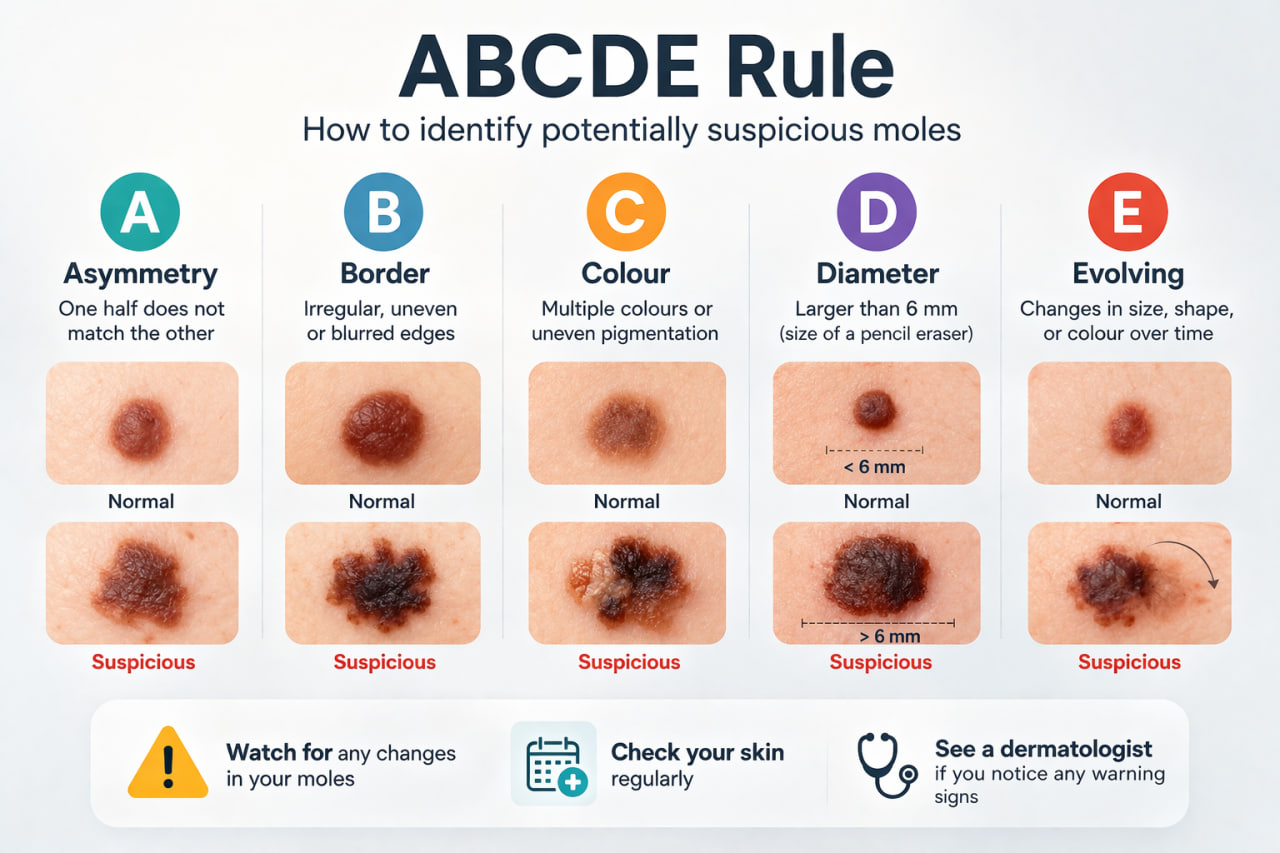
Arrange medical assessment if a mole changes noticeably in shape, size or colour, or begins bleeding without an obvious injury. A lesion that repeatedly crusts or fails to heal also deserves attention.
These signs do not automatically indicate melanoma. However, a mole check is appropriate when a lesion is evolving or looks distinctly different from your other moles.
Check your skin before visiting a doctor
Skin analysis with Skinive
Skinive can be used as a first step when you notice a new skin concern and are unsure what to do next. The app uses AI-based image analysis to assess visible skin lesions and provides information that can help users decide whether further medical evaluation should be considered.
Skinive is CE-marked medical software and is available 24/7. It can also support regular mole monitoring, which can make it easier to notice visible changes over time.
Key benefits include:
- Instant mole and skin analysis
- Ability to track changes over time
- Support for early detection of suspicious lesions
- Convenient access from home
The app is not a replacement for a dermatologist, biopsy, laboratory test or professional diagnosis. If a lesion appears suspicious, changes rapidly or causes concerning symptoms, arrange an in-person medical assessment.
How dermatology works in Canada
Canada does not have one identical dermatology pathway for every province. Edmonton is in Alberta, where eligible residents receive insured physician services through AHCIP.
Publicly funded dermatology in Alberta
For medically necessary dermatology, the typical pathway is:
Family doctor or primary-care physician → referral → dermatologist.
The referring physician assesses the skin problem and sends relevant clinical information to a specialist. The dermatologist or clinic then reviews the referral and may prioritize the patient according to medical urgency.
Eligible medically required physician and specialist services can be covered through AHCIP. Cosmetic procedures and other services that are not medically necessary are generally outside provincial coverage.
Waiting time is one of the main limitations. A routine referral for stable acne or eczema can be treated differently from a rapidly changing lesion where skin cancer is suspected.
If you do not have a regular family doctor, a walk-in clinic or another appropriate primary-care service may be able to examine the problem and arrange a referral when indicated.
Private dermatologists and self-pay services
Private dermatology in Alberta does not simply mean paying to bypass every requirement of the publicly insured specialist system.
Many Edmonton clinics combine insured medical dermatology with cosmetic or other uninsured services. Medical consultations may require a referral, while cosmetic treatments can often be booked directly.
Some self-pay consultations and assessments may also be available depending on the clinic. Patients should confirm eligibility, referral requirements, provider credentials and fees before booking.
A private dermatologist in Edmonton can therefore provide useful additional options, particularly for cosmetic or uninsured services, but direct access should never be assumed for every medical condition.
Dermatology clinics in Edmonton
Edmonton has university-affiliated specialist care, Alberta Health Services facilities and community dermatology clinics offering medical, surgical and cosmetic services.
| Clinic | Location | Services | Price |
|---|---|---|---|
| Kaye Edmonton Clinic / University of Alberta Dermatology | Edmonton | Medical dermatology, complex skin disease and specialist care | Insurance coverage |
| University of Alberta Hospital | Edmonton | Tertiary and specialist hospital services, including referral-based specialty care | Insurance coverage |
| Stratica Dermatology | Edmonton | Medical, surgical and cosmetic dermatology | 250–350 CAD |
| Symmetry Dermatology | Edmonton | Medical dermatology and cosmetic services | 250–350 CAD |
| Lucere Dermatology & Laser Clinic | Edmonton | Dermatology, skin assessment and cosmetic/laser services | 250–350 CAD |
Before choosing a skin clinic in Edmonton, determine whether you need insured medical dermatology or an elective service. Clinics offering both can have different booking processes for each.
Private dermatologists in Edmonton
Private and cosmetic dermatology can offer more scheduling flexibility for services outside AHCIP coverage. Direct booking is particularly common for aesthetic consultations, laser procedures and other elective treatments.
It does not follow that every medical problem can be seen immediately on a private basis. Confirm whether your chosen clinic accepts self-referrals for the specific service you need.
| Clinic | Services | Location | Price |
|---|---|---|---|
| Stratica Dermatology | Cosmetic, surgical and medical dermatology | Edmonton | 250–350 CAD |
| Lucere Dermatology & Laser Clinic | Cosmetic dermatology, laser and skin assessment | Edmonton | 250–350 CAD |
| Symmetry Dermatology | Medical and cosmetic dermatology | Edmonton | 250–350 CAD |
| Nakatsui DermaSurgery Centre | Dermatologic surgery, cosmetic treatments and skin services | Edmonton | 250–350 CAD |
| Rejuvenation Dermatology | Medical, surgical and cosmetic dermatology | Edmonton | 250–350 CAD |
When comparing clinics, ask who will actually perform the consultation. A private skin clinic may employ dermatologists alongside other physicians, nurses and aesthetic professionals.
Dermatologists near Edmonton
Edmonton has the largest concentration of specialist dermatology services in northern Alberta, but nearby communities can still provide useful alternatives for primary care, private skin services and selected specialist appointments.
Dermatologist in St. Albert
St. Albert borders northwest Edmonton and is one of the easiest alternatives for patients who do not want to restrict their search to Edmonton city limits.
People looking for a dermatologist in St. Albert can start with local family practices or primary-care clinics. Sturgeon Community Hospital provides important regional hospital services, while University of Alberta Hospital and Kaye Edmonton Clinic are major specialist facilities within a relatively short drive.
Private skin and cosmetic clinics are also available in St. Albert, although not every facility has a dermatologist on site.
For medically necessary dermatology, ask your referring physician whether an appropriate specialist in St. Albert or northwest Edmonton has suitable availability. The AHCIP referral pathway applies regardless of whether your specialist’s office is inside Edmonton itself.
Dermatologist in Sherwood Park
Sherwood Park is directly east of Edmonton and is convenient for residents of southeast and east Edmonton.
A patient searching for a dermatologist in Sherwood Park can access local primary-care practices and private skin services. Strathcona Community Hospital provides regional hospital care, while Grey Nuns Community Hospital and University of Alberta Hospital in Edmonton provide broader specialist resources.
Some dermatology-related services are available within Sherwood Park itself, but specialist capacity varies. A family physician can determine whether your condition should be treated locally or referred to an Edmonton specialist.
Private cosmetic clinics may offer faster appointments for uninsured services. Confirm whether the provider is a dermatologist and whether the treatment is medical, cosmetic or otherwise uninsured before booking.
Dermatologist in Leduc
Leduc lies south of Edmonton and is easily accessible from the city’s southern neighbourhoods via Highway 2.
Patients looking for a dermatologist in Leduc can begin with local primary care, while Leduc Community Hospital provides hospital and community health services. More specialized dermatology may involve travel to Edmonton facilities such as the University of Alberta Hospital or Kaye Edmonton Clinic.
This is particularly relevant for conditions requiring dermatologic surgery, complex diagnosis or specialized treatment.
Private skin and cosmetic services are available in the wider Edmonton metropolitan region. If you are willing to travel, ask whether an appropriate specialist south of Edmonton has an earlier appointment rather than assuming that central Edmonton will provide the shortest waiting time.
Dermatologist in Spruce Grove
Spruce Grove is west of Edmonton and serves a rapidly growing population together with neighbouring Stony Plain and Parkland County.
Someone seeking a dermatologist in Spruce Grove can use local family practices for initial assessment and referral. WestView Health Centre in Stony Plain is an important nearby hospital, while Misericordia Community Hospital and University of Alberta Hospital provide broader hospital services in Edmonton.
Specialist dermatology availability outside Edmonton may be more limited, so some patients will ultimately travel into the city.
Private skin and cosmetic clinics provide additional options for selected concerns. For medically necessary conditions, however, confirm whether the service is covered through AHCIP and whether a physician referral is required.
Dermatologist in Fort Saskatchewan
Fort Saskatchewan is northeast of Edmonton and has its own hospital and community healthcare infrastructure.
The Fort Saskatchewan Community Hospital provides local acute and outpatient care. Patients searching for a dermatologist in Fort Saskatchewan can also use family physicians and primary-care clinics to determine whether a dermatology referral is necessary.
For more complex specialist services, Royal Alexandra Hospital and University of Alberta Hospital in Edmonton are major regional centres.
Private cosmetic and skin services may be available locally or in northeast Edmonton. For a suspicious mole, persistent lesion or significant inflammatory skin condition, prioritize appropriate medical assessment over choosing a clinic simply because it offers the earliest cosmetic appointment.
Dermatologist in Beaumont
Beaumont is immediately south of Edmonton and is particularly convenient for residents of southeast Edmonton and communities near the airport corridor.
Primary-care practices can provide initial skin assessment and arrange referral to a dermatologist in Beaumont or the wider Edmonton region when appropriate. Grey Nuns Community Hospital and Leduc Community Hospital are accessible regional facilities, while University of Alberta Hospital provides more specialized care.
Local specialist capacity is smaller than in Edmonton, so a dermatology appointment may still require travel into the city.
Online assessment can be useful for suitable non-urgent concerns before travelling. Private cosmetic services are another option, but patients should distinguish clearly between aesthetic treatment and specialist medical dermatology.
Online dermatologists in Canada
Online dermatology can be useful when travel is difficult, you need initial guidance or you want to document a skin problem before an in-person appointment.
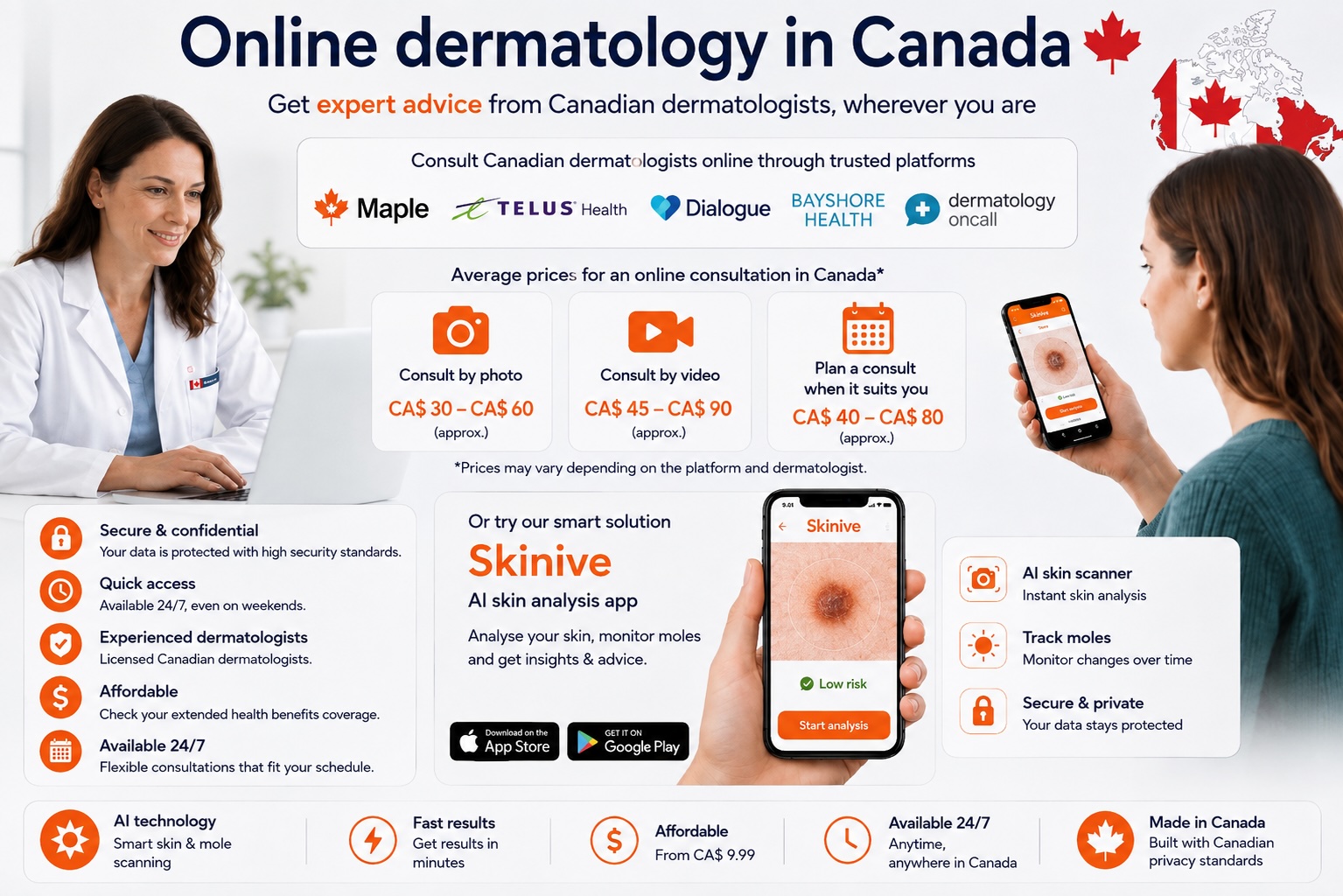
Virtual care does not eliminate the need for physical examination, dermoscopy or biopsy when these are clinically necessary.
| Platform | Services | Availability | Price |
|---|---|---|---|
| Skinive | AI skin analysis and mole monitoring | 24/7 | App-based; plan-dependent |
| Ontario virtual primary care options | Initial medical assessment and possible referral | Depends on provider and eligibility | May be OHIP-covered when eligibility and billing requirements are met |
| Maple | Virtual medical consultations and selected specialist services | Online | Self-pay or eligible benefit coverage depending on service |
| TELUS Health virtual services | Virtual healthcare through participating programs | Depends on plan/provider | Coverage varies |
| Private teledermatology providers | Image-based or video skin consultations | Varies across Canada | Self-pay fees vary |
Online assessment is particularly useful for triage, follow-up of visible changes and deciding what level of care to seek. A dermatologist may still request an in-person visit if the diagnosis depends on palpation, dermoscopy, laboratory testing or biopsy.
👉 Online dermatologists in Canada — full guide
How to get a dermatology consultation online for free or affordably
There is no universal free online dermatologist service covering every Canadian resident. Whether virtual care is publicly funded depends on the province, provider and service.
Free or publicly covered options
Alberta residents can first ask whether their family physician or another eligible primary-care provider offers virtual appointments. Where an insured physician service is appropriate, AHCIP coverage may apply.
A virtual primary-care assessment can sometimes solve the problem directly. If specialist expertise is required, the physician can determine whether a dermatology referral is appropriate.
AI tools such as Skinive can be used beforehand for initial screening and monitoring of visible concerns, but they should not be treated as a medical diagnosis.
Affordable options
Private telemedicine can provide relatively rapid access when publicly funded primary care is difficult to obtain.
Compare services carefully. Check whether the appointment is with a family physician, nurse practitioner or dermatologist, and whether prescriptions, follow-up or referrals are included in the advertised fee.
For suitable conditions, telemedicine may cost less than some uninsured in-person specialist consultations.
International options
International dermatology platforms can be useful for a second opinion, particularly if you already have photographs, test results or an established diagnosis.
They have important limitations for Alberta residents. An overseas clinician may not be able to prescribe locally, arrange Alberta investigations or create the referral required for the provincial specialist pathway.
Best approach
For many non-emergency visible concerns, a practical sequence is:
Skinive → online or primary-care assessment → in-person dermatologist when necessary.
If a lesion is rapidly changing, repeatedly bleeding or otherwise concerning, prioritize professional medical assessment rather than repeatedly checking it online.
Dermatologist waiting times in Edmonton
Waiting times depend on the diagnosis, urgency, specialist capacity and type of clinic. There is no reliable single waiting-time figure that applies to every dermatologist in Edmonton.
| Type | Typical access pattern |
|---|---|
| Routine AHCIP-covered dermatologist referral | Often several weeks to several months; varies significantly |
| Urgent referred dermatology | Prioritized according to clinical urgency |
| Specialized hospital or skin cancer pathway | Depends on referral criteria and triage |
| Private/uninsured service where available | Potentially days to several weeks |
| Online consultation | Same day to several days depending on provider |
Referral quality can influence triage. Clear information about rapid growth, bleeding, treatment failure or other clinically relevant changes helps the specialist understand why the patient needs assessment.
If you have heard nothing for an extended period, contact the referring clinic and confirm that your referral was successfully received.
You can also ask whether another appropriate dermatologist in Edmonton or a nearby community has earlier availability. If your condition worsens while you wait, notify your primary-care provider rather than assuming the original priority remains appropriate.
Cost of dermatologist in Edmonton
For Alberta residents, cost depends primarily on whether the service is medically necessary and insured or elective and uninsured.
| Service | Approximate patient cost |
|---|---|
| Eligible medically necessary dermatology under AHCIP | Usually no direct charge for the insured physician service |
| Uninsured medical consultation where offered | Often approximately CA$150–CA$350+ |
| Cosmetic dermatology consultation | Often approximately CA$100–CA$250+ |
| Elective mole mapping or skin screening | Approximately CA$150–CA$400+ depending on service |
| Cosmetic procedures and laser treatments | Highly variable; commonly several hundred dollars or more |
These are practical ranges rather than fixed fees. Prices can change, and consultation fees may not include procedures, pathology or follow-up.
A dermatologist in Edmonton may provide AHCIP-insured medical care and self-pay cosmetic services within the same practice. Always determine which pathway applies to your appointment.
Before paying privately, ask what the quoted price includes and whether additional charges could apply if the clinician recommends a biopsy, pathology examination or follow-up appointment.
Melanoma symptoms and suspicious moles
When is it urgent?
Most dermatology concerns are not emergencies. Stable acne, chronic eczema and cosmetic pigmentation problems can generally be managed through routine care.
Seek prompt medical assessment for a rapidly spreading or blistering rash, severe skin infection, significant skin pain accompanied by systemic illness or another rapidly deteriorating condition.
A mole or lesion that is changing quickly, repeatedly bleeding or ulcerating should also be assessed without unnecessary delay. Explain the specific changes when contacting your healthcare provider so that urgency can be evaluated.
Breathing difficulty, throat or facial swelling, collapse or other symptoms suggesting a severe allergic reaction require emergency care. Call 911.
In an emergency, waiting specifically for a dermatologist in Edmonton is not the appropriate first step. Emergency services can assess the immediate problem and involve specialists when necessary.
FAQ — Dermatologist in Edmonton
Do I need a referral to see a dermatologist in Edmonton?
For the usual AHCIP-insured medical dermatology pathway, a physician referral is generally required. The dermatologist reviews the referral and determines the appropriate priority.
Cosmetic and some uninsured services may permit direct booking. Always check the individual clinic’s requirements because direct access is not available for every type of dermatology appointment.
How long is the wait for a dermatologist in Edmonton?
Routine referrals can take weeks or months, while urgent cases may be prioritized much more quickly. The actual wait depends on the condition, specialist and current demand.
If the delay is substantial, ask your referring physician whether another suitable specialist has earlier availability. Report important changes in your condition while you are waiting.
Is a dermatologist covered by Alberta health insurance?
Medically necessary insured physician services can be covered through AHCIP for eligible Alberta residents when applicable provincial requirements are met.
Cosmetic and other medically unnecessary services are generally not covered. A clinic may therefore provide both publicly insured medical dermatology and privately paid services.
How much does a private dermatologist in Edmonton cost?
Uninsured consultations can cost a few hundred Canadian dollars, depending on the provider and type of assessment. Cosmetic consultations may have different pricing.
Ask whether follow-up, procedures and pathology are included. The initial consultation price does not necessarily represent the full cost of treatment.
Can I see an online dermatologist in Edmonton?
Yes. Alberta residents can access private telehealth services and may also have virtual options through local healthcare providers.
Remote assessment works well for selected visible skin problems. If dermoscopy, biopsy or another procedure is needed, you will still require an in-person appointment with an appropriate healthcare professional.
Where can I get a mole check in Edmonton?
A family doctor can assess a concerning mole and arrange dermatology referral when appropriate. Dermatology clinics and selected private skin services may also provide lesion assessment or elective screening.
If the mole has changed, describe exactly what happened: growth, altered shape or colour, bleeding or persistent crusting. These details can help determine urgency.
Can Skinive replace a dermatologist?
No. Skinive uses AI-based analysis to help users check and monitor visible skin concerns, but it does not replace a professional diagnosis.
Use it as an initial step or monitoring tool. Suspicious findings, persistent symptoms and changing lesions should be assessed by an appropriate healthcare professional.
What should I do if the dermatology wait is too long?
Confirm that the specialist received your referral and ask whether another appropriate clinic has earlier availability. You can also discuss expanding the search to St. Albert, Sherwood Park or other nearby communities.
Online assessment may provide useful guidance for suitable non-urgent conditions while you wait. If symptoms worsen, contact your healthcare provider so the urgency can be reassessed.
Choosing between public, private and online dermatology
For a medically necessary skin problem, primary care followed by an AHCIP-covered referral is usually the most appropriate starting point. This provides access to insured specialist services but can involve waiting for routine cases.
Private and self-pay services add flexibility for cosmetic treatment and other uninsured care. A private dermatologist in Edmonton may also offer selected direct-access services, but patients should verify referral requirements rather than assuming every medical consultation can be privately booked.
Online care provides another option for initial assessment, triage and follow-up. It is particularly useful when a condition can be photographed clearly and no immediate procedure is required.
Skinive can be used before these steps to analyse and monitor visible skin concerns. Its purpose is to provide accessible AI-based skin analysis and early detection support, not to replace professional medical care.
For many patients, the practical pathway is simple: document the concern, use Skinive as an initial check if appropriate, obtain primary or virtual medical assessment and see a dermatologist in Edmonton when specialist care is needed.