
Powered by AI | Skinive



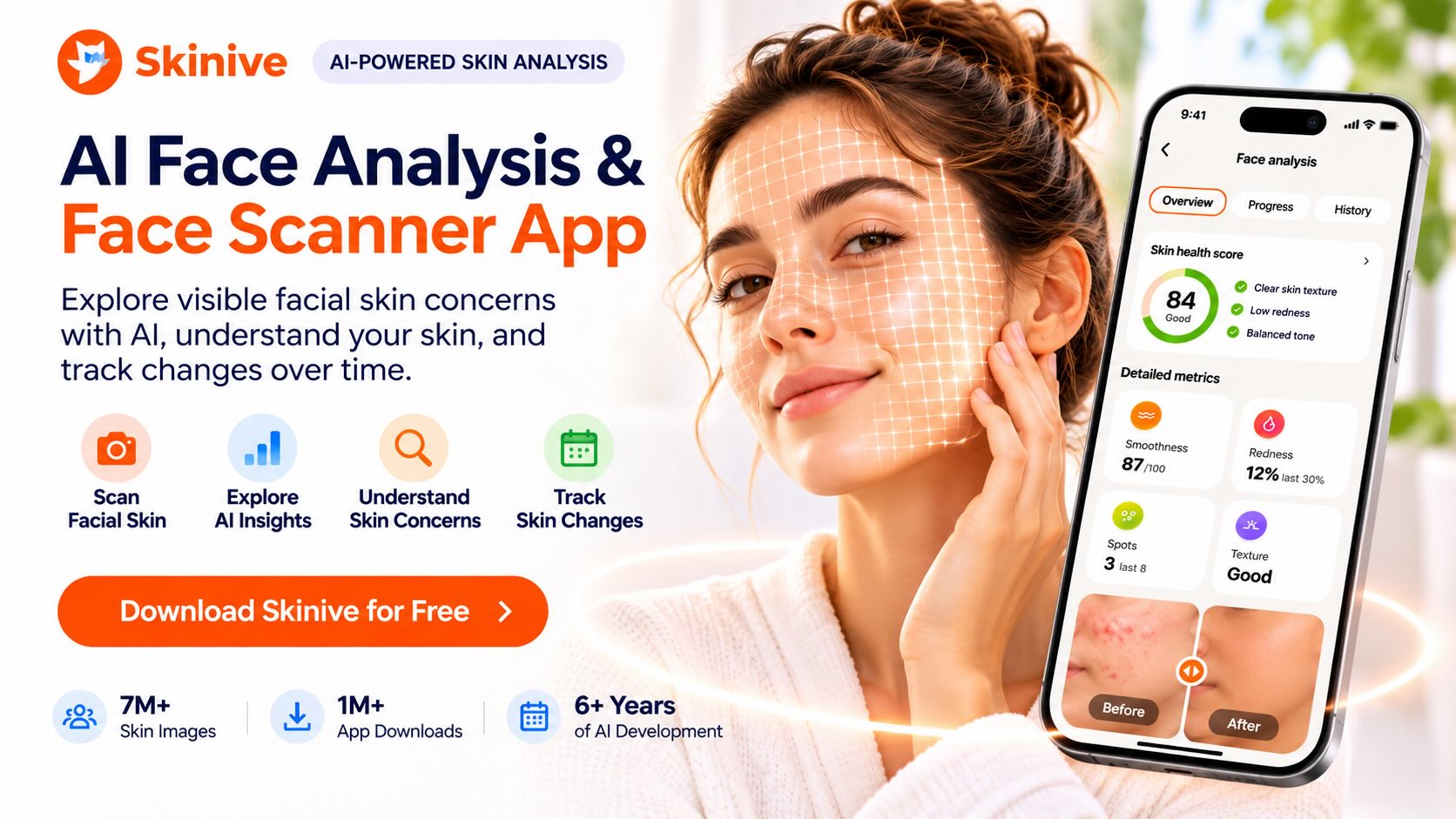
AI Face Analysis & Face Scanner App
Your face is personal. Understanding your facial skin should be simple.
Acne, redness, pigmentation, or an unexpected skin change can make you wonder what’s happening to your face. With the Skinive AI Face Analysis App, you can examine visible skin concerns, explore AI-generated findings, and monitor changes over time — directly from your smartphone.
Unlike beauty apps that rate facial attractiveness or analyse face shape, Skinive focuses on facial skin analysis. Its AI-powered scanner examines photographs of specific skin areas and identifies visually similar dermatological conditions, helping you learn more about your skin.
Whether you’re examining a breakout, exploring persistent redness, or following changes in a pigmented spot, Skinive makes AI-assisted skin analysis accessible wherever you are.
What you can do with Skinive:
- Scan specific areas of facial skin using your smartphone camera.
- Explore AI-generated findings across 60+ skin condition categories.
- Learn about acne, rosacea, pigmentation, and other visible concerns.
- Save facial skin images and compare results over time.
- Access educational information through the Skinive Dermatology Atlas.
(Available for iPhone and Android)
7M+ Skin Images | 1M+ App Downloads |AI Development since 2020
During the development of Skinive’s AI skin analysis technology, image quality has been an important technical consideration. A photograph can look acceptable to the human eye while still presenting challenges for computer vision. Four factors deserve particular attention.
Lighting
Different lighting conditions can change the apparent colour and contrast of skin. For example, warm indoor lighting may make redness appear different from how it looks in natural daylight.
Focus
Blurry photographs can obscure small visual details. Make sure the area you want to analyse is clearly visible.
Distance
Photographs taken from very different distances may capture different levels of detail. Try to keep the camera at a consistent distance when comparing the same area over time.
Camera angle
Changes in camera angle can affect shadows, reflections, and the visibility of skin features.
For meaningful comparisons, photograph the same area from a similar angle.
Skinive AI Team Tip: When tracking your skincare progress, try to use similar lighting, camera distance, and positioning for each photograph. Consistency makes visual comparisons easier to interpret. These practical considerations are part of the experience behind Skinive’s image-quality and skin analysis technology.
Skin Care Tracker: Monitor Your Skin Progress Over Time
Your skin does not look exactly the same every day. Changes in your environment, lifestyle, skincare products, and other factors may influence its appearance. A skin care tracker helps you maintain a visual history of your skin instead of relying only on memory. With Skinive, you can save skin analysis results and compare photographs taken at different times.
Why Track Your Skin?
Imagine introducing a new skincare routine. You may notice changes after several days or weeks, but it can be difficult to remember exactly how your skin looked before. A skincare tracker gives you a more consistent reference.
You can use it to:
- Document your skin’s appearance before changing your routine.
- Save photographs of areas you want to monitor.
- Compare visible changes over time.
- Observe the appearance of recurring skin concerns.
- Maintain a personal skin analysis history.
Turn Individual Skin Scans into a Visual Skin Diary
A single skin scan provides information about one moment. A series of photographs can help you understand how your skin’s appearance changes. This is the idea behind using Skinive as a skincare diary or skin progress tracker. You can return to previously examined areas, review earlier results, and compare them with newer photographs. This is particularly useful when you want to follow the appearance of acne, redness, or other visible skin concerns.
How Often Should You Track Your Skin?
There is no universal schedule that works for every skincare concern. For general skincare observation, taking comparable photographs at regular intervals can be more useful than scanning repeatedly throughout the day. Choose a schedule that fits your goals and gives you enough time to observe meaningful changes. If you’re following a specific treatment plan, your dermatologist’s recommendations should guide how and when you monitor your skin.
Face Skincare Routine Tracker App: Understand What Works for Your Face Skin
Your skincare routine may include cleansers, moisturizers, serums, sunscreen, and products designed for specific skin concerns. But how do you know whether your skin’s appearance is changing?
A skincare routine tracker app can help you approach this question more systematically. Skinive focuses on the visual side of skincare tracking: analysing your skin, saving results, and comparing changes over time

Why Facial Skin Analysis Matters
Your face is one of the first things people notice about you. It’s also the part of your skin you see most frequently — in mirrors, photographs, video calls, and everyday interactions.
Unlike many other areas of the body, facial skin is almost always visible. Even relatively small changes can attract attention: a breakout before an important event, persistent redness across the cheeks, or a dark spot that wasn’t noticeable before.
For some people, visible facial skin concerns affect confidence, social interactions, and quality of life. Understanding what may be happening to the skin can therefore be important for reasons that go beyond appearance.
Yet facial skin concerns aren’t always easy to interpret. Acne-like bumps may resemble other conditions. Redness can have different causes. Pigmented spots vary considerably in their appearance.
Skinive helps bridge the gap between noticing a visible skin change and learning more about it.
Rather than rating your appearance or promising perfect skin, the app provides AI-assisted visual analysis and dermatological education.
The goal is simple: understand your facial skin, recognise visible changes, and make more informed decisions about when to seek further advice.
What Is an AI Face Analysis App?
An AI face analysis app uses artificial intelligence and computer vision to examine photographs of the face. However, different applications analyse very different things.
Some evaluate facial proportions, symmetry, attractiveness, or estimated age. Others focus on cosmetic characteristics such as wrinkles or skin texture.
Skinive is designed for another purpose: AI analysis of visible dermatological concerns on facial skin.
Instead of assigning a beauty score, Skinive examines a photograph of a specific skin area and identifies visual similarities with skin condition categories represented in its AI models.
What Makes Skinive Different from Other Face Analysis Apps?
|
Type of Face Analysis |
Main Purpose |
Skinive |
|---|---|---|
|
Face symmetry analysis |
Evaluates facial proportions and symmetry |
Not the focus |
|
Beauty rating app |
Assigns attractiveness or beauty scores |
Not the focus |
|
Face shape detector |
Identifies oval, round, square, or other face shapes |
Not the focus |
|
Cosmetic face scanner |
Evaluates cosmetic features such as wrinkles or pores |
Supported |
|
Facial skin analysis |
Examines visible skin concerns and dermatological patterns |
Core functionality |
|
Facial skin tracking |
Saves images to compare visible changes |
Supported |
Skinive’s approach is particularly relevant if you’re looking for a face skin analysis app rather than an entertainment-oriented face scanner.
The technology focuses on skin images, not facial identity recognition.
How Does AI Facial Skin Analysis Work?
Skinive uses computer vision and AI models developed specifically for skin-image analysis. The app examines visible patterns in a photograph and provides information about visually similar skin conditions.
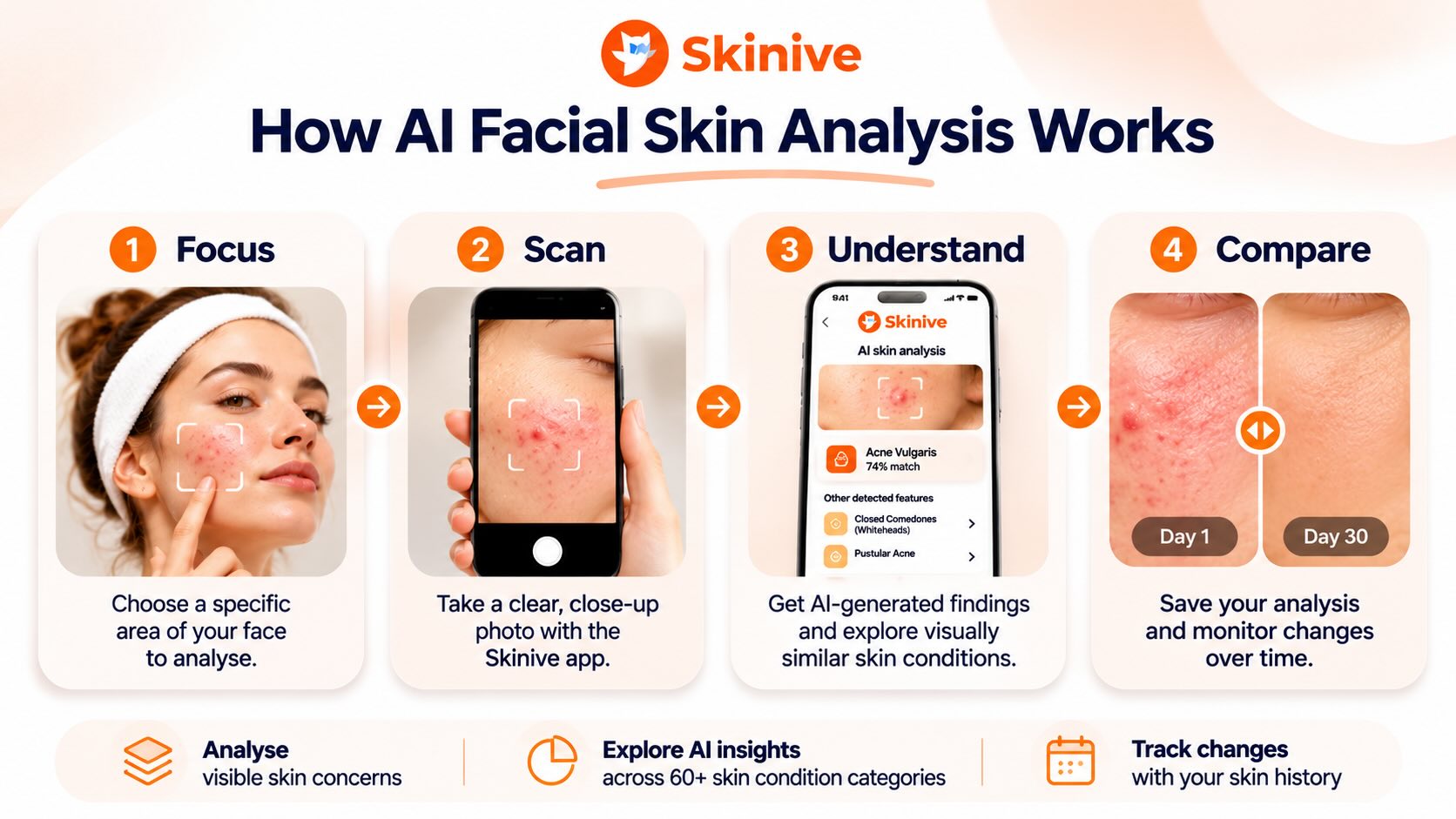
You can complete a facial skin analysis in four steps:
|
Step |
What You Do |
What Happens |
|---|---|---|
|
1. Focus |
Select a specific area of your face, such as a blemish, red patch, or pigmented spot. |
You identify the skin concern you want to examine. |
|
2. Scan |
Use the Skinive face scanner to capture a clear close-up image. |
The app obtains visual information for AI analysis. |
|
3. Understand |
Review the AI-generated findings and educational information. |
You can explore visually similar skin condition categories. |
|
4. Compare |
Save your analysis and return to the same area later. |
You can compare photographs and results over time. |
Why Skinive Analyses Specific Areas Instead of the Entire Face
Many AI face scanner apps use a full-face selfie. This approach can be suitable for evaluating facial proportions or general cosmetic characteristics.
Dermatological image analysis has different requirements.
A small blemish, pigmented lesion, or localized area of redness may occupy only a tiny part of a full-face photograph. Important visual details can become difficult to distinguish.
For this reason, Skinive’s dermatological face scanner focuses on a specific area of skin rather than attempting to evaluate every facial feature from a distant selfie.
A clear close-up helps the AI examine the relevant visual patterns.
Try AI Facial Skin Analysis with Skinive
What Can the Skinive Face Scanner Analyse?
Facial skin can develop many different visible concerns. Based on the Skinive team’s experience with real-world skin images, acne, rosacea, pigmentation, seborrheic dermatitis, herpes-related changes, and moles are among the categories frequently encountered during facial skin analysis.
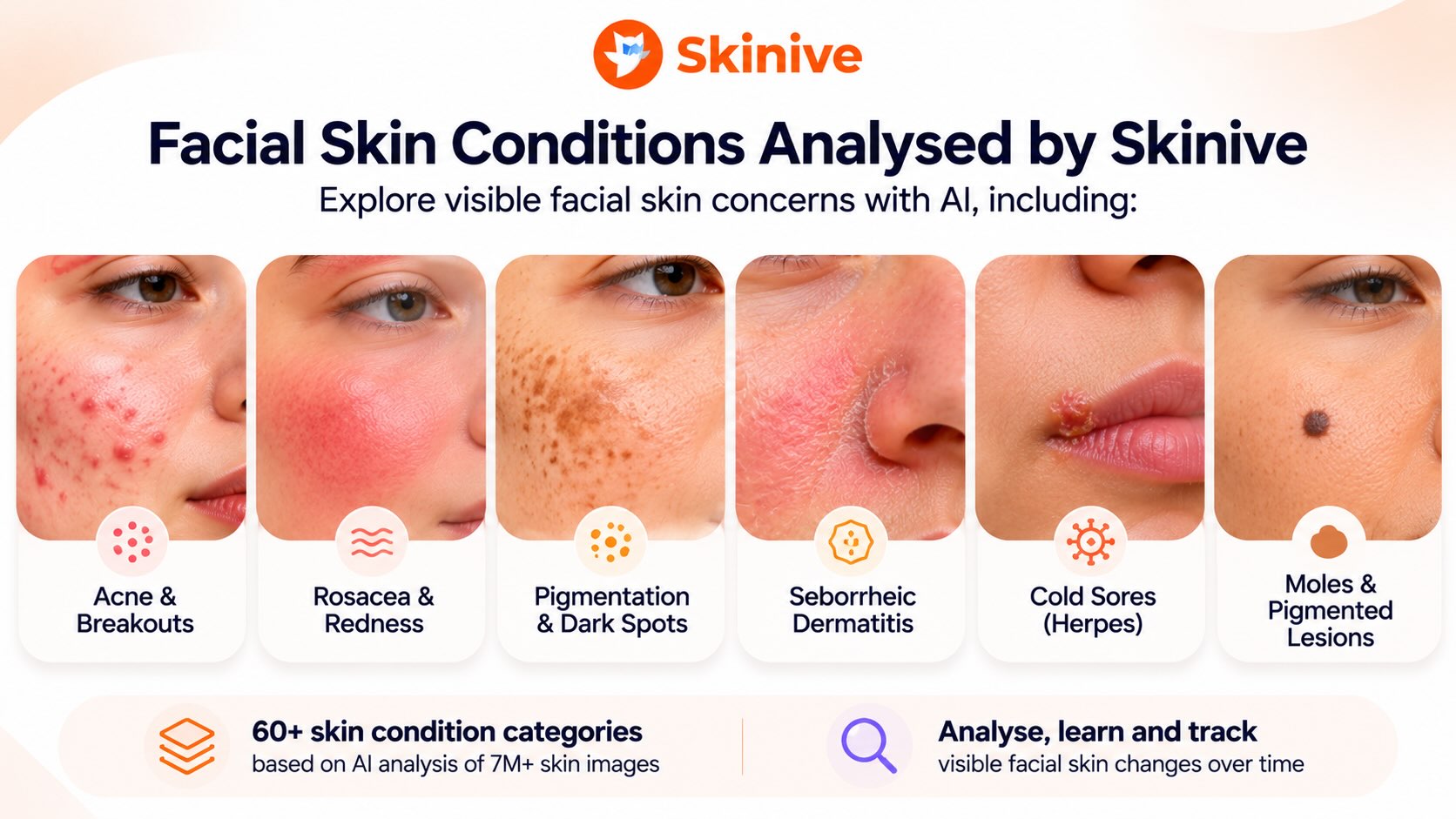
The following overview explains how these concerns may appear and what users can explore with Skinive.
|
Facial Skin Concern |
Common Visible Features |
How Skinive Can Help |
|---|---|---|
|
Acne and breakouts |
Pimples, inflamed bumps, blackheads, and acne-like lesions |
Explore visually similar skin condition categories and document changes |
|
Rosacea and facial redness |
Persistent redness, flushing, or visible inflammatory changes |
Examine localized redness and access relevant educational information |
|
Pigmentation and dark spots |
Brown spots, uneven pigmentation, or localized colour changes |
Analyse visible pigmented areas and compare their appearance over time |
|
Seborrheic dermatitis |
Redness and flaking, often around the nose or eyebrows |
Explore skin conditions with similar visual characteristics |
|
Cold sores and localized lesions |
Visible changes around the lips or other facial areas |
Access AI-generated visual-similarity findings and skin education |
|
Moles and pigmented lesions |
Localized pigmented spots with different shapes and colours |
Save images, explore findings, and observe visible changes |
These are examples of relevant categories, not a complete list of the conditions supported by Skinive. The AI technology recognises visual patterns associated with more than 60 skin condition categories.
Acne and Acne-Like Facial Breakouts
Acne is among the most familiar reasons people examine their facial skin. It can affect the forehead, cheeks, chin, and other areas, appearing as blackheads, whiteheads, inflamed bumps, or more pronounced lesions. However, not every acne-like eruption is acne. Several dermatological conditions can produce similar-looking bumps or redness. Skinive allows users to photograph the affected area and explore visually similar conditions. For more detailed information about this specific concern, see our AI Acne Analysis app.
Rosacea, Redness, and Irritation
Facial redness may be temporary, recurring, or persistent. It can affect the cheeks, nose, forehead, and other areas. Rosacea is one possible explanation for certain redness patterns, but other skin conditions may produce overlapping visual features.
An AI face skin scanner can help users explore those visual similarities and learn about relevant dermatological categories. A photograph alone cannot establish the underlying cause.
Pigmentation, Dark Spots, and Lentigo
Pigmentation changes are another frequent reason people examine their facial skin, particularly as they become more noticeable with age. Dark spots may vary in colour, size, shape, and distribution. Examples include post-inflammatory pigmentation, freckles, and sun-related lentigines. Skinive can analyse visible pigmented areas and help users maintain a photographic record. New, changing, or otherwise concerning pigmented lesions should be evaluated by a qualified healthcare professional.
Seborrheic Dermatitis and Other Facial Changes
Seborrheic dermatitis often affects areas around the nose, eyebrows, and other regions of the face. Visible changes may include redness and flaking. Localized lesions around the lips, including cold sores, can also raise questions about possible skin conditions. Skinive provides image-similarity findings and educational information that can help users understand the range of conditions associated with certain visual patterns.
What Millions of Skin Images Have Taught the Skinive Team
AI facial skin analysis isn’t only about developing algorithms. It’s also about understanding how people photograph their skin in everyday conditions.
Skinive’s technology has been developed over more than six years with contributions from AI specialists and dermatology experts. The Skinive ecosystem has accumulated experience with more than seven million skin images, including images captured outside controlled clinical environments. This work has provided practical insights into facial skin analysis, image quality, and user behaviour.
Insight 1: The Face Is Among the Most Frequently Analysed Areas
According to the Skinive team’s operational observations, the face is one of the areas users most frequently choose to examine. This is understandable: facial skin is highly visible, and even small changes can be noticeable during everyday interactions. Acne, redness, pigmentation, and other facial skin concerns frequently motivate users to seek additional information.
Insight 2: User Interests Change Across Life Stages
The Skinive team has observed differences in the facial skin concerns that attract users’ attention. Younger users frequently show interest in acne and breakouts. Among older users, questions related to pigmentation, rosacea, seborrheic dermatitis, lentigines, and other visible changes become more prominent. These are qualitative observations from Skinive’s experience, not formal age-specific prevalence statistics.
Insight 3: Image Quality Is a Critical Part of AI Analysis
One recurring challenge is that users sometimes photograph small skin concerns from too far away. Other common issues include uneven illumination, skin folds, and image distortion. These factors can reduce the visibility of relevant details and make image interpretation more difficult. The practical lesson is straightforward: a well-captured photograph is an essential starting point for useful AI image analysis.
Insight 4: Facial Skin Tracking Requires Consistency
When users compare images taken at different times, changes in camera angle, distance, or lighting can create apparent differences that don’t necessarily reflect changes in the skin itself. For more meaningful visual comparisons, the Skinive team recommends photographing the same area under similar conditions whenever possible.
These insights reflect the Skinive team’s practical experience with skin-image analysis. They are not presented as findings from a separate epidemiological study.
How to Take Better Photos with an AI Face Scanner
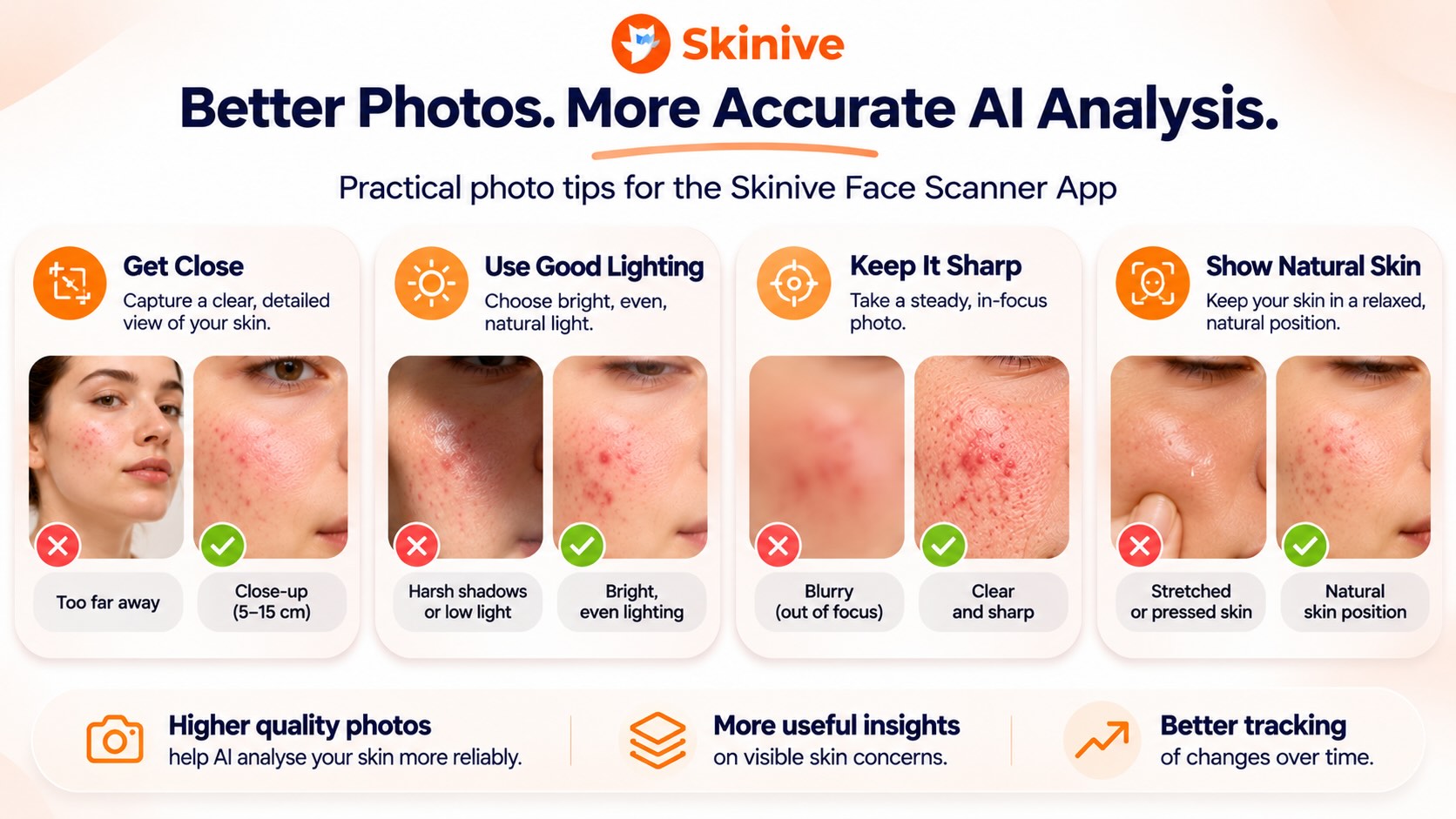
A smartphone camera can capture detailed images of facial skin, but photographic technique matters. The following recommendations are based on practical challenges encountered during Skinive’s AI development and real-world use.
|
Common Mistake |
Why It Matters |
Recommended Approach |
|---|---|---|
|
Camera too far from the face |
Small skin features may lack sufficient detail |
Move closer until the area of concern is clearly visible |
|
Uneven lighting |
Shadows can alter the appearance of redness and pigmentation |
Use soft, even illumination |
|
Blurry photograph |
Fine visual details become difficult to distinguish |
Hold the smartphone steady and ensure the skin is in focus |
|
Skin folds or stretching |
The skin’s appearance may become distorted |
Photograph the area in a natural position |
|
Beauty filters or retouching |
Filters may conceal or modify visible features |
Use an unedited photograph |
|
Different conditions during follow-up |
Lighting and angle differences complicate comparison |
Use similar lighting, distance, and framing |
Close-Up Facial Skin Analysis vs. Full-Face Selfies
One of the most important differences between Skinive and many beauty-oriented face scanner apps is the way images are captured. A full-face selfie is useful for showing your overall appearance, but it may not provide enough detail for analysing a small skin concern. For example, if you’re examining a blemish on your cheek, the relevant area should occupy a sufficient portion of the photograph to show its visible characteristics.
Skinive Tip: Focus on the specific area you want to analyse. A clear close-up is generally more informative for dermatological image analysis than a distant full-face photograph.
Track Facial Skin Changes Over Time
A single facial skin scan provides information about one moment. Repeated photographs can help you observe how the same area looks over time. Skinive allows users to save analyses and compare results from previously examined skin areas. This can be useful when following recurring breakouts, persistent redness, pigmentation changes, or other visible concerns.
Why Visual Comparison Matters
Imagine noticing a red patch on your cheek. You photograph it today, then return to the same area several weeks later. By comparing the images, you may be able to observe differences in its visible appearance. However, those differences should be interpreted carefully: lighting, camera distance, and other photographic conditions can affect the comparison.
Skinive’s history and comparison functionality helps organise this process without requiring you to manage separate photographs manually.
The Skinive Approach: Focus → Scan → Understand → Compare
Our recommended four-step method connects AI analysis with longer-term observation:
Focus on a specific concern → Scan the area → Understand the findings → Compare its appearance over time.
This creates a practical workflow for people who want more than a one-time face scan. Visual tracking can support awareness, but it cannot independently determine the cause of a change or establish whether a particular treatment is effective.
Download Skinive and Start Your Facial Skin History
AI Face Analysis vs. Traditional Skin Questionnaires
Many digital skincare tools use questionnaires to understand a person’s concerns. They may ask about symptoms, skin type, sensitivity, or previous experiences.
These questions can be useful, but they rely primarily on information supplied by the user. AI image analysis adds a different type of input: visible information captured by the camera.
|
Feature |
Traditional Questionnaire |
Skinive AI Face Analysis |
|---|---|---|
|
Main input |
Answers about skin concerns |
Photograph of a specific skin area |
|
Direct analysis of visible patterns |
No |
Yes |
|
Image-similarity findings |
Usually unavailable |
Yes |
|
Educational information |
Depends on the service |
Yes |
|
Saved images for comparison |
Not necessarily |
Yes |
|
Assessment of medical history |
May collect self-reported information |
Not a substitute for clinical assessment |
The approaches can complement one another. Photographs provide visual information, while symptoms, medical history, and other contextual factors may be essential for clinical interpretation.
Skinive focuses on AI-powered visual face skin analysis, not comprehensive medical diagnosis.
Why Choose Skinive for Facial Skin Analysis?
Skinive is developed by a team focused on applying computer vision and artificial intelligence to dermatological images.
Unlike face-rating applications or general-purpose beauty scanners, its consumer app is designed to help people explore visible skin concerns and access relevant educational information.
Skinive at a Glance
|
Skinive Experience |
What It Means for Users |
|---|---|
|
AI development since 2020 |
Experience building and improving dermatological image-analysis technology |
|
7M+ skin analyses done |
Extensive experience with real-world skin imagery |
|
1M+ app downloads |
Established consumer app experience |
|
60+ skin condition categories |
Broad coverage of visual dermatological patterns |
|
Educational information about skin conditions |
|
|
Skin analysis history |
Ability to save and compare results |
|
iOS and Android |
Accessible through a smartphone |
|
3 free AI analyses |
Test out the app before you subscribe, or gain free access by inviting your friends |
Developed with Dermatology Expertise
Skinive’s AI development involves specialists in artificial intelligence and dermatology. The company also maintains a Clinical Evidence Hub, where visitors can explore available scientific publications, evaluations, and information about the technology’s performance.
These resources help users understand the evidence behind Skinive rather than relying solely on marketing claims.
Designed for Skin Health Awareness, Not Beauty Ratings
Skinive doesn’t assign an attractiveness score or evaluate whether a person’s facial proportions meet a particular beauty standard. Instead, it focuses on visible skin concerns and educational interpretation. This makes it a relevant choice for people who want an AI facial skin analysis app rather than a facial recognition or beauty-scoring application.
What Can AI See in a Facial Skin Photograph?
AI image analysis works by evaluating visual patterns. It can identify similarities between the photographed area and patterns associated with skin condition categories represented in the model. However, a photograph doesn’t contain every type of information needed to understand skin health.
|
AI Can Help Evaluate |
A Photograph Alone Cannot Reliably Determine |
|---|---|
|
Visible colour differences |
The underlying cause of every skin change |
|
Appearance of localized lesions |
Whether a lesion is benign or malignant |
|
Patterns associated with acne-like conditions |
A confirmed medical diagnosis |
|
Visible redness and pigmentation patterns |
Exact skin hydration or barrier function |
|
Changes in photographed appearance |
Whether a treatment caused an improvement |
Skinive’s results are based on image similarity and intended to support skin awareness and education. If a skin concern is rapidly changing, bleeding, painful, or otherwise worrying, professional assessment is important.
Free Face Analysis App for iPhone and Android
Your facial skin changes throughout life. From acne and redness to pigmentation and other visible concerns, there are many reasons to pay attention to its appearance.
Skinive combines AI-powered facial skin analysis, dermatological education, and visual tracking in one mobile app.
Focus on a concern. Scan your skin. Understand the findings. Compare changes over time.
Ready to explore your facial skin with AI? Skinive makes it easy to get started without specialized equipment. All you need is your smartphone and a clear photograph of the skin area you want to examine.
Try 3 Free AI Face Scans & get free subscription by inviting friends
Download Skinive AI app – Face Scanner app & all-in one for your health & beauty
AI facial skin analysis, dermatological education, and visual tracking — in one mobile app.