
Free app to detect skin cancer



Skin Cancer Screening App: AI Skin & Mole Check
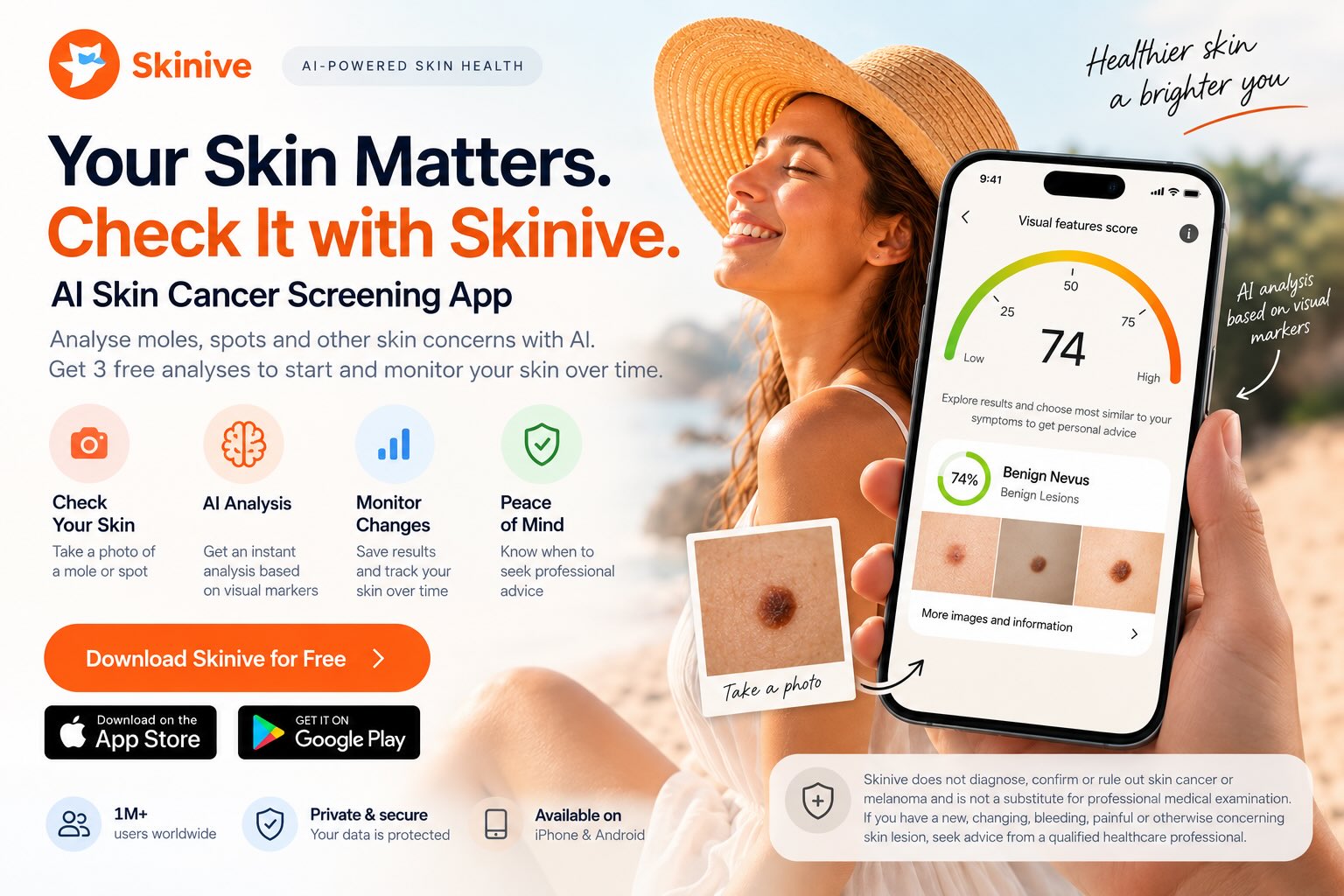
Looking for a skin cancer screening app or AI mole checker? Skinive helps you check and monitor visible moles, spots and other skin concerns using AI-powered image analysis. Take a photo with your smartphone to analyse the visual characteristics of a skin area and identify changes that may deserve closer attention.
Skinive can support regular skin self-checks and mole monitoring, but it does not diagnose or rule out skin cancer or melanoma and does not replace a dermatologist or medical examination. If you notice a new, changing, bleeding, painful or otherwise concerning skin lesion, seek advice from a qualified healthcare professional.
Quick summary
|
uestion |
Answer |
|---|---|
|
Can Skinive analyse a mole from a photo? |
Yes |
|
Does Skinive use AI for skin image analysis? |
Yes |
|
Can I monitor moles and skin spots over time? |
Yes |
|
Does Skinive diagnose skin cancer? |
No |
|
Can Skinive rule out skin cancer? |
No |
|
Does it replace visit to a dermatologist? |
No |
|
Are free skin checks available? |
Yes — new users receive 3 free analyses |
|
iPhone |
Yes |
|
Android |
Yes |
What Is a Skin Cancer Screening App?
People searching for a skin cancer screening app, skin cancer detection app, skin cancer scanner app or skin cancer detector app are often looking for a convenient way to check a mole or other visible skin change using their smartphone.
AI-powered skin analysis tools can examine visual characteristics in photographs and help users pay closer attention to areas of their skin that may warrant monitoring or professional evaluation.
However, there is an important distinction between AI-assisted skin analysis and a medical diagnosis.
A smartphone app cannot confirm that a lesion is skin cancer or guarantee that it is benign. Diagnosis of skin cancer may require professional examination and, when clinically indicated, additional procedures such as dermoscopy or biopsy.
Skinive should therefore be used as a skin awareness and monitoring tool alongside — not instead of — professional medical care.
How Does the Skinive AI Skin Check Work?
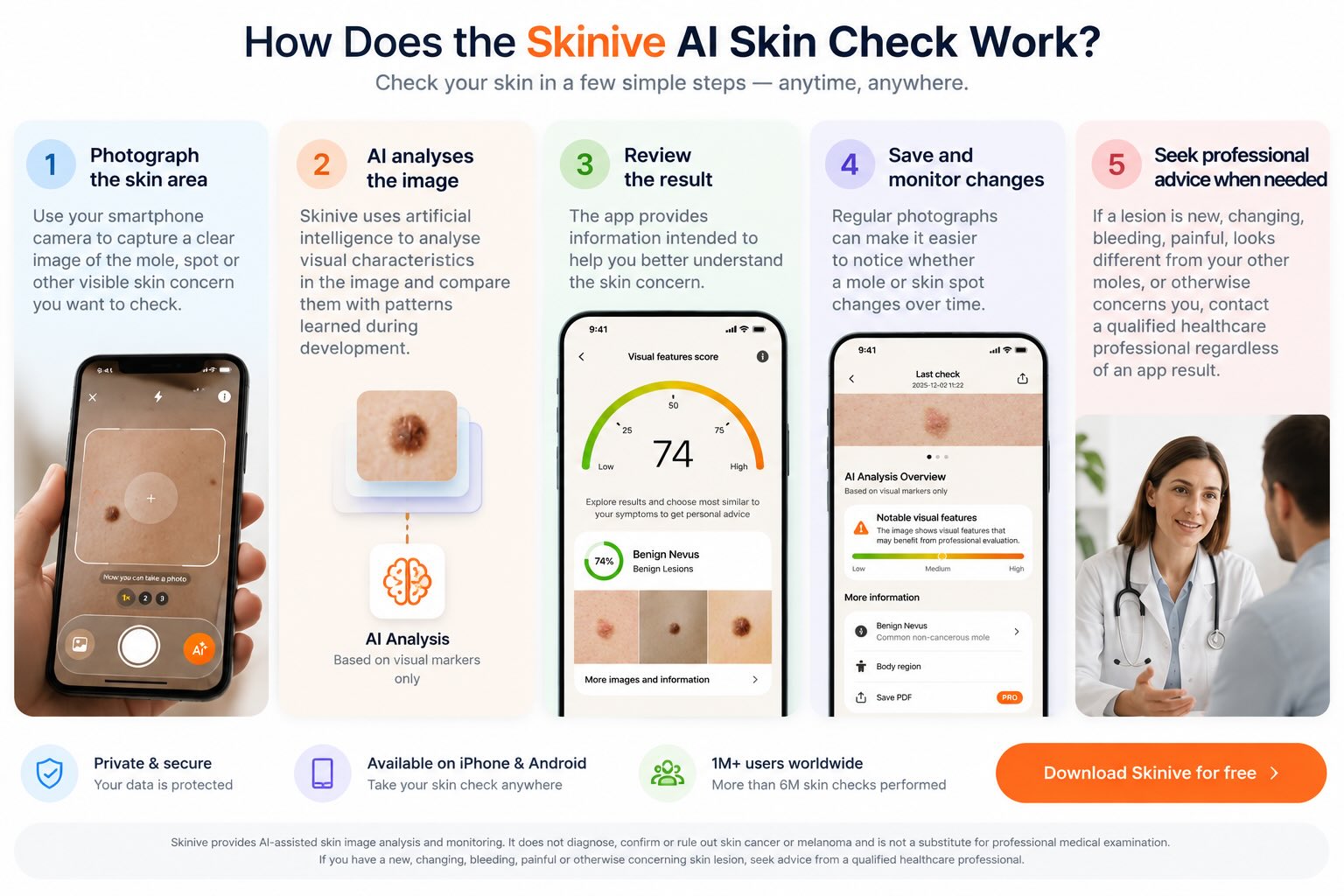
Using Skinive takes only a few steps.
1. Photograph the skin area
Use your smartphone camera to capture a clear image of the mole, spot or other visible skin concern you want to check.
2. AI analyses the image
Skinive uses artificial intelligence to analyse visual characteristics in the image and compare them with patterns learned during development of its skin-analysis technology.
3. Review the result
The app provides information intended to help you better understand and monitor the visible skin concern.
4. Save and monitor changes
Regular photographs can make it easier to notice whether a mole or skin spot changes over time.
5. Seek professional advice when needed
If a lesion is new, changing, bleeding, painful, looks different from your other moles, or otherwise concerns you, contact a qualified healthcare professional regardless of an app result.
TRY THE AI SKIN & MOLE CHECKER
Can AI Detect Skin Cancer From a Photo?
AI can analyse photographs of skin lesions and identify visual patterns associated with different types of skin changes. This makes AI useful as a supporting technology for skin awareness, image analysis and monitoring.
But AI image analysis is not the same as a confirmed skin cancer diagnosis.
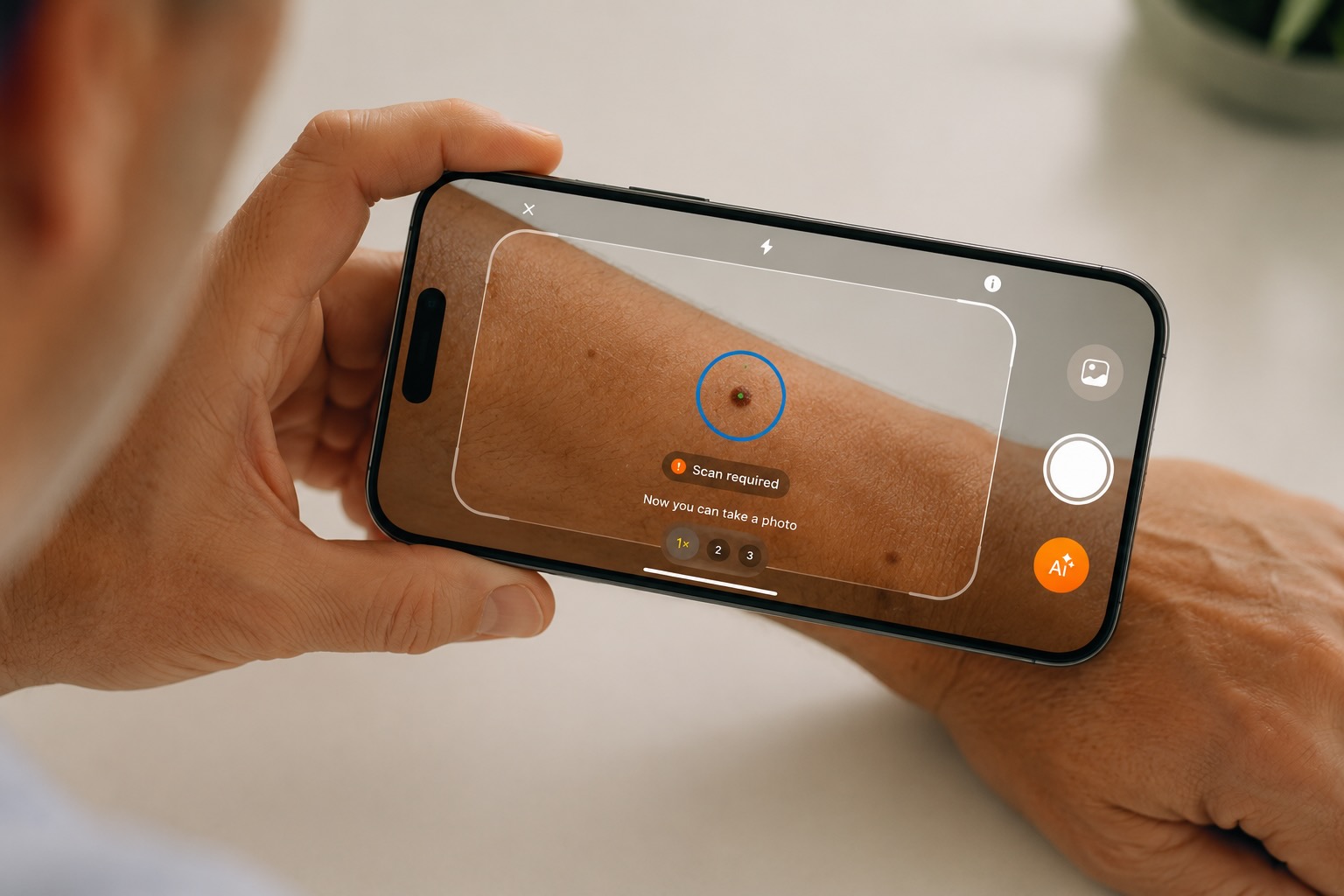
Skin cancers can vary considerably in appearance, and benign skin conditions can sometimes resemble concerning lesions. Conversely, some malignant lesions may not display obvious warning signs.
Skinive’s 2026 internal validation report evaluated its algorithm on a fixed validation dataset of 27,829 skin images. For the combined category of precancerous and malignant skin neoplasms, the report gives 2026 sensitivity of 91.9% and specificity of 94.8%. These figures describe performance on the validation dataset and should not be interpreted as a guarantee for an individual lesion or as a substitute for clinical diagnosis.
Read the Skinive Accuracy Report 2026 →
Can an AI App Diagnose skin cancer?
No app result should be used to confirm or rule out skin cancer.
Skin cancer develops from melanocytes, the cells that produce melanin. It can arise in an existing mole, but it can also appear as a new skin lesion.
An AI skin cancer app, skin cancer checker app or skin cancer scanner may help analyse and monitor photographs, but a suspicious lesion should be assessed by an appropriately qualified healthcare professional.
If you are specifically looking for information about checking and monitoring moles, see:
Melanoma: Photos, Symptoms & Warning Signs →
The ABCDE Rule for Checking Moles
One widely used way of remembering common warning signs associated with skin cancer is the ABCDE rule. It can help you become more familiar with changes worth discussing with a healthcare professional.
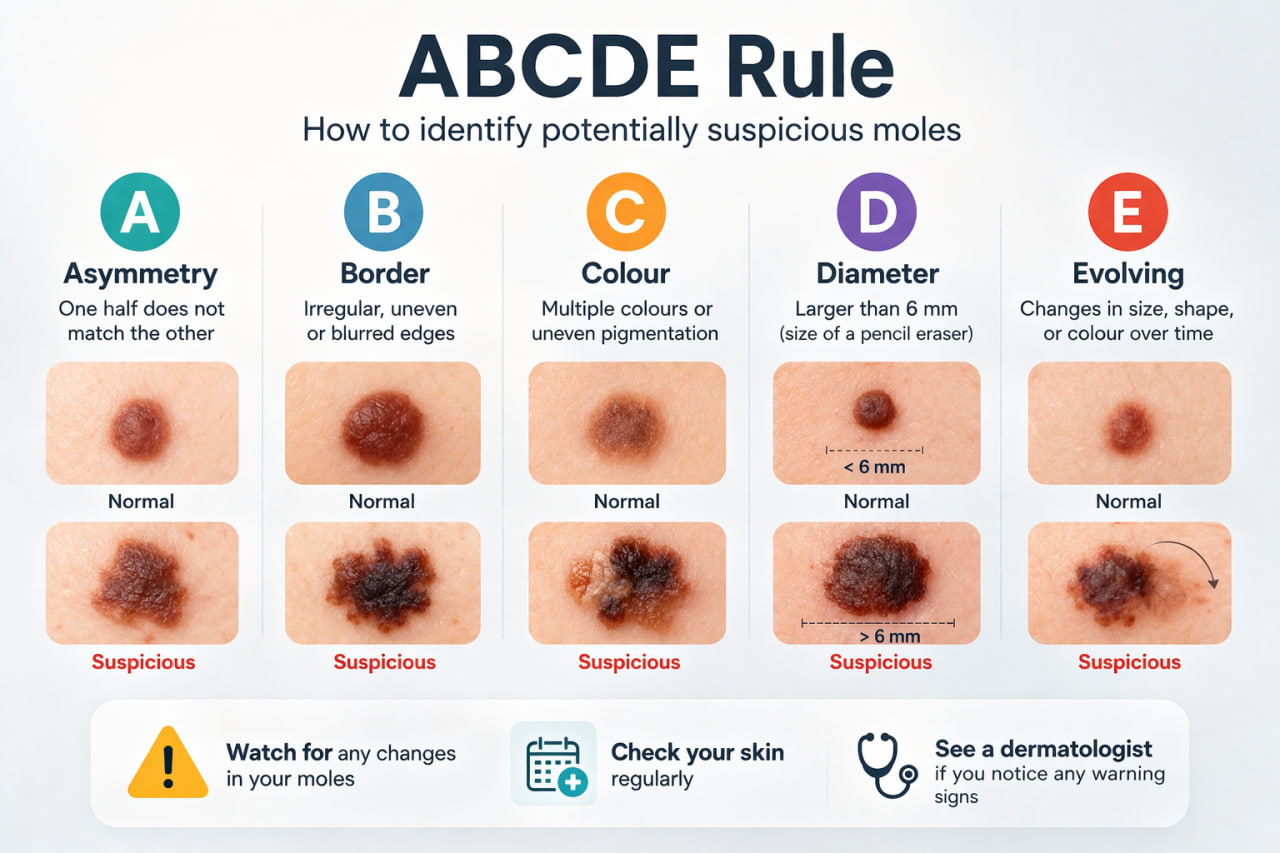
ABCDE Rule: Skin cancer self-examination
A — Asymmetry
One half of the mole or spot looks different from the other half.
B — Border
The edges may appear irregular, ragged, notched or blurred.
C — Colour
The colour is uneven or contains different shades.
D — Diameter
A diameter greater than approximately 6 mm can be a warning sign, although skin cancer can also be smaller.
E — Evolving
The mole changes in size, shape or colour over time.
Of these signs, change is particularly important. A new spot or one that changes in size, shape or colour should receive attention. Another warning sign is a lesion that looks noticeably different from the person’s other spots — sometimes described as the “ugly duckling” sign.
The ABCDE rule is a guide, not a diagnostic test. Not every skin cancer follows these characteristics, and many benign moles may display one or more of them.
What Are the Main Types of Skin Cancer?
Skin cancer is not a single disease. Different cancers develop from different types of cells in the skin and can behave differently.
Basal Cell Carcinoma (BCC)
Basal cell carcinoma develops from basal cells in the epidermis and is one of the most common forms of skin cancer.
Learn more about Basal Cell Carcinoma →
Squamous Cell Carcinoma (SCC)
Squamous cell carcinoma develops from squamous cells. Its appearance can vary, which is one reason professional assessment of persistent or changing skin lesions is important.
Learn more about Squamous Cell Carcinoma →
Melanoma
Melanoma develops from melanocytes. Although it is less common than basal and squamous cell skin cancers, recognising potentially concerning changes and obtaining appropriate medical assessment is important.
Learn more about Melanoma →
Other Skin Cancers
Less common forms include Merkel cell carcinoma, Kaposi sarcoma and some cutaneous lymphomas.
An app should not be used to determine which type of skin cancer a person has. A medical diagnosis requires evaluation by an appropriately qualified healthcare professional.
What Skin Changes Should You Pay Attention To?
It is worth becoming familiar with what is normal for your own skin.
Changes that deserve attention can include:
-
- a new mole or skin spot;
-
- a mole changing in size, shape or colour;
-
- a lesion that looks noticeably different from your other moles;
-
- persistent bleeding or crusting;
-
- a skin lesion that does not heal;
-
- persistent itching, tenderness or pain;
-
- a spot that continues to grow or otherwise change.
For melanoma specifically, a new spot or a changing existing spot is an important warning sign.
These signs do not necessarily mean cancer, but they are reasons to consider professional assessment.
Skin Cancer Screening App vs. Dermatologist
An AI skin app and a dermatologist have fundamentally different roles.
|
AI Skin App |
Dermatologist / Healthcare Professional |
|---|---|
|
Analyse a skin image |
Perform clinical examination |
|
Help monitor visible changes |
Interpret medical history and symptoms |
|
Store previous skin checks |
Use dermoscopy when appropriate |
|
Support regular skin awareness |
Decide whether further testing is needed |
|
Available from a smartphone |
Can establish a medical diagnosis |
|
Cannot confirm or rule out cancer |
Can arrange biopsy or other investigations when indicated |
The most useful role for an AI skin scanner is therefore to support awareness and monitoring while helping users recognise when professional attention may be appropriate.
Can You Check for Skin Cancer Online for Free?
Searches such as “skin cancer check online free” or “skin cancer detection free” usually reflect the same need: someone has noticed a skin change and wants an accessible first step.
Skinive can be downloaded for free, and new users receive 3 free AI skin analyses after registration.
You can use these analyses to photograph and check visible skin concerns such as moles and skin spots and save results for monitoring.
However, a free AI skin check is not a free cancer diagnosis. If you are concerned about skin cancer or melanoma, professional medical assessment remains the appropriate next step.
Can I Use Skinive as a Cancer Mole Checker App?
Skinive can analyse and monitor images of moles, but it should not be described or used as a tool that confirms whether a mole is cancerous.
A more useful approach is to combine:
regular self-awareness + photographic monitoring + AI-assisted image analysis + professional evaluation when something is concerning.
Skinive lets you save previous checks, making it easier to return to a skin area and monitor visible changes over time.
For more information:
How Accurate Are AI Skin Cancer Apps?
Accuracy varies between technologies, datasets, image quality, skin conditions and the population in which a system is used. A single accuracy percentage therefore cannot tell you whether an individual lesion is benign or malignant.
Skinive’s 2026 internal evaluation used 27,829 validation images and reported overall skin-image-analysis accuracy of 94.2% across the evaluated dataset. For the combined precancerous and malignant neoplasm category, sensitivity was 91.9% and specificity 94.8%.
These are validation results, not a guarantee of performance for every photograph or person.
Image quality, lighting, positioning and the characteristics of a lesion can affect image-based analysis. A concerning lesion should therefore receive professional medical evaluation regardless of an AI result.
See methodology and full results in the Skinive Accuracy Report 2026 →